 The Guardian ·
Economy, business and finance
UK rents accelerate as London house prices fall, and inflation rises to 3.1% – as it happened
Soaring motor fuel costs have pushed UK inflation to a five-month high in August
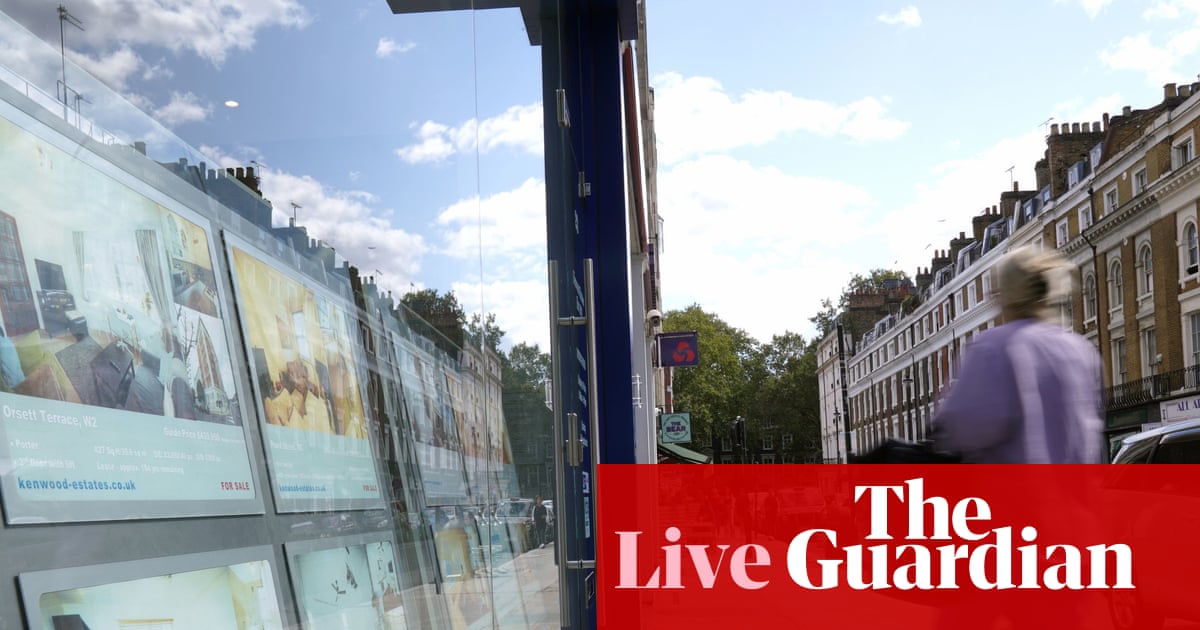
The average property price in the capital fell by 3.3% year-on-year in July – the eleventh consecutive drop, and the lowest annual rate since January 2024.
The Office for National Statistics reports that “Inner London particularly affected” and that the average house price in London is now £19,000 below the recent peak in July 2025, at £569,000.
Overall, the average house price for England was £293,000 in July, up by 1.1% (£3,000) from a year earlier, the ONS reports.
UK inflation has returned above 3% as soaring fuel and transport prices triggered by the Iran war heap renewed pressure on British households.
Figures from the Office for National Statistics show inflation as measured by the consumer prices index rose from 2.9% in July to 3.1% in August. The increase, which matched City forecasts, was driven by motor fuel prices rising by almost a quarter.
In a critical week for the economy, the Bank of England is preparing for a decision on interest rates on Thursday against a backdrop of rising inflationary pressures from soaring oil and gas prices.
With headline inflation drifting further from its 2% target, financial markets predict a one-in-five chance of a quarter-point rise from the current level of 3.75% as Threadneedle Street comes under pressure to take action. The City expects as many as four increases to 4.75% by the end of next year.
Economists were encouraged, though, that UK core inflation remained unchanged in August.
In the property sector, house prices are continuing to drop in London.
The average property price in the capital fell by 3.3% year-on-year in July – the eleventh consecutive drop, and the lowest annual rate since January 2024. This means the average house price in London is now £19,000 below the recent peak in July 2025, at £569,000.
Spending by US consumers recovered sharply in August, suggesting Americans are not cutting back despite the jump in energy prices caused by the Iran war.
US retail sales rose by 1.2% in August, the most in five months, following a 0.5% drop in July.
The figures are not adjusted for price changes, so this may reflect that people bought more stuff or just that stuff became pricier.
The Green party are calling for rent controls to protect UK tenants from spiralling cost increases.
Green MP Hannah Spencer has argued that this morning’s data showing rents rising at the fastest rate this year shows that the government must act, saying:
“The latest ONS figures show how completely broken the private rented sector is.
“The Renters’ Rights Act has not done enough for affordability. The temporary accommodation crisis we are seeing across the country is a direct result of a private rented sector spiralling out of control.
“The fastest rent rises in the North West and North East, at 5.8%, mean hundreds of pounds more a year transferred from families and individuals already stretched to breaking point straight into the pockets of private landlords.
“We need rent controls now, and council homes built at scale. Families in my constituency and across the country can’t afford to wait any longer.
“If Andy Burnham is serious about finally tackling the cost of living, he needs to act now.”
Eearlier this week property website Zoopla reported that the number of homes for rent has dropped by 3% compared with a year ago.
The US housing market is feeling the strain from higher borrowing costs
US mortgage rates last week climbed to the highest level in more than a year, with a 30-year mortgage rate up 12 basis points to 6.97%. That’s the highest level since May 2025.
Joel Kan, vice president and deputy chief economist at the Mortgage Bankers Association, says:
“Ongoing market concerns over spiking energy prices, persistently high inflation, and future monetary policy pushed bond yields and mortgage rates higher last week.”
UK supermarket chain Morrisons has reported its strongest sales growth for more than a year, as it pushes through its turnaround plan.
The debt-laden retailer said it was boosted by hot weather and the World Cup over the latest quarter, and had also cut its borrowing levels.
Like-for-like sales rose by 3.2% in the 13 weeks to 26 July, its fifteenth consecutive quarter of LFL growth.
Boss RamiBaitieh said the group’s trading was “robust” and surpassed wider UK grocery market after investment into improving its pricing:
“Our stronger sales momentum reflected a broad-based improvement across the business - with our Supermarkets, Online, Convenience, Pharmacy and Myton manufacturing businesses all reporting good growth, underlining our progress with our plans to renew and modernise Morrisons.
“Key to this performance is our continued commitment to keeping prices low. The recent launch of our Unbeatables price promise, which guarantees customers won’t find better value on hundreds of essential products at named major supermarkets, has already had a positive impact.
If you’re just tuning in, the big news of the morning is that UK inflation has returned to above 3%.
Soaring fuel and transport prices triggered by the Iran war pushed up the cost of living, heaping renewed pressure on British households.
With headline inflation drifting further from its 2% target, financial markets predict a one-in-five chance of a quarter-point rise from the current level of 3.75% as Threadneedle Street comes under pressure to take action. The City expects at least four increases to 4.75% next year.
Economists said there were signs that underlying inflation remained in check amid a cooling UK jobs market, although they said the fallout from war in the Middle East could push the headline rate close to 4%.
Mike Ashley's son-in-law become chair of Hugo Boss
After agitating for change at Hugo Boss, retail magnate Mike Ashley appears to have decided that his son-in-law is the best man to take on the job.
HugoBoss announced this morning that MichaelMurray has been elected at its chairman, after the previous incumbent Stephan Sturm resigned under pressure from Fraasers for “an orderly transition” of power.
Sturm stepped down on Monday morning, a month after HugoBoss’s board rejected a £1.7bn takeover offer from Ashley’sFrasers group.
Frasers owns around 48% of HugoBoss’s equity, giving it powerful influence over the fashion group.
SinanPiskin, deputy chairman of the Supervisory Board of Hugo Boss, says Murray is an “excellent successor” to Sturm, adding:
“His election signals clarity in the leadership of the Supervisory Board at an important stage for the Company and ensures continuity in our strategic course moving forward, in the interest of all our stakeholders.
We wish Michael Murray all the best in his new role and look forward to continuing our close and constructive collaboration.”
PwC UK‘s revenues have fallen for the first time in over a decade, as the big four accountancy firm struggled with a slump in its Middle East business.
Total revenue for the UK group, which includes its operations in the Middle East and the Channel Islands, slipped by 3% to £6.2bn in the 12 months ended in June. Revenues in the Middle East business fell by 15% to £1.7bn, offsetting a 2% rise in the UK.
Marco Amitrano, who leads PwCUK, admitted there had been a “more difficult trading environment in the Middle East”, but said the firm was seeing “clear evidence that the choices we’ve made are strengthening our business”.
“There is always more to do... Our focus now is on maintaining that momentum - continuing to transform, helping our clients take the opportunities ahead, and creating sustainable value for our business, our clients, our people and the wider UK economy.”
Indeed despite the overall drop in revenue, PwC partners were paid more this year: profit per partner rose 8% to £935,000, up from £865,000 in the 2024/25 period.
That contrasted with a 12% drop in its total headcount, with 4,000 fewer people working at the business overall compared with last year. PwC, like other big four firms, has been reducing its staff numbers in recent years as the sector has grappled with a prolonged slowdown in demand after a pandemic-era boom, as well as AI disruption.
Yesterday it emerged that rival firm KPMG is cutting about 200 jobs from its UK advisory business, including staff working on AI.
UK five-year fixed mortgage rates hit highest since November 2023
Fixed-rate mortgages in the UK have become even more expensive this morning.
Data provider MoneyFacts reports that the average five-year mortgate rate has risen to its highest since 8 November 2023, at 5.82%, up from 5.78% yesterday.
Shorter-term fixed loans are pricier too. The average two-year fixed residential mortgage rate is now 5.77%, the highest since 11 May.
“Mortgage borrowers are facing another unwelcome rate shock as the average five-year fix has hit 5.82% for the first time since November 2023.
Volatile swap rates have been forcing lenders to reprice, with major banks such as NatWest, Santander, HSBC, and Lloyds Bank all boosting rates for the second time since the start of September. For many borrowers, this is deeper than a headline rate, it could be the cost of their next mortgage and with inflation continuing to creep up, households’ budgets will be under pressure.”
UK rental inflation hits highest rate so far this year
The cost of renting a property in the UK has risen again, and at a faster rate.
The average UK monthly private rent increased by 3.8%, to £1,400, in the 12 months to August, new data from the Office for National Statistics shows,
That’s up from 3.7% in July, and the highest since last December.
Average rents increased to £1,459 (4.0%) in England, £846 (4.3%) in Wales, and £1,013 (1.1%) in Scotland, in the year to August.
Average rent was highest in London , at £2,332 a month, and lowest in the North East at £788 a month, in August.
The North East and North West had the highest rent annual inflation rate of all English regions, both at 5.8%, in the 12 months to August 2026. The North East’s annual rate was down from 6.3%, while the North West’s annual rate was up from 5.7%, in the 12 months to July 2026.
London’s annual inflation rate rose to 3.5% in the 12 months to August 2026, up from 3.0% in the 12 months to July 2026
Some industry figures have warned that the recently introduced Renters’ Rights Act, which bans no-fault evictions and gives tenants stronger rights, could lead to higher rents and landlords selling up.
Britian’s largest housebuilder has cut its construction plans for this year, in a blow to the government’s house-building targets.
BarrattRedrow announced this morning that it now plans to complete between 17,500 and 17,900 homes in the current financial year, down from a previous goal of 17,700-18,200.
It blamed “continued planning delays” for holding back its activities.
The company aso beat market expectations by reporting adjusted pre-tax profits of £572.8. for the year to 28 June.
Its shares have jumped over 8% in early trading, making Barratt the top riser on the FTSE 100 this morning.