 Firstpost ·
Economy, business and finance
Canada to be EU’s ‘first associate member’: What could this mean?
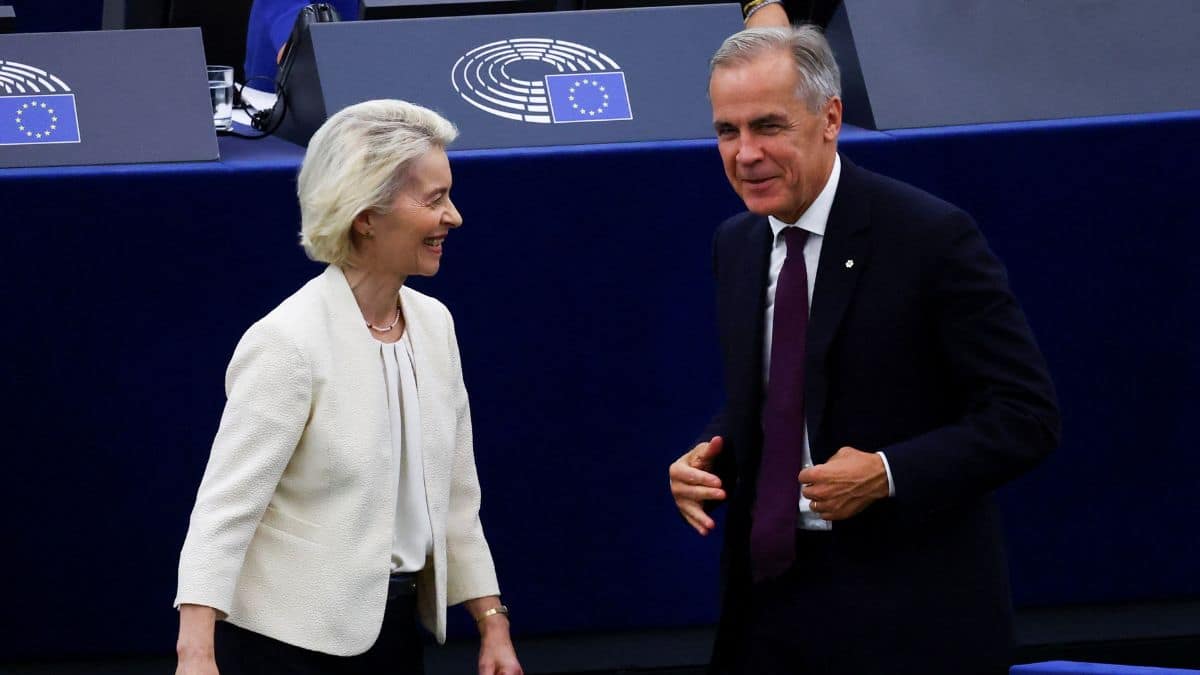
European Commission President Ursula von der Leyen has backed opening the door for Canada to become the European Union’s first ‘associate member’, as Ottawa seeks closer ties with the bloc without pursuing full membership. The idea comes as Canada seeks new alliances amid tensions with the US. However, such a status does not currently exist under EU treaties
European Commission President Ursula von der Leyen said on Wednesday she wanted to open the door for Canada to become the European Union's first "associate member".
Canada is looking for a closer relationship with the European Union without becoming a full
member, as Ottawa seeks new alliances amid tensions with the United States. The proposal could create a new form of partnership between Canada and the bloc, although such an "associate member" status does not currently exist under EU treaties.
Earlier this week, Canada's Prime Minister Mark Carney was in Strasbourg to listen to von der Leyen's annual State of the Union address, and said Canada was seeking a "unique alliance" with the EU but not membership.
US President Donald Trump criticised the proposal, calling the prospect of Canada joining the EU “laughable”. Speaking in Charlotte, North Carolina, Trump said the move could be a “hostile act” and threatened to impose more tariffs on the bloc if he believed European leaders had bad intentions.
“If it’s a good intention, that’s fine. If it’s a bad intention, we’ll put very heavy tariffs on Europe,” he said, according to the Associated Press.
What might the new relationship involve?
There is currently no such status as "associate member" set out in the European Union's treaties — though various versions of an associate-type of membership have been floated in the bloc over the years.
Most recently, Germany suggested Ukraine be an associate member as an interim stage to full accession, though the proposal failed to gain traction as some EU capitals pushed back.
The idea has also previously been discussed in relation to post-Brexit Britain, although no concrete steps were taken.
What is Canada seeking?
Carney is seeking new alliances amid repeated threats by US President Donald Trump against Canada's sovereignty.
Canada is not seeking full EU membership. Jonathan Wilkinson, Canada's ambassador-designate to the EU, said Ottawa wants “to get as close as we possibly can” to the bloc while strengthening rather than diminishing Canadian sovereignty, according to the Associated Press.
A Canadian official familiar with the discussions also told the Associated Press that Ottawa was exploring an arrangement that could allow Canadians to live and work in Europe without visas as part of a broader strategic partnership.
Both sides want to forge deeper cooperation to counter US and Chinese economic dominance as well as preserve democracy and the rules-based international order, which they see as under threat.
Carney has also argued that middle powers need to work together to increase their leverage. In a speech at the World Economic Forum in Davos in January, he said, “When we only negotiate bilaterally with a hegemon, we negotiate from weakness. We accept what is offered,” according to the Associated Press.
In her speech, von der Leyen said the two sides would create a "common prosperity and economic space". This would include joint work on manufacturing, a tech alliance, integration of defence industrial bases, the Arctic, AI, energy and critical minerals.
Von der Leyen also said Europe and Canada “see the world with the same eyes”, and pointed to their cooperation on Ukraine, defence, raw materials and supply chains. “And we have stood together: on Ukraine, on defence, on raw materials and on supply chains. But above all... Europe and Canada believe in democracy,” she said, according to the BBC.
Canada has also already moved closer to the EU on defence. According to the Associated Press, Canada this year became the first non-European country to join the EU's €150 billion SAFE defence programme, giving Canadian companies access to joint procurement as Europe seeks to strengthen its defence readiness.
Why might the idea of ‘Associate member’ be complicated?
Implementing such an 'associate' status would be unprecedented and may be legally complex.
There is no established framework for such a relationship. I remains unclear who would have to approve an associate membership arrangement and how long the process could take.
Wilkinson said Ottawa and Brussels were focusing first on defining the substance of the relationship rather than deciding what to call it. “Before you actually get to the point where you decide what you’re going to call something, you should actually know the shape,” he said, according to the Associated Press.
Wilkinson said the shape of the proposed relationship could become clearer at the Canada-EU summit in October, when the two sides are expected to make an announcement and could also decide how to describe the arrangement.
Von der Leyen was speaking in her capacity as President of the European Commission, the bloc's executive arm. It would fall on the EU member states to decide whether the idea flies.
There is no suggestion Von der Leyen is proposing enshrining the status of 'associate member' in EU treaties. That would require unanimity among all 27 capitals and ratification by all domestically.
Canada and the EU already have a trade agreement, called CETA. More than a decade after the deal was struck and nine years since it provisionally entered into force, several EU countries still have not ratified it.
If Canada wishes to become locked into the EU's Single Market, Ottawa would need to reconcile Canada's norms and regulations to match EU law.
Canada would become a rule-taker with no say on policy if it entered the Single Market without full membership like Iceland, Norway, and Liechtenstein, who are members of the European Economic Area.
Switzerland has select access to the Single Market through trade agreements including the free movement of people, transport and product standards recognition. Canada's rules have historically been geared towards its biggest trade partner, the United States.
What does this mean for EU candidate countries?
The quest for a deeper alliance between Canada and the EU will not impact the path to accession for European candidate states -- but it may serve as an irritant if Canada is perceived to be getting special treatment.
Accession negotiations and aligning with EU norms is a long process that often requires candidate nations to push through politically sensitive reform.
Full membership can only be granted to European states and provides access to the bloc's €18 trillion ($20.77 trillion) Single Market, voting and representation, EU funding and legal recourse to the European Court of Justice.
Ukraine saw Germany's proposal for "associate membership" as "unfair" as Kyiv would participate but with no voting rights.
The EU has said it could admit new members as soon as 2030. Montenegro, Albania, Ukraine and Moldova are the most advanced among candidate countries.