 The Indian Express ·
Science and technology
India’s lunar ambitions and the growing competition in space
As competition in space evolves, concerns over weaponisation mount, and explicit rules governing outer space remain absent, how does India seek to balance its ambitions? Could deepening international partnerships offer it greater leverage? See infographics.
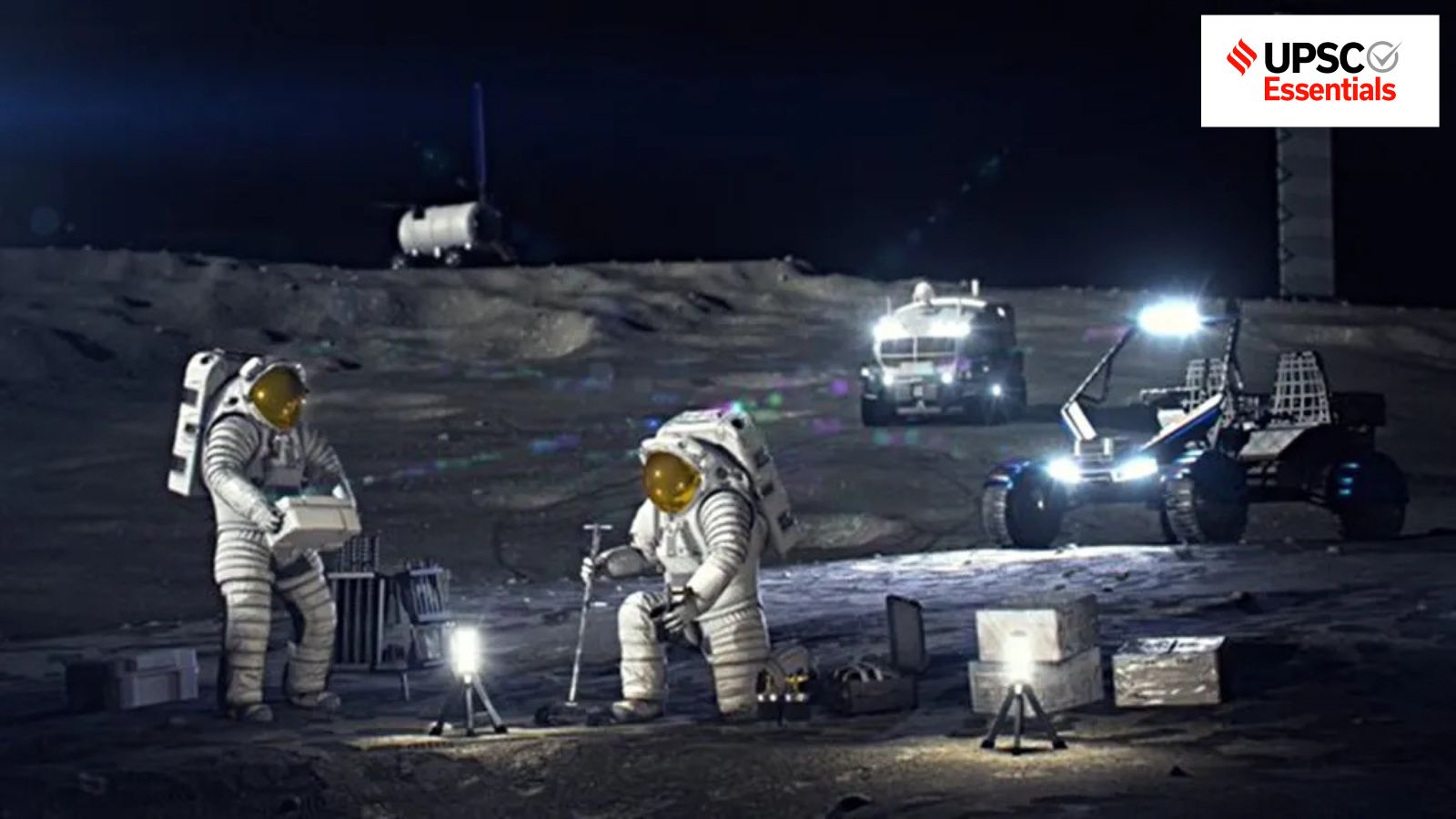
The growing international focus on sustained human presence on the Moon and its South Pole is driven by strategic considerations, including key locations on the Moon, the potential value of lunar resources, and the pursuit of technological sovereignty and industrial capacity.
With orbits becoming more crowded, technologies more powerful and actors more numerous, Prime Minister Narendra Modi stressed the need for global partnerships prioritising long-term sustainability over short-term gains. He made these remarks while addressing the International Space Summit in Paris via video-conferencing last week.
India has ambitious future targets for the space agency — establishing an indigenous space station by 2035 and sending an astronaut to the Moon by 2040. But as competition in space evolves, concerns over weaponisation mount, and explicit rules governing outer space remain absent, how would India balance its ambitions? Could deepening international partnerships offer it greater leverage?
Over the years, the India-US relations have evolved substantially. Anchored in part by the Initiative on Critical and Emerging Technology (iCET), bilateral cooperation has expanded to space cooperation as well. India signed the Artemis Accords – the US-led framework for peaceful and sustainable exploration of the moon and beyond – and has been formally invited to join NASA’s Moon Base programme.
Notably, the trajectory of Indo-US space relations has evolved from close partnership to a period marked by technology denial, embargoes, mistrust, and subsequently towards a broader strategic partnership. The US, particularly NASA, played an important role in the formative years of India’s space programme.
In the 1960s, NASA worked with Vikram Sarabhai and the Indian National Committee for Space Research (INCOSPAR), the precursor of ISRO, to help establish the Thumba Equatorial Rocket Launching Station (TERLS).
The Thumba space station, considered the birthplace of the Indian space programme, was established with international assistance, including US-supplied sounding rockets and technical training. This stage of initial collaboration also contributed to the landmark Satellite Instructional Television Experiment (SITE) in 1975–76, where NASA made its ATS-6 satellite available to broadcast educational programming to 2400 villages across India.
However, India’s 1974 nuclear test marked a turning point in India-US relations. It contributed to a broader shift towards tighter non-proliferation and controls on technology transfers. While pre-approved projects like SITE continued, India’s access to sensitive technologies became increasingly restricted.
Nonetheless, the gradual shift towards the space cooperation between the two countries reflects not only the geopolitical climate of the 21st century but also India’s emergence as a capable space power. The success of Chandrayaan-3 in becoming the first to land near the lunar south pole demonstrated India’s ability to undertake high-precision space missions with comparatively efficient use of resources.
Notably, planetary scientists for the first time have confirmed the existence of a hidden impact crater on the lunar surface using mineralogical data obtained from Chandrayaan-1, and it could predate the oldest known impact craters on the moon.
Moreover, the Gaganyaan mission, the upcoming Bharatiya Antariksh Station (BAS) project, joint frameworks like NASA-ISRO Synthetic Aperture Radar (NISAR), and the Axiom-4 mission to the ISS illustrate India’s growing footprint in human spaceflight and deep-space exploration. Furthermore, such partnerships enable the ISRO to build expertise in complex space systems while sharing the high costs and risks of advanced missions.
As mentioned earlier, a number of strategic considerations are shaping the growing international focus on sustained human presence on the Moon and its South Pole. How do these considerations shape the evolving competitions in space?
One of the key considerations is the strategic locations on the Moon. The present-day space race focuses on micro geographies like the Permanently Shadowed Regions (PSRs) within polar craters, which may contain water-ice deposits, and nearby regions known as ‘peaks of eternal light’, which receive perpetual or near-perpetual sunlight and could provide continuous solar power. Access to these locations could give significant advantages for future lunar operations and cislunar logistics.
Another key consideration is the potential for lunar resources to become very valuable assets in the future. Water-ice, which is the water molecules that exist in a solid, frozen state on the moon, is a resource that could become of key importance. Through In-Situ Resource Utilisation (ISRU), lunar water could potentially be processed into drinking water, breathable oxygen and hydrogen-oxygen rocket propellant, enabling deep-space fueling on the moon and reducing the need to transport these resources from Earth.
Other resources, including Helium-3 and Rare Earth Elements (REEs), have also attracted scientific and commercial interest, although their large-scale extraction and economic viability remain uncertain.
A third important consideration is technological sovereignty and industrial capacity. Participation in the lunar base architecture can help ensure sovereign capability in life-support systems, autonomous robotics, surface power, communications and logistics. This will contribute to the strengthening of indigenous capabilities, particularly in the long term. This may also create opportunities for Indian private space companies to enter higher-value global space supply chains.
But cislunar space, which refers to the three-dimensional region of space that starts from Earth and extends outward to include the Moon and its surrounding orbital paths, is now becoming an area of strategic competition.
The US-led Artemis framework and the International Lunar Research Station (ILRS), co-led by China and Russia, represent the two major approaches to future lunar exploration. Against this backdrop, can deep technical integration with the US-led Artemis framework provide India greater leverage? Can this also allow India to contribute to key discussions on issues such as radio spectrum allocation, resource utilisation and surface rules, and have a say in the evolving governance of outer space?
However, executing a joint lunar architecture involves several challenges around legal, security, technology and financial concerns. First, the 1967 Outer Space Treaty bans national appropriation of celestial bodies. However, the Artemis Accords recognise the extraction and use of space resources and provide for temporary ‘safety zones’ to prevent harmful interference. This has caused concerns among non-signatory developing nations, particularly with regard to the non-appropriation principle.
The second is the risk of militarisation. The confirmation by the US that it had active weapons deployed in space, the first such public admission by any country, has sparked a fresh debate over the weaponisation of space.
Much of the lunar infrastructure is also inherently dual-use. Communication and navigation systems, deep-space surveillance, and positioning beacons can also be used as military assets for anti-satellite operations or domain awareness. As activities in lunar space increase, such capabilities could lead to mistrust, strategic competition, and gradual militarisation of what has traditionally been treated as un-demarcated shared commons.
The third important challenge is in the form of interoperability. Integrating the systems of ISRO and NASA requires common standards for communications, power systems, and other important space technology like docking mechanisms, airlocks, robotics, life-support systems and ISRU. This standardisation process will require significant investment and effort from both bodies. Differences in funding and institutional capacity between NASA and ISRO, and the differences in the export and import norms in both nations, could also make equitable burden-sharing difficult.
Finally, sustained lunar activity will need to create key mechanisms that can address issues such as lunar dust, debris, harmful interference and the protection of scientifically important sites.
Hence, translating the diplomatic invitation to join the Moon Base programme into a role of a permanent and powerful player in lunar exploration would require addressing various challenges. A first priority could be to establish an explicit framework for technology transfer and import-export controls, etc.
Second, India may use its diplomatic leverage to advocate for a broader multilateral framework governing lunar activities, addressing legal tensions between the 1967 treaty’s prohibition on national sovereignty and the Artemis Accords’ safety zones, and supporting the responsible use of resources and preservation of outer space as a global common.
Further, India may work with the US and other space powers for developing norms for lunar safety, resource utilisation, debris mitigation, scientific-site protection and prevention of harmful interference. This would allow India to benefit from deeper US cooperation while building indigenous capability and preserving its strategic autonomy.
1. The growing strategic importance of the Moon is driven not merely by scientific exploration but also by questions of resources, technology and geopolitical influence. Discuss.
2. India’s proposed indigenous space station and its ambition of sending an astronaut to the Moon represent a shift from access to space towards sustained human presence in space. Examine the opportunities and challenges involved.
3. India’s space programme has increasingly acquired a diplomatic dimension. Discuss with reference to India’s growing international partnerships in space.
4. India-US cooperation in emerging and critical technologies has the potential to reshape bilateral cooperation in space. Discuss.
5. What challenges does the weaponisation of outer space pose to international peace and security? What role can India play in promoting responsible behaviour in space?
(Kannan K is a Doctoral candidate at the Centre for Economic and Social Studies, Hyderabad.)
Share your thoughts and ideas on UPSC Special articles with ashiya.parveen@indianexpress.com.
Stay updated with the latest UPSC articles by joining our Telegram channel – IndianExpress UPSC Hub, and follow us on Instagram and X.