 Firstpost ·
Politics
When 600 armed men laid siege to Mecca’s Grand Mosque for 2 weeks in 1979
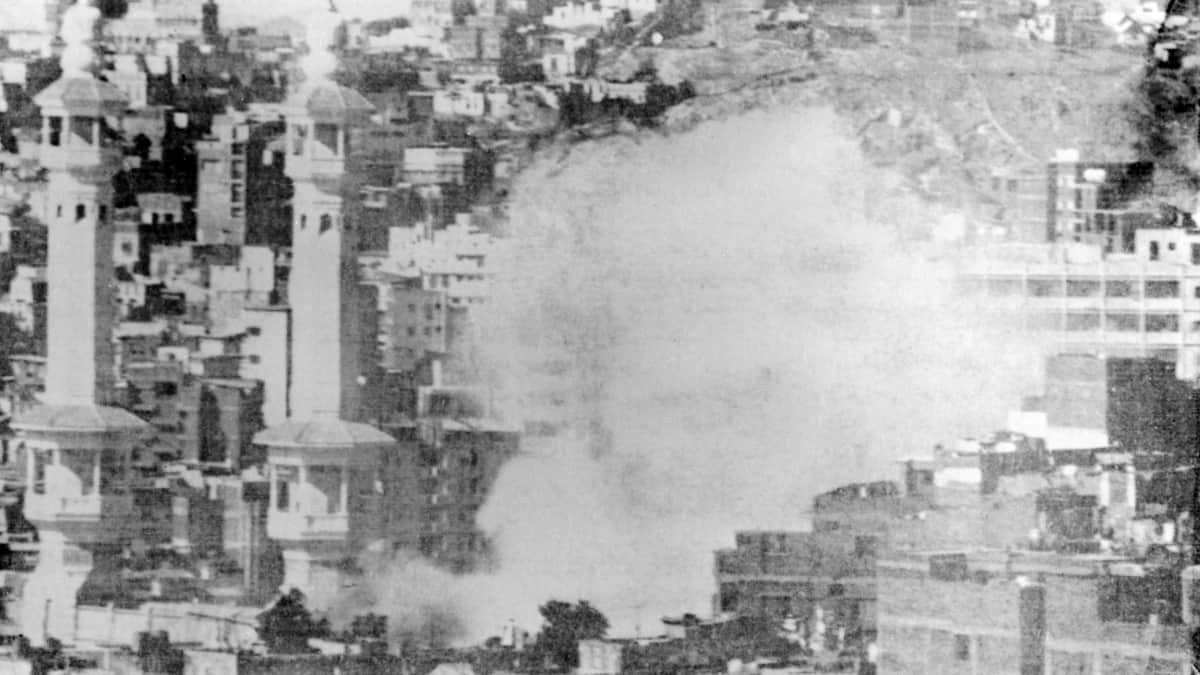
Tuesday’s attempted drone attack on Mecca in Saudi Arabia has revived memories of the 1979 siege of the Grand Mosque. On November 20, around 600 men, led by preacher Juhayman al-Utaybi, seized the vast complex, taking all of its occupants hostage. It took two weeks and countless deaths before the rebels could be flushed out
On Tuesday (September 15), Saudi Arabia for the first time issued an air alert after a drone purportedly fired by the Houthis was intercepted near the religious city of Mecca. Shortly later, Riyadh lifted the alert, putting residents at ease.
However, for many, the incident from Tuesday has revived memories of one of the most traumatic episodes in the modern history of the kingdom: when the Grand Mosque was taken over by an armed Islamist group, led by a 40-year-old preacher called Juhayman al-Utaybi.
So, what happened now and what happened almost 47 years ago?
On Tuesday (September 15), Saudi Arabia’s air defences destroyed a drone attempting to enter the airspace of the holy city of Mecca. According to Riyadh, the incident occurred around 6.50 pm Saudi time.
Saudi coalition spokesperson Turki al-Malki posted on X, “The Royal Saudi Air Defense Forces intercepted and destroyed a hostile drone launched by the Terrorist Houthi Militia before it entered the prohibited airspace of the Holy City of ‘Makkah Al-Mukarramah’.”
Al-Maliki condemned the incident as an attempt to frighten worshippers and harm civilians, warning that the security of the two holy mosques and pilgrims is a “red line”.
Reacting to the incident, Saudi Arabia also issued a security alert in the holy city of Mecca for the first time since the Houthis last attempted to target the sacred area in 2017. However, the alert was lifted after a few minutes.
However, a Houthi source has strongly rejected the claim that they pose a threat to the city of Mecca or other Islamic holy sites. “We categorically deny that there is any threat from Yemen directed at the city of Mecca or any other holy sites,” the source said, condemning what he described as “misinformation”.
Tuesday’s events revived memories of an armed takeover of the Grand Mosque of Mecca back in 1979.
On November 20, an estimated 50,000 worshipers from all over the world gathered for morning prayers in the huge courtyard surrounding the sacred Kaaba in Mecca, Islam’s holiest place. Just as the imam completed the prayers, commotion broke out.
Then shots rang out.
Following this, 40-year-old former Saudi National Guard corporal and religious preacher, Juhayman al-Utaybi, pushed the imam aside and spoke out over the microphone, “Fellow Muslims, we announce today the coming of the Mahdi… who shall reign with justice and fairness on Earth after it has been filled with injustice and oppression.”
According to Juhayman, the ‘Mahdi’ – a divinely guided figure, who is described as one with extraordinary powers by God – was his brother-in-law, Mohammed Abdullah al-Qahtani.
Juhayman, a corporal of the Saudi army, was convinced that the then Saudi royal family had become too corrupt to serve as custodians of Islam’s holiest site. Hence, it was necessary to overthrow the Saudi royals, and the siege of the Grand Mosque was a step towards that objective.
Soon after, Juhayman and his band of around 600 men spread out through the vast mosque complex and within an hour the Grand Mosque had been successfully taken over with thousands taken as hostages.
When news broke of the takeover of the Grand Mosque in Mecca, Saudi Arabia’s leadership was taken aback. An ailing King Khaled and Defence Minister Prince Sultan were tasked with initiating a response.
At first, they sent a few patrol cars to investigate, but as they drove up to the Grand Mosque, they came under a hail of bullets. Realising the severity of the situation, a number of units of the Saudi National Guard were sent into to retake the shrine.
However, this effort failed miserably. Mark Hambley, a political officer at the US embassy in Jeddah, told the BBC that this assault was brave but naive. “They were immediately shot down. The sharpshooters had very good weapons, very good calibre Belgian rifles.”
Soon, a security cordon was established around the Grand Mosque, and special forces, paratroopers and armoured units were called in. What ensued was a bloody confrontation, resulting in many deaths.
The rebels withdrew into an extensive network of rooms, cells and underground passages beneath the mosque.
This situation dragged on for nearly two weeks.
Then, Saudi Arabia sought help from foreign powers, with France sending a small team of specialists to help devise a plan to flush out the rebels from the Grand Mosque.
They ideated and came up with the plan of gassing out the rebels, filling up the basement with gas to render the air unbreathable.
Finally, on December 5, 1979, Juhayman and his rebels, around 100 in number, surrendered.
A month later, on January 9, 1980, Juhayman and 62 others were publicly executed in several Saudi cities, including Mecca and Medina. The executions were carried out simultaneously in different parts of the kingdom and became the largest mass execution in Saudi Arabia’s modern history.
The siege of Mecca had a far-reaching impact.
In order to restore its authority, the Saudi royal family, led by Crown Prince Fahd, implemented more conservative religious policies. Social reforms were rolled back, and the Islamic moral police took control over life in the kingdom.
Only recently has Crown Prince Mohammed bin Salman been moving the country to a more moderate path, away from the extremism that took root after the siege.
It also cemented the Iran-Saudi Arabia rivalry. As Wall Street Journal correspondent Yaroslav Trofimov, who wrote the book on the Siege of Mecca, explained, Tehran, as a Shiite power, was seen as a heretical danger that needed to be confronted.
The siege also had an impact on none other than Al-Qaeda founder, Osama bin Laden. According to Trofimov, a young Osama was shocked by the government’s use of massive military force against the rebels, and by the subsequent damage to the shrine. In one of his pamphlets, Osama also referred to the incident, stating that they had “desecrated the Haram, when this crisis could have been solved peacefully”.