 Scroll.in ·
Politics
Youth protests: SC refuses to reconstitute panel probing police excesses
The court said that ‘aspersions’ had been cast on the committee ‘in a manner that is both premature and precipitate’.
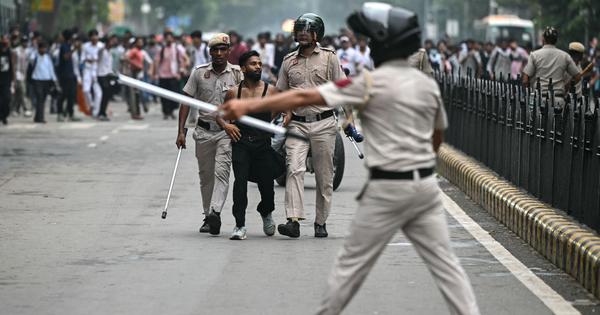
The Supreme Court on Wednesday refused to reconstitute an enquiry committee it has formed to investigate the alleged police excesses during the youth protests in July and violence against security forces, Bar and Bench reported.
The bench said that aspersions had been cast on the committee “in a manner that is both premature and precipitate”.
On August 18, the court had formed the committee in response to petitions alleging that the police used excessive force against protesters marching to Parliament in Delhi on July 20.
The panel is headed by Justice R Subhash Reddy, a retired Supreme Court judge. The other members are former Punjab and Haryana High Court Chief Justice Ravi Shankar Jha, former Delhi High Court Justice Shalinder Kaur, former Central Bureau of Investigation Director Rishi Kumar Shukla and retired Meghalaya police chief LR Bishnoi.
During the protests in July, several demonstrators were injured after the security personnel used lathis, fired tear gas and pellet guns to disperse the crowd.
The petitioners in the original matter also pointed out instances of the police in Bihar using allegedly excessive force against protesters who were demonstrating in solidarity with the youth agitation in Delhi.
The court ordered the committee to examine the suggestions made by the petitioners as well as the respondents, which includes the Union government.
The petitioners in the original matter suggested that the panel should examine the use of allegedly “excessive and disproportionate” force by the police, including the use of lathi-charge and tear gas against the protesters, the use of pellet guns and electric batons, and the “monitoring and surveillance” of demonstrators.
The petitioners also urged the committee to look into alleged cases of “targeted violence, harassment and molestation” of female protesters.
They further called for the panel to look into aspects such as ensuring that the police and security personnel wear proper uniforms and visible nameplates while carrying out arrests or while using force, and preventing the routine use of orders prohibiting public gatherings to stop peaceful protests.
The court said that the allegations of targeted violence and sexual harassment against women protesters should be taken on priority.
The respondents submitted that the committee should examine the alleged use of force and violence by protesters against the police and damage to public property allegedly caused during the demonstrations.
The bench had asked the panel to submit its interim findings periodically so that the court can “take appropriate measures” and issue directions.
The court clarified that setting up the panel would not prevent the police or the authorities from taking administrative or disciplinary action against officers found to have violated service rules.
Edited by Neerad Pandharipande.