 Firstpost ·
Politics
Mecca under ‘attack’: Where is the Mecca Pact — and Pakistan?
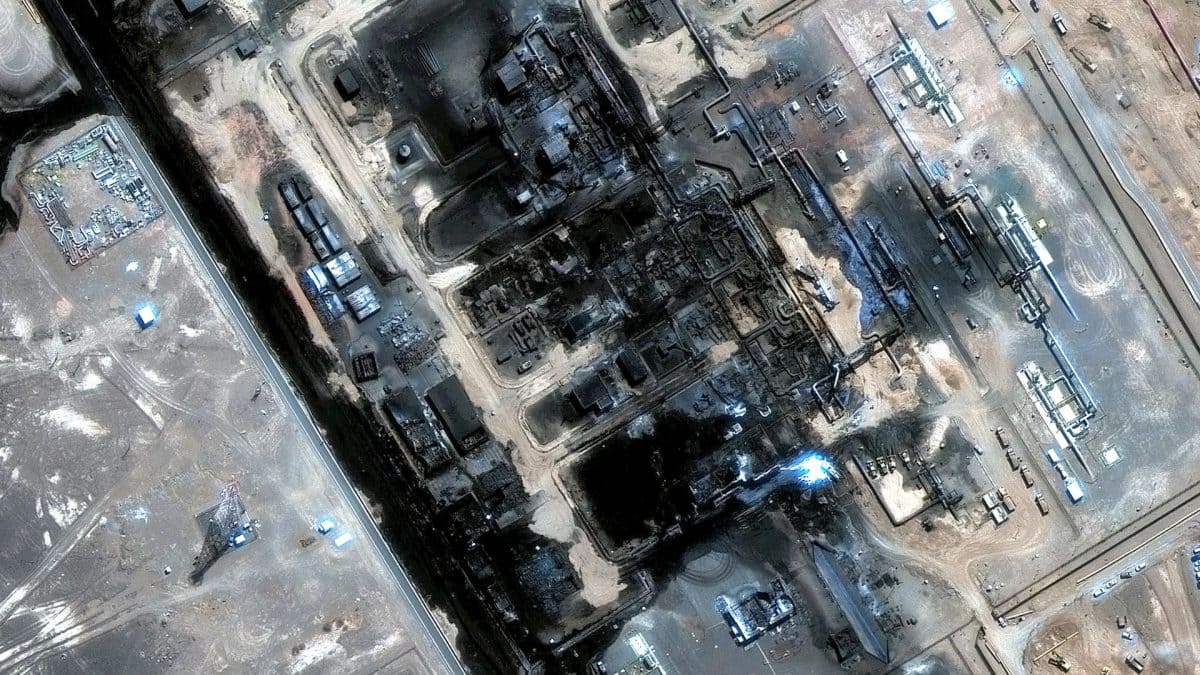
Barely a month after its signing, Saudi Arabia is under Houthi attack, but the Mecca Pact is missing in action
For experts and even students of geopolitics, the Mecca Pact looked suspect from Day 1. But few would have expected the defence agreement — signed with much fanfare by Saudi Arabia, Turkey and Pakistan on August 7, 2026 — to face such a severe test so soon. The arrangement, touted particularly in Pakistan as an “Islamic Nato”, is already confronting uncomfortable questions as Houthi attacks put Saudi Arabia under immense pressure.
The Nato-style Mecca Pact, which intended to “strengthen collective deterrence against any act of aggression, and stipulates that any armed attack against any one of the three States shall be regarded as an attack against them all”, is missing in action even after Saudi Arabia’s Civil Defence issued an emergency alert warning of a possible hostile aerial attack in Mecca. The Houthis, on their part, have denied targeting Islam’s holiest city, with a member of the group’s political bureau calling Riyadh’s claim a lie. “Our operations target its oil facilities and military bases, which are far removed from the sacred sites,” a member of the group’s political bureau wrote on X.
It remains unclear whether Mecca itself was actually targeted. Some observers have suggested that Riyadh may be invoking the threat to the holy city to consolidate Muslim public opinion in its favour. Whatever the truth, Saudi Arabia’s growing concern over the Houthi threat is difficult to miss.
Days after Saudi Crown Prince Mohammed bin Salman sought military assistance from US President Donald Trump to “help fight Yemen’s Iran-aligned Houthis”, reports suggested that Riyadh had also turned to the United Kingdom for assistance. Amid all this, one of the supposed trump cards of the Mecca Pact — Pakistan — is conspicuous by its absence.
The pact, which The Times of London described as a “copy-and-paste borrowing from the Nato alliance’s crucial common commitment”, was arguably as much an exercise in geopolitical signalling as a workable military arrangement. For Riyadh, it projected the possibility of Pakistani strategic backing in its competition with Tehran. For Ankara, it sent a message to both Tel Aviv and Tehran. For Islamabad, it offered another way of demonstrating to New Delhi that Pakistan now had an iron-clad Islamic shield to protect it in a post-Pahalgam-like scenario. It also reflected what former diplomat Vivek Katju, writing in Firstpost, described as “Pakistan’s constant hunger for recognition in the Islamic Ummah as a leading Muslim country”.
Providing common security was neither viable, nor was it the objective.
The first serious test of the Mecca Pact has exposed the gap between the sweeping language of collective defence and the considerably more complicated realities of military intervention. It did not require a confrontation with a major conventional military power to reveal those limitations. Pressure from the Houthis has been enough to call the “Islamic Nato” a hoax.
Coming to Pakistan, the Mecca Pact — like its much-publicised diplomatic initiatives involving the Iran war — was an image-building exercise. It meant nothing more. It is currently facing its worst crisis since 1971, with almost every peripheral region in the country — from Balochistan and Khyber Pakhtunkhwa to Pakistan-occupied Kashmir and Sindh (even Punjab is raging with fury given the treatment being meted out to Imran Khan) — simmering with discontent.
Against this backdrop, expectations that Pakistan could readily come to Saudi Arabia’s military rescue deserve scrutiny. If Riyadh interpreted the Mecca Pact as guaranteeing Pakistani military intervention whenever Saudi territory came under attack, the present crisis is a wake-up call. All Pakistan wanted was power projection — and, of course, access to Saudi money.
Given Pakistan’s history, this is hardly surprising. Since its creation in 1947, it has repeatedly sought to convert its geography and strategic importance into leverage with major powers. Soon after Partition, Mohammed Ali Jinnah, in an interview with American journalist and photographer Margaret Bourke-White, said that Pakistan could serve as a strategic outpost against communist Russia. This has been the case ever since.
During the Cold War, Pakistan became an important Western partner against Soviet influence. In the 1980s, its territory and intelligence establishment became central to the US-backed campaign against Soviet forces in Afghanistan. After September 11, 2001, Pakistan once again became indispensable to Washington, this time as a “major non-Nato ally” in the so-called war on terrorism, even as its relationship with the Taliban was too obvious to miss.
The actors and circumstances changed, but the underlying logic remained remarkably durable: Pakistan repeatedly sought to monetise its geography, military capabilities and geopolitical relevance. Steve Coll, in Ghost Wars, offers a striking illustration of the contradictions surrounding Pakistan’s role during the Afghan jihad. Coll recounts CIA officer Gary Schroen meeting Afghan commander Ahmad Shah Massoud and showing him an estimate indicating that the CIA had supplied more than 2,000 missiles to Afghan fighters. Massoud looked at the figure. ‘Do you know how many of those missiles I received?’ He wrote a number on the paper and showed it to Schroen. In a very neat hand Massoud had written ‘8’. ‘That was all,’ Massoud declared, ‘and only at the end of the fight against the communist regime’.”
The episode illustrated the degree of Pakistan’s doublespeak during the Afghan war. The contradictions became even sharper after 9/11. Pakistan joined the US-led “war on terrorism” and received billions of dollars in American assistance, yet in 2011, Osama bin Laden was discovered and killed by US forces in Abbottabad, close to Pakistan’s premier military academy at Kakul.
For Islamabad, joining the Mecca Pact therefore fits a familiar strategic pattern: obtain diplomatic prestige, reinforce Pakistan’s claim to leadership within the Muslim Ummah, and deepen relations with a wealthy patron. The problem arises when symbolism collides with obligations. The Houthi attacks have provided an early and unexpected reality check.
Barely a month after its signing, Mecca is under “attack”. And the Mecca Pact — along with Pakistan — is missing in action.
(Utpal Kumar is the author of ‘Bharat Rising: Dharma, Democracy, Diplomacy’ and ‘Eminent Distorians: Twists and Truths in Bharat’s History’. Views expressed in the above piece are personal. They do not necessarily reflect Firstpost’s views.)