
Why Monsoon Session of Karnataka legislature ended 3 days in advance
Read at The Indian ExpressWeather and environment · 1 outlet covered this
Why Monsoon Session of Karnataka legislature ended 3 days in advance
How outlets told it
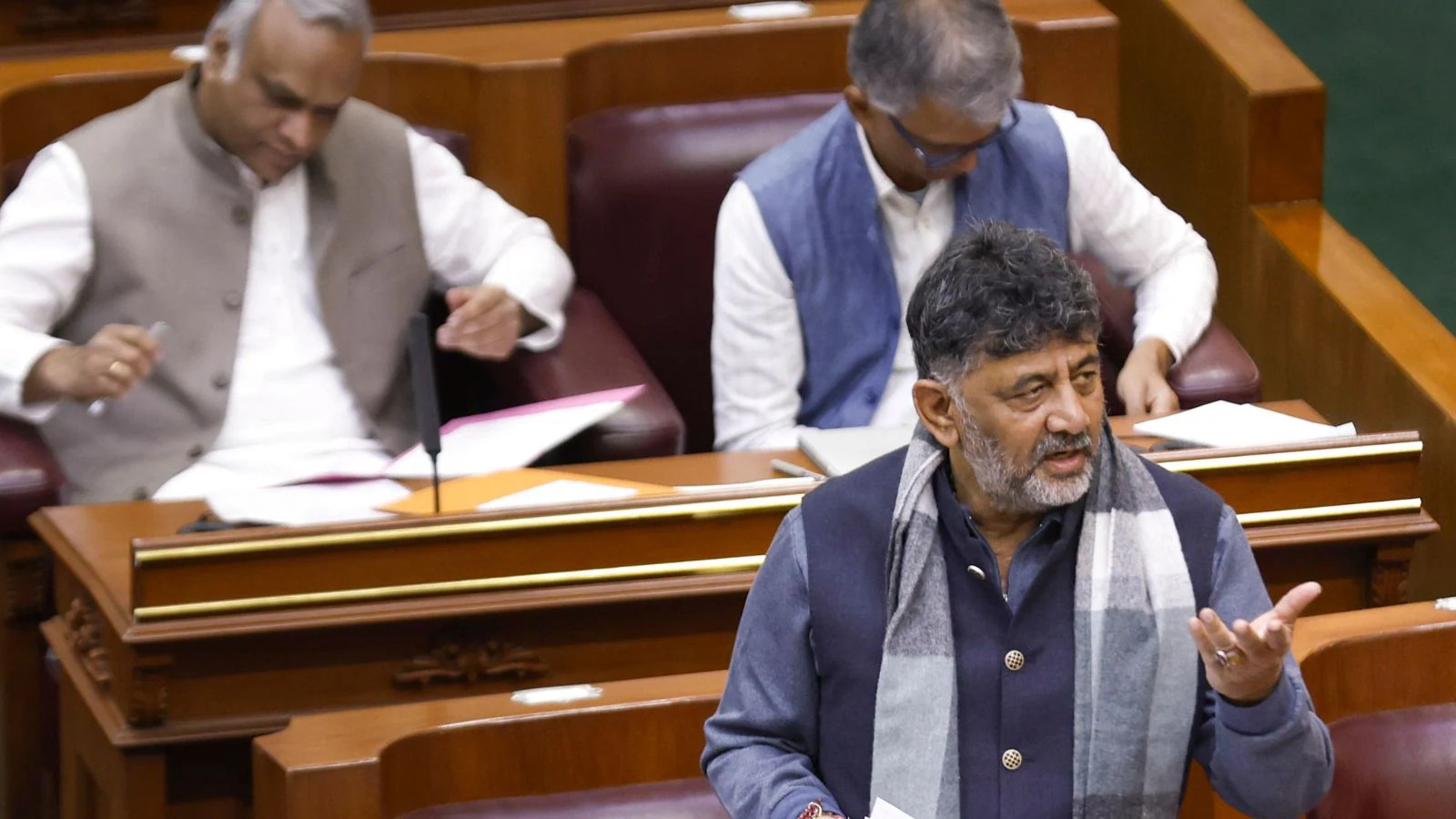
The Monsoon Session of the Karnataka legislature ended three days ahead of schedule on Monday after the Opposition BJP continued to demand the resignation of Congress minister B Nagendra over his alleged role in the Karnataka Maharshi Valmiki Scheduled Tribes Development Corporation (KMVSTDC) scam.The two-week session was curtailed amid repeated disruptions, with the BJP insisting that Nagendra step down after the CBI chargesheeted him in connection with the alleged scam. The Congress government, however, maintained that the charges against the Bellary Rural MLA had not been substantiated by evidence. The CBI has also reportedly sought the Governor’s sanction to prosecute Nagendra.Both Houses were adjourned sine die after the government passed the Supplementary Finance Bill. Speaking in the Legislative Council before the adjournment, Chief Minister D K Shivakumar accused the BJP of disrupting proceedings instead of following legislative procedure. “There is nothing wrong in asking for the resignation of minister B Nagendra in connection with the illegal transfer of funds of the Valmiki Development Corporation. But a notice should be given and a discussion should be held on this,” Shivakumar said. He said investigative agencies, including the CBI, had conducted probes but that the government had so far received no documents directly establishing Nagendra’s guilt. “In this context, it would not be appropriate to disrupt the proceedings of the House without holding a debate,” he added.
Shivakumar said issues concerning farmers, youth, land, water and the state’s language should have received priority over political protests. Key issues left undebated The curtailed session meant that several pieces of legislation and public issues listed for discussion could not be taken up. Among the Bills that were not tabled or passed was the Karnataka Regulation of Use of Government Premises and Public Property Bill, 2026, which seeks to regulate the use of public spaces by private groups and organisations. Other issues that did not see debate included the drought situation, land acquisition from farmers for the proposed Bidadi township, KPSC recruitment, the absence of women ministers in Shivakumar’s Cabinet, Cauvery water sharing with Tamil Nadu and the Special Intensive Revision (SIR) of electoral rolls. The Bidadi township project has also faced opposition from the BJP’s NDA ally, the Janata Dal (Secular), led by former chief minister H D Kumaraswamy. The Karnataka Appropriation Bill for 2026-27 approved the first instalment of supplementary Budget estimates amounting to Rs 7,042.69 crore.
A senior government official described the developments as part of a broader trend in parliamentary politics, with governments refusing to concede to Opposition demands even when it came at the cost of legislative business. BJP takes issue to Governor Leader of the Opposition in the Assembly R Ashoka, who spearheaded the BJP’s campaign against Nagendra, alleged that the government ended the session early because it feared the Opposition would intensify its protests, including through overnight demonstrations inside the legislature. After the session was adjourned, Ashoka led a BJP delegation to Governor Thawar Chand Gehlot and sought his intervention to ensure Nagendra’s removal. “The case has not been closed. No clearance has been given. Instead, the investigation has progressed to the stage of filing a chargesheet. In such a situation, what moral justification does the government have for re-inducting the same person in the Cabinet?” Ashoka said in a letter to the Governor. He said legal eligibility was separate from the question of Constitutional propriety and public confidence, and urged the Governor to take “appropriate Constitutional steps” to prevent Nagendra from continuing as minister while criminal proceedings related to corruption allegations were pending. Nagendra alleges political targeting Nagendra, who resigned as minister for Scheduled Tribes in 2024 after the alleged scam came to light, has denied wrongdoing and accused central agencies of targeting him. He has said he was willing to discuss the matter on the floor of the House, but alleged that the BJP was unwilling to allow such a debate because he belonged to the Adivasi community. Nagendra has also pointed to criminal cases pending against ministers in BJP governments and questioned why the Opposition was demanding his resignation alone. The Congress government has similarly maintained that the CBI investigation has not established Nagendra’s direct involvement in the alleged diversion of funds. Congress MLA and former additional advocate general A S Ponnanna, who advises the Karnataka government, has said the CBI investigation did not link Nagendra directly to the misappropriated funds. What CBI and ED have alleged The Valmiki corporation case concerns the alleged diversion of Rs 94.73 crore deposited with the Union Bank of India’s M G Road branch in Bengaluru. The money was allegedly transferred to 18 accounts linked to a firm in Telangana. The CBI has alleged that Nagendra received a bribe of Rs 1.2 crore for awarding a Rs 13.95-crore tender to private firms on behalf of the corporation. According to the CBI, K Srinivas Reddy, a beneficiary of contracts from the corporation, transferred Rs 5.27 crore to Nekkanti Nagaraj, an associate of Nagendra. Nagaraj allegedly routed Rs 1.2 crore to Nagendra through his relatives. Nagendra was arrested by the ED in July 2024 after investigations into the alleged siphoning of the corporation’s funds. However, the Karnataka Special Investigation Team (SIT) did not name Nagendra or the concerned bank officials as accused in its chargesheet in the predicate fraud case. In October 2024, a special court dealing with cases against elected representatives granted Nagendra bail. The court observed that the ED had not established the basic element required to show that Nagendra was a recipient of the alleged proceeds of crime. The court also noted that Nagendra had not been named as an accused in the predicate offence and that the prosecution would have to explain how he had received the proceeds of crime. The ED had described Nagendra as the alleged “kingpin and mastermind” of the offence, but the court found that the investigation, at that stage, had not established his receipt of the proceeds. Nagendra has maintained that the ED attempted to pressure him into naming senior Congress leaders, including then Chief Minister Siddaramaiah and Shivakumar. Who is Nagendra? Nagendra, 54, is a prominent Adivasi leader and a four-time MLA from the Bellary region. He belongs to the Valmiki Nayak community and was inducted into the Congress Cabinet for the first time in May 2023, when the Siddaramaiah government came to power. Before joining the Congress, Nagendra was a BJP MLA from Kudligi between 2008 and 2013. During that period, he was associated with the Bellary mining network linked to former BJP minister G Janardhan Reddy. Nagendra operated an iron ore trading firm, Eagle Traders and Logistics, which came under scrutiny during investigations by the Karnataka Lokayukta and the CBI into alleged illegal iron ore exports. In his 2023 election affidavit, Nagendra declared 26 pending cases related to illegal mining, including four CBI cases, and assets worth about Rs 17 crore. His declared wealth rose sharply during his first stint as an MLA, increasing from around Rs 2 crore to Rs 14 crore over five years. Over the subsequent decade, his declared wealth increased by about 21%, according to his election affidavits. In the 2023 Assembly elections, Nagendra defeated BJP heavyweight and former associate B Sreeramulu in Bellary Rural. The victory was seen as a significant political setback for the BJP in a region where the Valmiki Nayak community has considerable influence. Nagendra is regarded within the Congress as an emerging Valmiki Nayak leader. His political influence in the Bellary region was also seen as a factor in the Congress winning the Bellary Lok Sabha seat in the 2024 elections. Bellary has a sizeable tribal population, with the Valmiki Nayak community forming an important constituency. Scheduled Tribes account for roughly 30 per cent of the population in the Bellary Lok Sabha constituency, compared with about 3 per cent across Karnataka.