
A birthday wish with perfect timing: Why PM Modi’s greeting to Nirmala Sitharaman said a lot
Read at The Indian Express1 outlet covered this
A birthday wish with perfect timing: Why PM Modi’s greeting to Nirmala Sitharaman said a lot
How outlets told it
4 min readNew DelhiAug 22, 2026 10:56 AM IST First published on: Aug 22, 2026 at 06:45 AM IST As the BJP organisational revamp sparks off talk again of a Union Cabinet reshuffle, one minister’s stock shot up this week. Wishing Finance Minister Nirmala Sitharaman on her birthday on August 18, Prime Minister Narendra Modi lauded her role in “India’s reforms and economic development” and in the government’s endeavours for “a strong and self-reliant” India. Sitharaman replied within the hour, telling the PM: “Your guidance has always served as a motivation to me.”In Delhi’s power corridors, the exchange is being seen as a vote of confidence for Sitharaman, already the country’s longest-serving full-time woman finance minister. PM Modi’s mention of her role in “reforms and economic development” is particularly significant at a time when India hopes to maintain its 7% growth momentum while keeping inflation in check and overcoming the setbacks of capital outflows and the energy- and supply-chain disruptions resulting from the West Asia conflict.
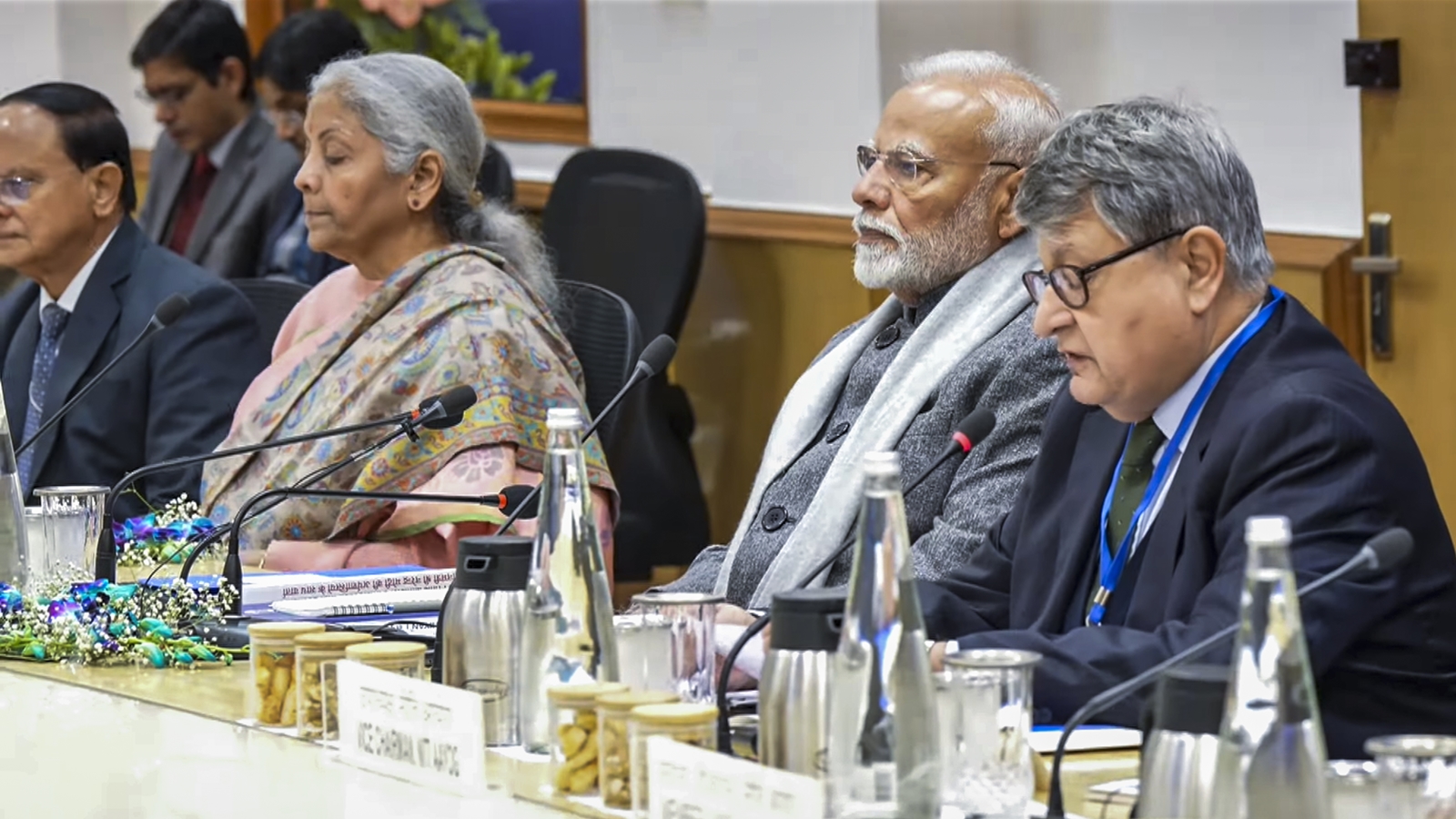
That she is at the forefront of these efforts was also underlined by her “leading” a ministerial delegation to Singapore to participate in the 4th India-Singapore Ministerial Roundtable (ISMR) on August 19-20. A post on X by the Ministry of Finance specified this clearly: “The FM is leading a delegation that comprises Dr @DrSJaishankar, Minister of External Affairs; Shri @PiyushGoyal, Union Minister for Commerce & Industry; and Shri @JitinPrasada, Union Minister of State for Electronics & IT and Commerce & Industry.” Union ministers Nirmala Sitharaman and S Jaishankar with Bihar CM Samrat Choudhary during a meeting in New Delhi on Friday. PTIThe ISMR provides a platform to review progress in India-Singapore collaboration efforts and to explore new areas across six pillars: advanced manufacturing, connectivity, digitalisation, healthcare and medicine, skills development, and sustainability. On August 17, Sitharaman chaired the third meeting of the Apex Monitoring Authority of the National Industrial Corridor Development and Implementation Trust. At the meeting, also attended by Piyush Goyal, Madhya Pradesh Chief Minister Mohan Yadav, and NITI Aayog Vice-Chairman Ashok Kumar Lahiri, the Finance Minister urged states to resolve bottlenecks relating to land, connectivity, utilities, and statutory clearances in industrial corridors.
Most significantly, after the students’ protest at Jantar Mantar last month, Sitharaman has been among the few leaders of the BJP fronted by the party to make an outreach to young citizens. She spoke about how the young have their ears closer to the ground, has denied that the government ever tried to stop protests over examination paper leaks, and acknowledged issues in the education and employment sectors. In an interview with The Indian Express earlier this week, Sitharaman reiterated this, when asked about a significant number of graduates being neither in education nor training. Admitting deeper structural issues, she said: “… courses which all of us go and join and come out of… they don’t ready you for jobs. But ironically, they don’t even ready you for becoming an entrepreneur.”
The minister added: “Our university courses give you a certificate, which is a bachelor’s degree, on something. If you have done Economics or Political Science, what do you do with it afterwards? After BA, what do you do? You go for an MA. But after an MA, you need to have something.” Also during the week, Sitharaman held meetings with chiefs of 12 public sector banks, where she nudged them to up their “cool” quotient in the eyes of the young, without sacrificing the prudence that the business requires. The minister said that having grown up with smartphones, the youth today are tech savvy and they expect banking to be simple, intuitive, personalised, and available at all times. And, public sector banks could “not be ‘not cool’”, Sihtaraman said. “Please get some young people to talk to you about what makes you appear cool. At least one portion of your banks, where they deal with customers, you can make sure that everything is ‘cool’.”