
Karnataka’s growth roadmap for ’37 goes beyond Bengaluru
Read at The New Indian Express1 outlet covered this
Karnataka’s growth roadmap for ’37 goes beyond Bengaluru
How outlets told it
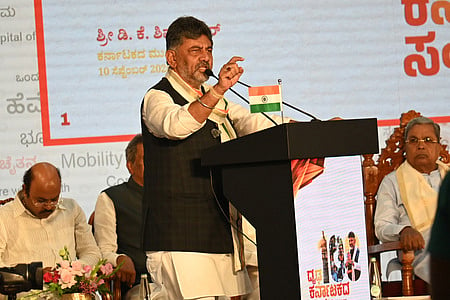
BENGALURU: Karnataka is set to launch a consultation process to chart a roadmap for 2037, with strong emphasis on decentralising growth beyond Bengaluru, and developing multiple regional economic hubs, according to LK Atheeq, financial adviser to Chief Minister DK Shivakumar.
Atheeq, a retired IAS officer who holds a position on par with the chief secretary, said the exercise would involve all stakeholders and regions. "We are going to launch a state consultation on the roadmap to 2037 involving all stakeholders.
We need to regionally diversify and create more growth magnets around Kalaburagi, Hubballi-Dharwad, Belagavi, Ballari-Vijayanagara, Davangere-Shivamogga, Mysuru-Chamarajanagara, Mangaluru-Udupi-Karwar," he stated.
The move forms part of the Congress government's longer-term vision for Karnataka@2037 (with interim targets for 2032), which sits within the broader national horizon of 2047. Officials have earlier outlined goals that include eliminating poverty, ensuring 100 per cent completion of 12 years of schooling, reducing infant mortality and malnutrition, creating around 10lakh jobs annually, and targeting a Rs 1-trillion state economy by 2037.
Technology, high-tech manufacturing, and export-oriented agriculture, horticulture and animal husbandry are seen as key growth drivers, alongside a parallel push to expand the Bengaluru Metropolitan Region's economy significantly.
Atheeq, a 1991-batch Karnataka-cadre officer who earlier served as Additional Chief Secretary, Finance, and Additional Chief Secretary to the Chief Minister, also chairs the Bengaluru Business Corridor project.
His reappointment as financial adviser shortly after Shivakumar assumed office underscores the government's reliance on experienced bureaucratic hands while pursuing welfare and infrastructure goals.
Karnataka's economy remains heavily concentrated in and around Bengaluru, which accounts for a disproportionately large share of the state's GSDP and high-value employment in IT, startups and related services.
This has delivered rapid growth but has also sharpened regional disparities, strained urban infrastructure, and left many northern and interior districts lagging in industrialisation, skills and quality jobs.
The proposed 'growth magnets', spanning the Hyderabad-Karnataka region (Kalaburagi), twin-cities of Hubballi-Dharwad, Belagavi, Ballari-Vijayanagara mining and industrial belt, Davangere-Shivamogga corridor, Mysuru-Chamarajanagara area, and the coastal Mangaluru-Udupi-Karwar stretch, signal an intent to build on existing strengths: education and knowledge hubs in Mysuru and Hubballi-Dharwad, industry and logistics potential in Belagavi and Ballari, and port-linked opportunities on the coast.
If successfully executed through genuine multi-stakeholder consultation, targeted infrastructure, skill development and investment facilitation, the approach could ease pressure on Bengaluru, create more balanced opportunities, and make growth more inclusive.