
Rural Andhra Pradesh reels under power outages
Read at The New Indian Express1 outlet covered this
Rural Andhra Pradesh reels under power outages
How outlets told it
VIJAYAWADA: Severe heat and dry weather driven by El Niño conditions have triggered widespread power disruptions across rural Andhra Pradesh, leaving farmers, patients, and households facing unscheduled outages lasting up to six hours a day.
With the power consumption surging past peak summer levels due to a 37% rainfall deficit in parts of the State, power distribution companies (Discoms) have begun imposing unannounced load shedding under the name of Emergency Load Relief (ELR).
While major cities like Visakhapatnam, Vijayawada and Kakinada continue to receive stable supply, rural and Agency mandals are bearing the brunt of the deficit.
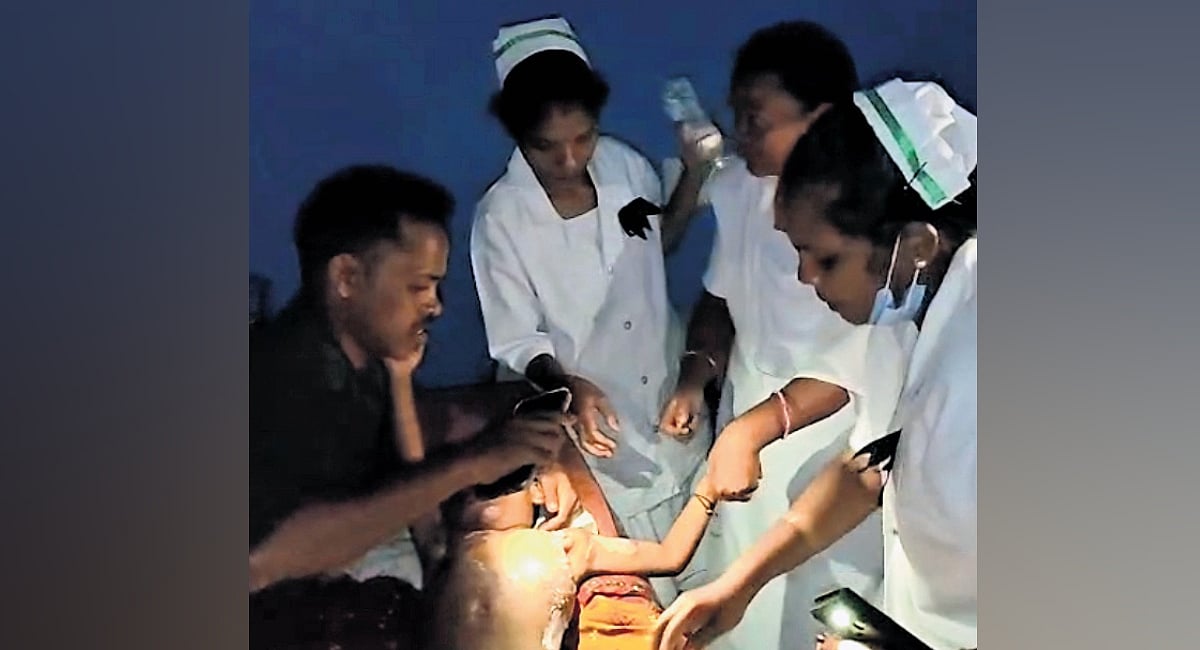
In a glaring instance of the crisis in rural healthcare, medical staff at the Community Health Centre (CHC) in Bhadragiri, Parvathipuram-Manyam district, were forced to treat a five-year-old burn victim, Biddika Jeevan, under cellphone flashlight when power snapped and the facility’s backup generator failed to function.
Low hydel, wind output deepen power supply crisis in State
The incident sparked intense public backlash over the lack of emergency power backup in government hospitals.
The situation is equally critical in the farm sector. With monsoon rains failing, farmers in Vizianagaram, Parvathipuram-Manyam, Prakasam, and Rayalaseema districts are relying entirely on borewell motors to save standing crops. “We have cultivated paddy in two acres with the support of borewell water,” explained P Umasankar, a farmer from Talluru mandal in Prakasam district. “With the unexpected power cuts in the daytime, we have to sleep in our fields to run the motor at night time continuously for at least two to three hours as groundwater in our borewells has also decreased significantly.”
In Prakasam district, daily consumption has jumped from an average of 7–8 million units (MU) to 9 MU. APCPDCL Ongole Circle SE K Venkateswarlu said, “To meet the gap and sudden surge in power consumption, it is unavoidable to go for power relief measures. Accordingly, at peak hours we are maintaining half-an-hour, one-hour, and one-and-a-half-hour power cuts to streamline power supplies.”
Small business owners are feeling the financial strain. “With the unusual power cuts, we have to use a power generator for our shop,” said Guru Prasad, a textile shop owner in Markapuram.
Along the coastal belt in Kovur mandal of Nellore district, aquaculture farmers fear heavy crop losses as power cuts stop aerator motors, causing oxygen levels in shrimp ponds to drop sharply.
Meanwhile, the situation across Krishna, NTR, Guntur and Palnadu districts reflects a sharp urban-rural divide. Urban Vijayawada remains completely insulated with no power cuts, but residents in the surrounding rural pockets of these four districts are facing frequent and unscheduled outages. Without any definite pattern or prior notice, rural consumers in these belts experience random power disruptions lasting 10 to 15 minutes, occurring twice or thrice a day.
Despite widespread disruptions, officials maintain that no official load-shedding orders exist.
TRANSCO Executive Engineer N Hari Sevya Naik in Kadapa district explained, “Due to the El Niño effect, daily power consumption in the district has risen from 15 million units to 17 million units—an extra 2 million units per day. Between September 1 and 10, we supplied 161 MU compared to 125 MU in the same period last year. Units are tripping due to heavy load but there are no official power cuts.”
Officials attributed the generation gap to reduced hydel output from depleted reservoirs, low wind power generation, and technical underperformance at thermal units like Krishnapatnam and Hinduja.
Reviewing the crisis on September 10, Energy Minister Gottipati Ravi Kumar directed power utilities to procure power in advance.