
India-Uzbekistan trade, defence ties hit high spots with 16 key outcomes
Read at Business StandardPolitics · 1 outlet covered this
India-Uzbekistan trade, defence ties hit high spots with 16 key outcomes
How outlets told it
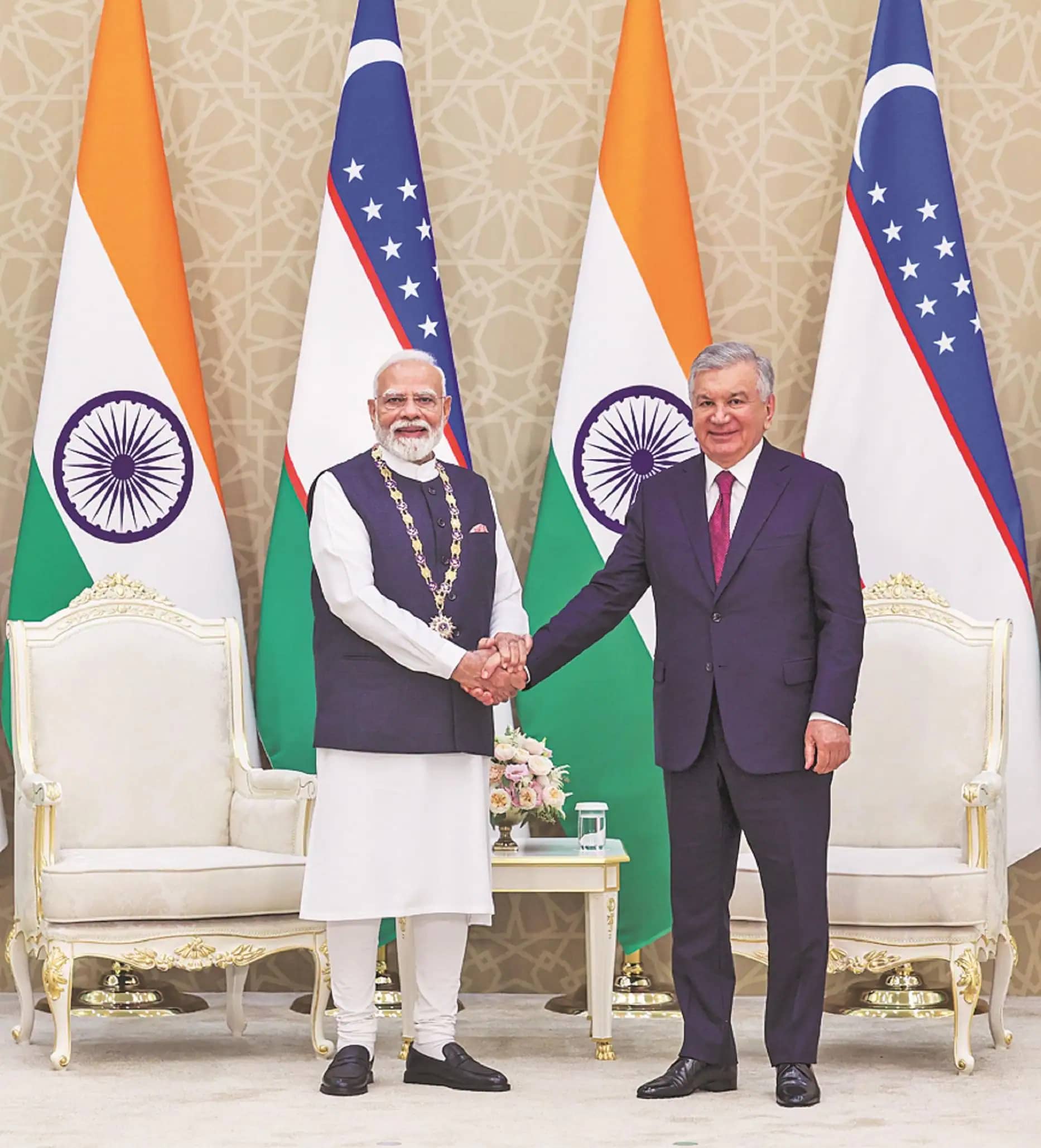
After talks between Prime Minister Narendra Modi and Uzbekistan President Shavkat Mirziyoyev in Tashkent on Sunday afternoon, the delegations of the two countries announced 16 outcomes, including a long-term arrangement for the supply of uranium from Central Asian nation to India. New Delhi and Tashkent also set a target of almost quadrupling bilateral trade to $5 billion in the next four years, resolved to strengthen defence ties, such as defence co-production, elevate their relations to a comprehensive strategic partnership, and institute a foreign minister-level dialogue. Modi was given the “Oliy Darajali Do’stlik” Order, Uzbekistan’s highest honour for foreign leaders, by the Uzbekistan President. Significantly, at his talks with the Uzbek President, Modi announced that New Delhi would host the India-Central Asia Summit in 2027. According to a joint statement issued after the Modi-Mirziyoyev meeting, the two leaders called for strengthening engagement within the Central Asia-India format at the level of heads of state and other levels. The inaugural India-Central Asia Summit was held virtually on January 27, 2022, after New Delhi had to cancel plans to host the leaders of the five Central Asian Republics as guests at the Republic Day parade that year because of apprehensions of another Covid-19 spike. In a pathbreaking visit, and the first by an Indian Prime Minister to do so, Modi travelled to all the five Central Asian Republics during an eight-day trip in July 2015. His visit boosted hopes of improved India-Central Asia connectivity, especially via Iran’s Chabahar port and the North-South Trade Corridor, and also provided further momentum to the “Connect Central Asia” policy that the Manmohan Singh government had launched in 2012. Modi then told the gathering at Kazakhstan’s Nazarbayev University in Astana: “In an age of globalisation, Asia cannot remain fragmented. And Central Asia cannot remain distant and disconnected from India.” Also Read India-Central Asia trade has increased fourfold to $2 billion since, with Uzbekistan as India’s largest trading partner in the region. India-Uzbekistan bilateral trade was $1.32 billion last year. But after the cross-border terror attack at an Indian Army brigade headquarters in Jammu and Kashmir’s Uri in 2016, New Delhi’s relations with Islamabad have plummeted, as have any plans for better connectivity with Afghanistan and Central Asia. United States sanctions against Iran have affected connectivity via the Chabahar port. In contrast, China’s Belt and Road Initiative lifted China-Central Asia trade to $106 billion in 2025. The Prime Minister’s current visit to the Central Asian Republics is expected to strengthen the perception that New Delhi wishes to remain deeply engaged with Central Asia. India has sought to revive the effort in the last couple of years with External Affairs Minister S Jaishankar hosting the foreign ministers from the region at the India-Central Asia Dialogue of Foreign Ministers in June 2025, where the Prime Minister met the ministers. Modi landed in Bishkek, the capital of the Kyrgyz Republic, on Sunday evening to attend the Shanghai Cooperation Organisation (SCO) Summit on Monday and Tuesday, where he will meet the rest of the Central Asian leadership. His announcement that New Delhi will host the India-Central Asia Summit next year is interesting since Islamabad, as chair of the SCO, will host the grouping’s summit in 2027. On India’s participation in the SCO Summit next year, Indian officials said a decision would be taken “by the appropriate authority at the appropriate time and our appropriate level of participation will be decided accordingly”. In Bishkek, the Prime Minister is slated to have a bilateral meeting with Russian President Vladimir Putin, and likely to meet Chinese President Xi Jinping. Both Putin and Xi are scheduled to attend the Brics Summit in New Delhi on September 12-13.Modi could also meet Iranian President Masoud Pezeshkian, their first meeting after the conflict started in West Asia. Iran is one of the 11 full members of Brics. It is crucial if India is to get all members to reach a consensus on a joint Brics declaration. Verbal disagreements between the Iranians and representatives of the United Arab Emirates have marred preparatory Brics meetings in New Delhi, including the one that the foreign ministers of the Brics members attended in May. The Prime Minister is also likely to flag the issue of the blockage of maritime trade through the Strait of Hormuz with the Iranian President.The meeting in Bishkek would also offer Modi an opportunity to meet Tajik President Emomali Rahmon. The meeting would be important not only because Modi is set to invite him for next year’s India-Central Asia Summit. Both India and Tajikistan are contenders for the Asia bloc’s vote for the non-permanent United Nations Security Council (UNSC) seat for the two-year 2028-29 cycle, with the election slated for June next year. In 2009, New Delhi convinced Kazakhstan to withdraw from elections for the 2011-12 cycle, and later supported Kazakhstan to secure the UNSC seat for the 2017-18 term.11 agreements signed; five announcements made India and Uzbekistan on Sunday signed 11 agreements and made five announcements. The agreement on mining will pave the way for a long-term arrangement for the supply of uranium from Uzbekistan to India, Indian officials said. Uzbekistan is one of the world’s top five uranium suppliers. The two countries will also increase trade in critical minerals and their exploration.The two leaders committed to increasing bilateral trade to $5 billion by 2030. During his address to a joint briefing, Modi said India and Uzbekistan would take structured steps to address issues related to market access, connectivity, banking and payment. The two leaders emphasised the need for a comprehensive review of the existing bilateral legal instruments and to modernise the treaty framework in line with present-day realities. The two sides agreed to undertake joint measures to broaden the range of goods traded between the two countries. They decided to create a Joint Working Group to address non-tariff issues and investment barriers. New Delhi and Tashkent agreed to introduce digital platforms to support small and medium-sized enterprises and facilitate bilateral trade. They will also promote dialogue among regulators and facilitate faster and greater market access in each other’s markets. Officials said the two countries recently held a meeting of their Intergovernmental Commission on Trade, Economic, Scientific and Technical Cooperation in June and the Uzbekistan-India Business Forums in August. The two sides agreed that there was great potential for bilateral trade in electrical items, engineering products, automobiles and pharmaceuticals. The two leaders noted that a joint feasibility study on the Uzbekistan-India Preferential Trade Agreement had been concluded, and asked relevant ministries to explore the next steps on a time-bound basis. They stressed the need for cooperation in mining, nuclear energy, industrial cooperation, and critical and strategic minerals, including projects for processing mineral resources, producing value-added products and recycling initiatives. They also expressed an interest in encouraging Indian companies to participate in the development of prospective mineral deposits in Uzbekistan and Uzbek enterprises for joint collaboration in India. In his speech, Modi said Uzbekistan was at the heart of Central Asia, and at the heart of India’s engagement with the region. He noted the convergences between the “Yangi Uzbekistan” and “Viksit Bharat 2047” visions, with the youth, innovation, inclusive growth, and modern technology at their centre. He said that the two countries would work to establish direct linkages between their defence industries, which would lead to co-production and co-development in the years to come. He said the two countries had zero tolerance towards terrorism, extremism and separatism. Modi said India would help Uzbekistan in the conservation of its Buddhist sites. “A stronger India-Uzbekistan partnership will be a powerful force for peace, progress and prosperity in Central Asia,” the Prime Minister said. Enhancing the partnership India is among Uzbekistan’s top 10 trading partners. Both nations committed to increase trade to $5 bn by 2030 from $1.32 bn nowAround 400 Indian companies operate in Uzbekistan, with a combined project portfolio exceeding $5 billionIndia’s trade surplus with Uzbekistan more than trebled from $ 200 million in FY22 to $ 643 million in FY26Uzbekistan imports more than $3 billion of medical products annually. Tashkent has invited the Indian pharma industry to establish joint manufacturing unitsIndia’s imports from Uzbekistan have become increasingly concentrated in natural gums and resins, fertilisers, copper tubes and raw silkIndia is looking to increase fertiliser imports from UzbekistanUzbekistan has significant reserves of copper, molybdenum, lithium, tungsten, graphite, selenium, and other technology metalsThe central Asian country has planned 120 critical-mineral projects worth $ 4.2 billion during 2026–2030