 The Indian Express ·
Education
A visually impaired student asked one question. It led to a Rs 6 lakh award
Himaja' project 'Rudhra' converts spoken words into Braille and print the pattern in a way that allows users to sense the characters in their actual form instead of reversing it and learning the corresponding pattern.
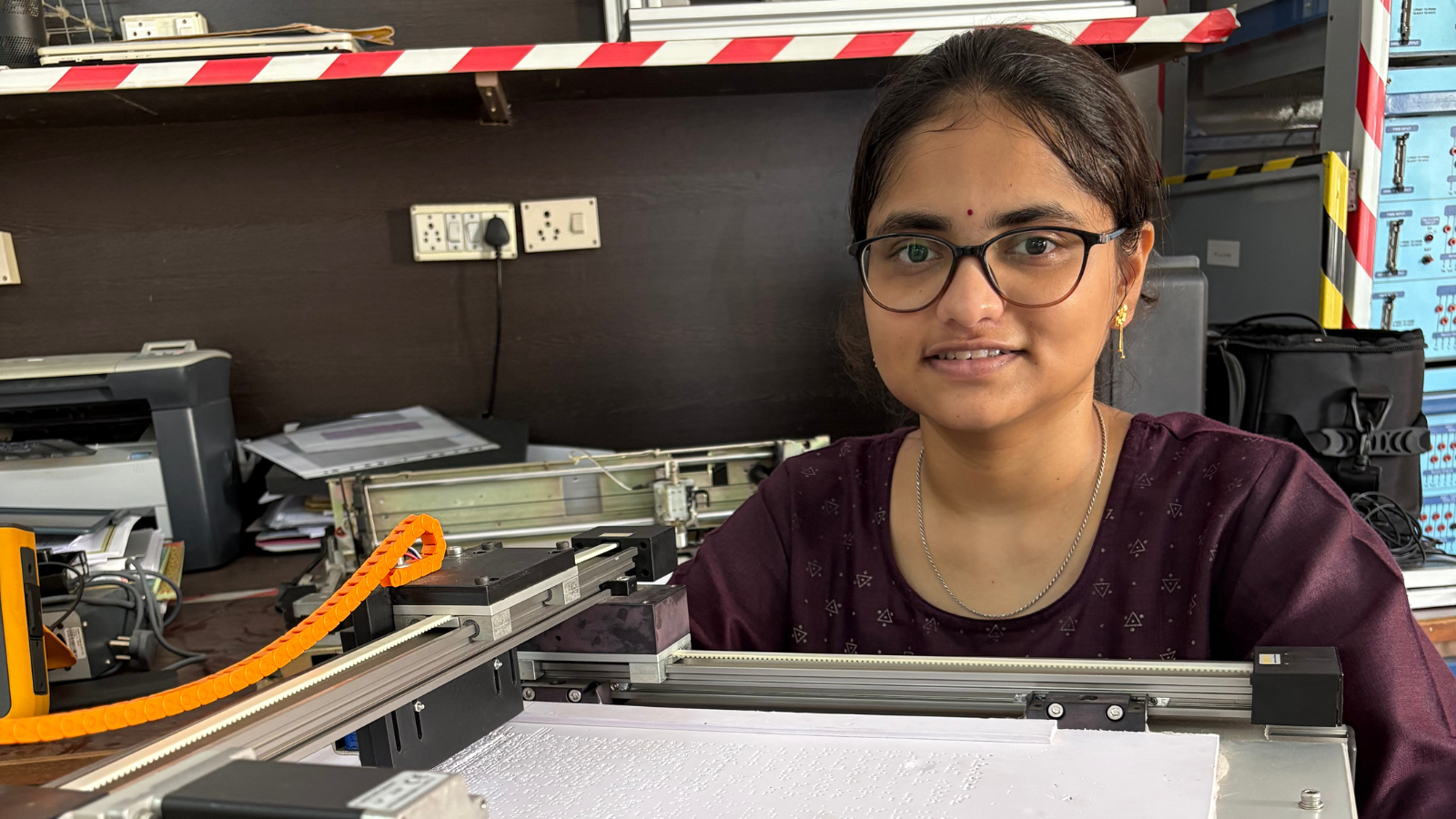
A question from a visually impaired student changed the direction of Himaja Lingampalli’s innovation. While visiting a school for visually impaired children near her college, Lingampalli, a fourth-year BTech student at Sri Vishnu Engineering College for Women, watched students use traditional Braille slates and pins to write. The process required them to apply considerable pressure to punch dots onto paper. Once the writing was complete, they had to turn the sheet over to read the Braille from the reverse side.
The experience made Himaja wonder if technology could make the process less physically demanding and easier for visually impaired students.
Her idea eventually took shape as ‘Rudhra’, a voice-enabled Braille printing system designed to make Braille writing more accessible. The innovation has won the James Dyson Award in India for 2026, along with a cash prize of Rs 6 lakh. Himaja will represent India in the international round of the award.
The initial challenge was not just the physical effort involved in punching the dots. Students also had to learn and remember the corresponding six-dot patterns that make up Braille characters. For Himaja, the visit raised a simple question: could her technical knowledge help reduce some of these difficulties?
Read | How special seats drove a 52% surge in women joining IITs
Himaja’s prototype looked very different from the current version of Rudhra. It required students to use push buttons to select the six dots that make up each Braille character. She took the prototype back to the school to test it and gather feedback from the students. But one student’s question made her rethink the entire approach.
“Akka, why can’t we just speak instead of pressing these buttons?” the student asked.
That question became the turning point for Himaja. She began exploring how voice input could be incorporated into the system using Alexa, eventually transforming the button-based prototype into a voice-enabled Braille printing device.
The system is now capable of converting spoken words into Braille and printing the corresponding characters. Himaja said the machine produces Braille patterns that users can feel and read in their actual form, eliminating the need to reverse the paper and learn the corresponding pattern before reading it.