 The Indian Express ·
Education
DU students’ union polls: Why hostel safety and rent entered final campaign pitch
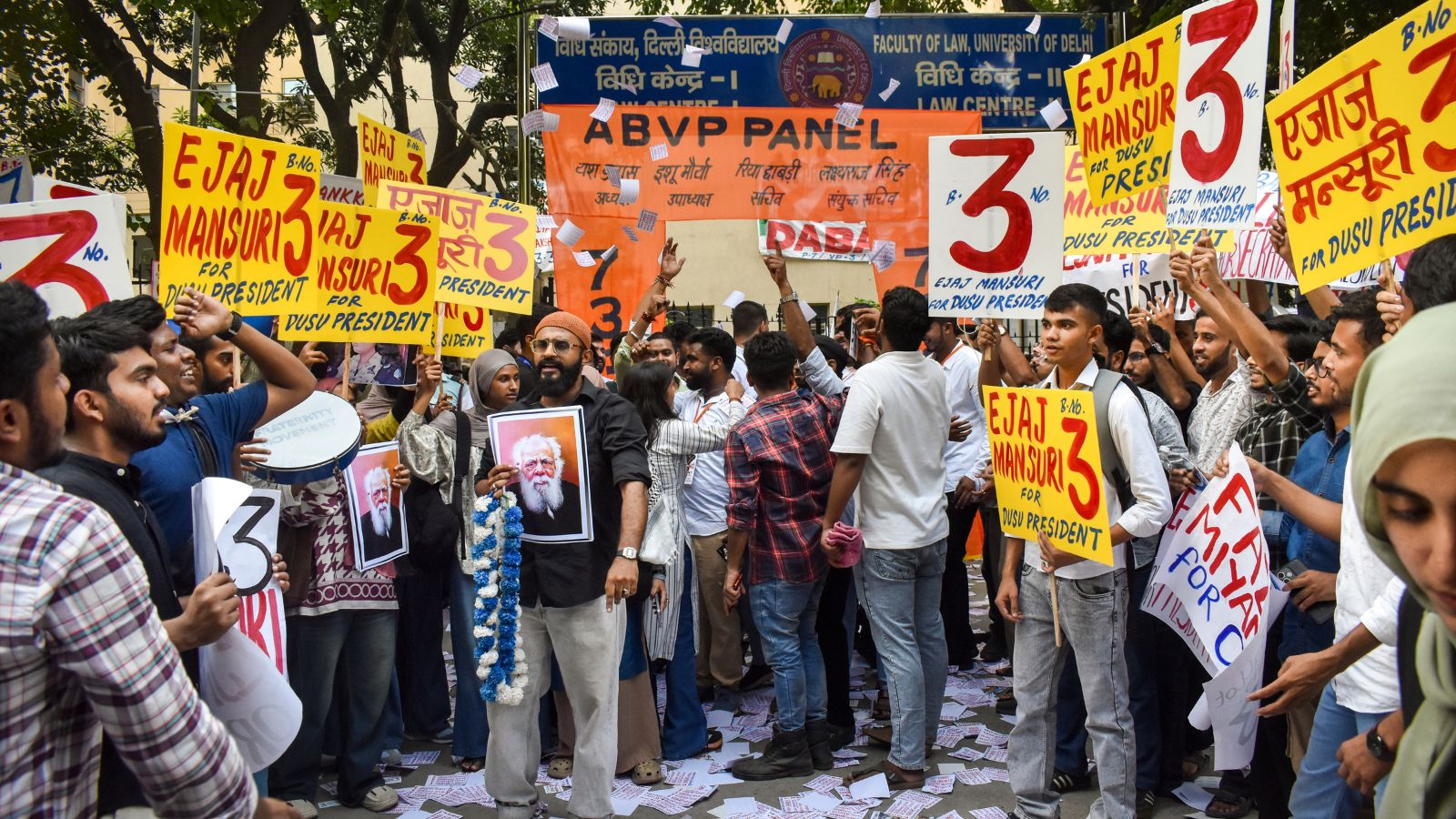
The campaign also played out somewhere else – on students’ phone screens, where viral reels, follower counts and emotional narratives were fighting for the Gen Z vote.
The ABVP released a video set to the fast-paced track ‘DU Bole Dil Se, ABVP Fir Se (DU Speaks from the Heart, ABVP Once Again)’.
With flash mobs, drone shots and rap beats in the background, it featured its panel: presidential candidate Yash Dabas, vice-presidential nominee Ishu Maurya, secretary nominee Riya Chhawdi and joint secretary candidate Lakshay Raj Singh.
A student walks along a footpath past a wall covered with posters of candidates contesting the upcoming Delhi University Students’ Union (DUSU) elections, at North Campus of Delhi University, in New Delhi, Wednesday, Sept. 16, 2026. (PTI Photo/Rushikesh More)
The NSUI took a very different approach. In a video shot on a phone, the parents of its Adivasi presidential candidate Vijay Shankar Meena appealed to students from outside their home at Lalsot in Rajasthan’s Dausa district.
His father, leaning on a walking stick, sat beside his mother. “Up to now he was my son, but the moment he stepped into this election, he became the son of the sarv samaj (entire society),” he said with folded hands.
Maheshmurti Leni S Jadhav, Joint Secretary of the AICC research department and the DUSU NSUI panel in-charge, pointed to Meena’s social media reach.
“Look at Vijay Meena’s Instagram… he has crossed over 88,000 followers, stretching far beyond DU to across the country and even overseas,” she said.
“Social media is playing a decisive role in how this generation decides to vote… The Gen Z voter is far more vocal and discerning. They question incumbents directly. While you see dramatics and theatrics staged by rivals just for viral attention… It is an authentic digital connection that resonates,” she added.
The Left alliance of AISA and SFI also acknowledged the shift, though it said its main focus remained firmly rooted in traditional on-ground engagement.
“There is definitely a shift in the air,” said Sharanya Verma, campaign in-charge for the alliance.
New Delhi: Police personnel stand guard ahead of the ‘Delhi University Students’ Union’ (‘DUSU’) elections, in New Delhi, Wednesday, Sept. 16, 2026. (PTI Photo/Rushikesh More)
She said students were more willing this year to discuss issues such as rent and university-run hostels after the Satya Niketan building collapse.
“Earlier, students were largely cynical, assuming nothing would ever change. This time, when we go class-to-class talking about rent regulation and university-run hostels, students don’t just silently listen, they also ask questions… They ask why more hostels had not been built despite the same union being in power for years, and why they were paying Rs 20,000 for rooms sized like a matchbox,” she added.
Verma, however, said the online conversation often looked different from what happened in a classroom, alleging that money, muscle and caste-based campaigning continued to shape the election.
“Students will tell us, ‘we saw your reel, we agree with your fight’. But on the ground, money and muscle remain brazen. They walk into colleges and chant their caste names instead of discussing policy. We faced targeted intimidation every single day of this campaign… including a violent attack on our activist Stanzin at Sri Aurobindo College on September 3.”
The Left questioned the exclusion of students from 22 women’s colleges from central DUSU voting, including students at Lady Shri Ram College, Gargi College and Jesus and Mary College.
“Who is afraid of women’s votes?” Verma asked. “It’s interesting that none of the other main contenders like ABVP and NSUI have raised this issue.”
Verma maintained that tokenism – like parties promoting symbolic representation such as NSUI’s Adivasi presidential candidate – does little to change daily campus power dynamics if caste patronage networks are not dismantled.
The campaign, meanwhile, marked several firsts this year.
The Association of Students for Alternative Politics (ASAP), the AAP’s student wing, fielded visually challenged candidate Pankaj Kumar for secretary. But sources in the Left and ABVP said the campaign failed to gain much traction among students with the campaign being visibly dominated by middle-aged supporters.
At Rajdhani College on Wednesday, independent vice-presidential candidate Deepanshu Shokeen drew crowds with yellow banners and marigold garlands. Shokeen and Vishesh Yadav had entered the fray after failing to get NSUI tickets. Their decision to contest independently has led to concerns among party insiders about a possible split in the anti-ABVP vote.
Student housing and safety remained common themes across manifestos.
ABVP promised new hostels, separate girls’ hostels and fire-safety audits. NSUI demanded strict implementation of rent-control measures, regular landlord inspections and a DU portal listing affordable PGs and rentals. AISA-SFI sought the Rent Control Act, college subsidies and at least two hostels per college, while ASAP called for “Hostels for All” and cheaper public transport.
On Wednesday, DU Vice-Chancellor Yogesh Singh directed colleges to keep security tight for the next three to four days, with night patrols until September 18 — when voting will take place — and a teacher appointed to coordinate with police.