 Scroll.in ·
In Assam, eye testing at post offices is helping many see clearly again
The early results of a pilot project show that basic vision care is an unmet need among many.
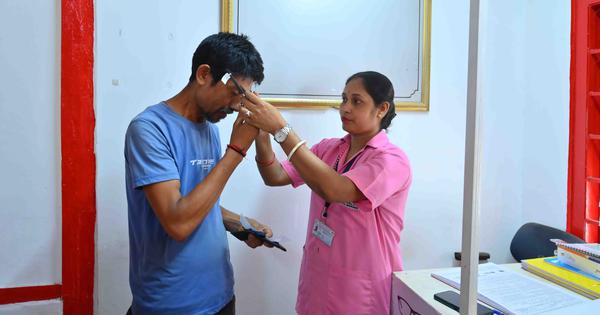
At a post office in Assam, Bandana Devi, has found herself doing a job that has little to do with letters, parcels or money.
Since December 2025, Devi has been working as an accredited social eye care worker, testing the eyesight of people who come into the post office. She is part of a pilot project by the nonprofit VisionSpring Foundation, in partnership with India Post, to bring basic vision care closer to people who may have limited access to eye clinics.
“There have been a lot of footfalls since I began working on the programme,” said Devi. “People here suffer from short-sightedness and vision problems. I have seen over 3,000 people, and many are happy after coming here.”
The post office seems like an unlikely place to get an eye test. But for people in parts of Assam, the post office can be considerably easier to reach than a hospital or an eye clinic.
The early results of the pilot project indicate that basic eye care is a significantly unmet need. Five post offices are being used to screen eyesight and provide reading glasses to those who need them.
As of July, nearly 9,000 people had been screened. Around 72% – 6,421 people – were found to have presbyopia, which is the age-related difficulty in focusing on things close up, and were provided with eyeglasses.
Eighty-two per cent of those who received spectacles were wearing them for the first time. Anjali Deka, 47, who runs a small tea stall, said, “Since I started wearing them, life has changed so much.” It was a liberating experience for her. “I am able to help my children with their homework and one of them has got over 97% in her exams,” said Deka.
Romesh Chandra Sharma, a local priest, knew something was wrong with his sight. “My vision was dipping and things looked blurry,” he said. Then he visited the post office to get his eyes tested. “I can read my religious texts better now and it is proving a boon,” he said.
These experiences point to a problem that can easily go unnoticed: people often live with deteriorating near vision without seeking help.
In poorer households, an eye examination may not be a priority. Visiting a clinic can involve travel, time away from work, and the cost of spectacles. If a vision problem develops gradually, people may simply adjust.
Assam’s pilot project is trying to remove some of those barriers with a screening service where many people are frequent visitors. “We chose post offices because they are the most trusted address across India,” says Anshu Taneja, s managing director, India, at VisionSpring Foundation. “People in Assam may have never seen an eye doctor but they have been to their post offices several times.”
Millions may be living with blurred vision
India’s postal network gives the experiment considerable reach.
There are nearly 165,000 post offices across the country, a majority in rural areas and remote villages. Apart from mail, the local post office is also where people collect pensions, send money, make savings deposits and access a range of government services. Can that existing network now help close a gap in basic healthcare?
The financial circumstances of the people reached by the pilot underline why access matters. The average monthly household income among Assam’s beneficiaries is approximately Rs 7,000, while 41% come from households earning less than Rs 5,000 a month, according to VisionSpring Foundation which relied on data from the state’s Socio Economic and Caste Census from 2015.
On those incomes, even a relatively inexpensive pair of glasses can compete with immediate household needs.
Assam is a useful setting for the experiment because of its large tea industry. Thousands of people depend on tea gardens for their livelihoods, and some tea workers have been among those coming to the participating post offices for eye tests. Tea picking requires workers to distinguish between leaves, often while working for long periods. Declining near vision can make that more difficult.
Clement Songate, a senior social sector professional involved in the project, said tea garden workers are among those using the service, although the pilot does not yet have separate figures for them.
“Tea pickers are an important constituency,” said Songate. “We do have post offices where there are tea gardens, and some of the workers do come to the post offices and use the service.”
At the Baihata post office, 35 km from the state capital, postmaster Putesh Kumar Deka has watched the eye-testing service become part of the activity around his counters. “People come here for all kinds of postal work, and now they are also coming here to have their eyesight checked and get their glasses,” he said. “They are really happy with the service.”
The first phase of the Assam project has established that there is a need for such service. The next challenge is whether this model can continue. The organisations involved are looking at a possible incentive or paid model for every pair of glasses dispensed, as they consider how the service could be sustained.
In Bangladesh, VisionSpring Foundation’s research found that while providing reading glasses to low-income workers, they associated spectacles as something accessible to people with higher incomes. In Uganda, it has been working with health authorities and other partners to train community-level workers to identify and address presbyopia.
Now, it remains to be seen if India’s postal system can make basic vision care a part of its vast and busy network.
Murali Krishnan is an independent journalist.