 The Guardian ·
Poland warns Russia planning ‘hybrid strikes’ against countries supporting Ukraine – as it happened
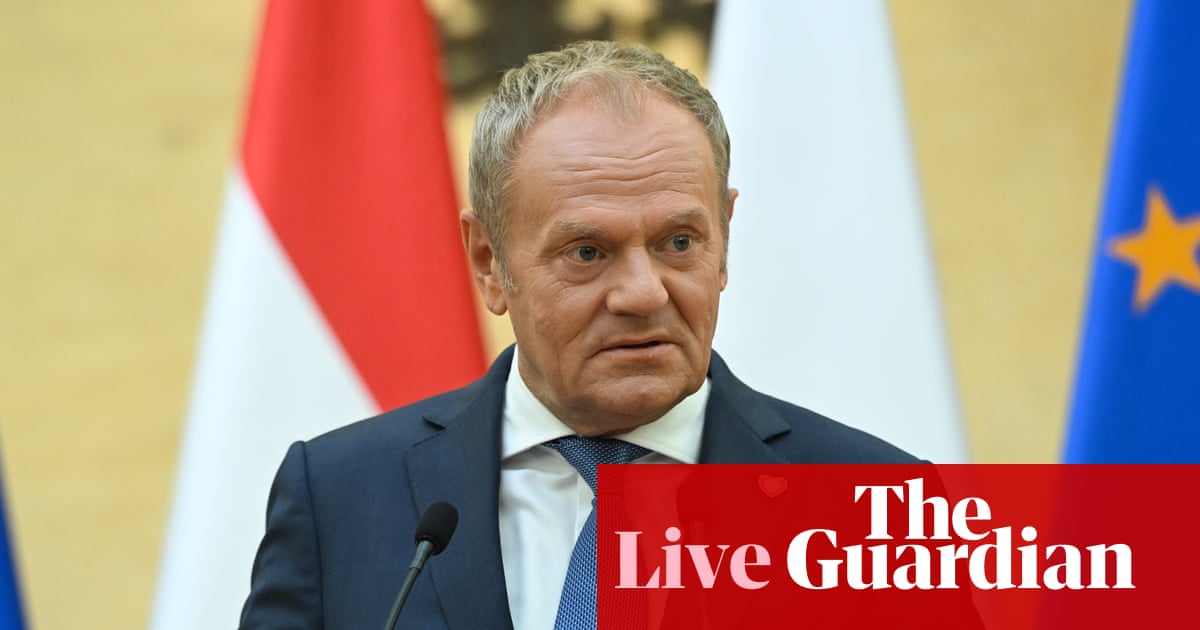
Intelligence shows Russian 'plans for hybrid strikes ... against countries supporting Ukraine, including Poland,' Tusk says
Tusk says that intelligence assessments show “plans for hybrid strikes using drones and missiles against countries supporting Ukraine, including Poland”.
He says the latest intelligence on this is “very consistent and convincing”.
He says that Russia is expected to pretend that any incidents are “accidental” in a bid to “paralyse or at least weaken Nato’s resolve to invoke the relevant provisions” of the Nato treaty.
“There is a real risk that drones or other types of projectiles could be launched into the territory of one or more Nato countries on the eastern flank, and could even cause damage, and the official narrative will be that this is an accident and that there is no reason for anyone to consider any response from Nato.
The aim … will be to weaken Nato’s integrity in general and, above all, to convince … member states that Article 5 is more theoretical than practical – that is, the assumption that no one will want to die for Latvia or Lithuania, given that we are dealing with incidents rather than a declaration of war.”
He says he expects Russia to use “recurrent” incidents to use them as “an increasingly stark illustration of Nato’s helplessness” to respond in a united manner.
And, on that note, we will be closing the blog for today.
Polish prime minister Donald Tusk has said that intelligence assessments show Russian “plans for hybrid strikes using drones and missiles against countries supporting Ukraine, including Poland” over the winter (17:23), with “provocations ... far more dangerous that those we have faced so far” (17:33).
Tusk said the coming autumn and winter is likely to be “the most critical moment” in Russia’s full-scale aggression on Ukraine (17:20) as he warned Russia will also try to test Nato’s resolve in defending its eastern flank (17:28).
Polish PM earlier warned that “if anyone dares to attack us, they will face a resolute response from us and our allies,” as he responded to growing aggression from Russia (17:15).
Swedish prime minister Ulf Kristersson has resigned from his post, as final results of the Swedish parliamentary election confirmed his four-party coalition will not have a majority in the new parliament (13:57).
The former prime minister and left-leaning bloc leader, Magdalena Andersson, welcomed the result, vowing to lead the country “in a new direction” (15:33).
However, Kristersson and his allies cast doubt on whether the left-leaning bloc of four parties will be able to build a stable coalition to form the next government (14:10, 14:24, 16:00).
Canadian prime minister Mark Carney has called for closer ties between Canada and the EU on trade, energy, “pooled” sovereignty, mobility in a warmly received speech at the European parliament in Strasbourg (12:22).
He welcomed the EU’s suggestion of an “associate membership” for Canada, but said “what matters is the substance” as he set out a number of key areas of focus for further talks with the EU
Carney also rejected Trump’s criticism of the plans, saying “no one is going to dictate our culture or with thom we can strike agreements internationally”.
If you have any tips, comments or suggestions, email me at jakub.krupa@theguardian.com.
I am also on Bluesky at @jakubkrupa.bsky.social and on X at @jakubkrupa.
Tusk's stark warning about Russian plans for hybrid strikes against Ukraine's allies - summary
Polish prime minister Donald Tusk has said that intelligence assessments show Russian “plans for hybrid strikes using drones and missiles against countries supporting Ukraine, including Poland” in the coming months (17:23).
In a sombre speech in the Polish parliament, Tusk warned that Poland will face ‘provocations ... far more dangerous that those we have faced so far’ (17:33) as Russia is expected to test Nato’s resolve in defending the territory of its members on the eastern flank.
The Polish prime minister cautioned that the coming autumn and winter is likely to be “the most critical moment” in Russia’s full-scale aggression on Ukraine (17:20).
Tusk said the available intelligence suggested Russia will pretend any incidents are “accidental” to further stress test Nato’s article 5.
Tusk also warned that some European parties “currently gaining in strength” are only “looking for an excuse” to not defend Poland, Latvia, and Lithuania, calling for a united response to any threat in the region (17:28).
Tusk did not specifically reveal which intelligence agencies he was citing.
However, Poland’s security services minister Tomasz Siemoniak met CIA director John Ratcliffe last week, just days after his much-discussed trip to Russia.
Poland’s defence minister Władysław Kosiniak-Kamysz is also planning to go to the US next week for urgent talks with US defence secretary Pete Hegseth.
Make of that what you will.
Tusk and other key ministers also repeatedly quoted Polish intelligence agencies in the past, whether in response to repeated security incidents, airspace provocations near Poland, or arrests of people suspected of planning acts of sabotage on behalf of Russian intelligence services.
Poland will face 'provocations ... far more dangerous that those we have faced so far,' Tusk warns
Tusk also warned right-wing opposition parties that “inciting hostility towards the European Union, towards our allies and towards Ukrainians is simply implementing Russia’s strategy.”
“Everyone must finally understand this,” he says.
Going back to security threats, he says that while “there is nothing to suggest an invasion,” Poland will “have to pass a very serious test, because we will certainly be the target of provocations and incidents far more dangerous than those we have faced so far.”
He ends his speech with a plea to the parliament:
“So we must pass this test – all of us, both politicians and the nation as a whole.
That is why I will appeal to all of you, without exception, that wherever the issue concerns the security of our borders, the airspace over Poland, or the safety of our homes, we must speak with one voice, take joint decisions, not hesitate … The nation will truly hold us all, without exception, to account for this.”
Some politicians 'just looking for excuses' to not defend Poland, Latvia, Lithuania, Tusk warns
Tusk also talks about Poland’s absolute resolve to defence all other Nato countries.
He says “this is very important, because as. a border country … we are likely to need allied loyalty under Article 5 more than Portugal or Ireland.”
“It is not the case that all politicians in the west, in the United States or in Europe, are thinking about how to defend Poland, Lithuania, Latvia and Estonia, and that they are all eager to prove immediately that they are staunch allies and will come to our aid under Article 5.
Far from all of them. There are many politicians, as well as political forces, which are currently gaining in strength and influence in European countries, who are just looking for an excuse: we won’t die for Poland; we won’t die for Latvia or Lithuania.”
He says that’s why Poland must be very openly ready to follow through on its allied commitments.
“Article 5, loyalty within the alliance, and faithfulness to our commitments must become our hallmark,” he says.
Tusk says Russia is not prepared or willing to get involved in any serious discussions about ending its aggression against Ukraine “at least until the end of winter.”
“They are convinced that this winter will be a time of dire crisis for Ukraine,” he says.
Coming autumn, winter will be 'most critical moment' in Russian war against Ukraine, Tusk says
Tuskis now speaking in Polish parliament,speaking about what he believes Poland and Ukraine’s other allies should be expecting in the coming months as Russia ramps up pressure and threats against Nato.
He says he wants to outline “the most likely scenario for the next few months, as it is a scenario involving serious events and one that requires us to be focused, serious and, above all, mentally prepared to face difficult challenges.”
He says “late autumn and winter” are expected to be “the most critical moment” in the Russian war of aggression against Ukraine so far.
Tusk noted that Russia is increasing its attacks using jet-powered drones, which he believes “very few [countries] are currently prepared to effectively counter.”
“Russia’s objective today is to destroy Ukraine’s economy and logistics on as large a scale as possible. … Ukraine is expected to face constant strikes of very high frequency and intensity. This includes the six main Ukrainian cities, with the destruction of warehouses containing all types of products essential, first and foremost, for the country’s defence, as well as – as we have witnessed in recent weeks – very severe damage to the railway infrastructure.”
'If anyone dares to attack us, they will face a resolute response from us and allies,' Poland's Tusk says
Meanwhile, Polish prime minister Donald Tusk warned that “if anyone dares to attack us, they will face a resolute response from us and our allies,” as he responded to growing tensions and aggression from Russia.
In a sombre speech marking the 87th anniversary of the 1939 Soviet invasion of Poland, Tusk said he would “prefer to speak only about the heroic deeds recorded in the history books,” but “Russia’s escalating aggression is not letting me do that.”
“History, as we know, does not repeat itself, but it does rhyme, and we must interpret these rhymes of history today with due seriousness,” he said.
Responding to recent Russian incidents in and around Poland – including last year’s drone incursion into Poland, a Russian missile straying into Poland in July, and recent incidents at the Polish-Ukrainian border – Tusk insisted that Warsaw “will not be intimidated.”
“Russia does not need to cross our border. It is already waging a hybrid war against us using drones, acts of sabotage and disinformation on the internet. We know from our allies that the coming months may bring further provocations,” he said.
He said he was “neither afraid nor naive” about the dangers posed by Russia.
“I am from Gdańsk. In May 1939, a certain French politician – a future Nazi collaborator – asked in the French press why anyone should die for Gdańsk. A few months later, the whole of Europe was dying.
To those who say today that this is not our war, I would like to remind them of this lesson from history. In 1939, our alliances existed only on paper, really. We were left on our own. Today, we are members of Nato and the European Union.”
We spend almost 5% of our GDP on defence. This is almost twice as much as Germany and twice as much as France. We are building one of the strongest armies in Europe; we secured €44bn from the EU’s SAFE programme, the most from all EU countries. And Polish borders are today the best marked borders on the entire continent.
Europe, which in 1939 did not want to die for Gdańsk, today funds Polish armaments.
But we are aware that even the largest army is not enough if the nation is not ready.
Therefore, I address all those who look at the future with anxiety:
We are not seeking war, but if anyone dares to attack us, they will face a resolute response from us and our allies. Long live a free and secure Republic of Poland.”
He is also speaking in the Polish parliament now, promising to set out further details on the threats facing Poland.
Germany, US sign 'letter of intent' on close defence cooperation, despite previous clashes
Following months during which the German government has sought to convince the public that militarily (and otherwise) Germany must stop relying on its erstwhile trustworthy partner, the United States, due to the erratic, rude and unruly behaviour of its president, the defence ministers of both countries signed a “letter of intent” this week, signaling close cooperation after all.
Germany’s defence minister, Boris Pistorius, visibly surprised at the warm reception he received in Washington earlier this week, said after his first meeting with US war minister Pete Hegseth he had only heard warm words of praise for Berlin over its contribution to joint defence goals.
This was in sharp contrast to the bitter tirade Hegseth had delivered to European defence ministers just weeks ago, accusing them of abandoning the US in the Iran war, or to the message disseminated by president Trump earlier this year when he announced the withdrawal of thousands of US troops who are stationed in Germany, in what was interpreted as a clear snub to Berlin.
At a time of dwindling military stocks – the US looking at its war against Iran, Germany, focused mainly on helping to defend Ukraine - the counterparts’ intention, so the letter states, is for “enhanced bilateral cooperation in the defence sector to support transatlantic industrial production and maintenance capacities” and although using slightly wishy-washy terminology, it suggests quite a political U-turn.
From accepting that the Trump administration had mentally withdrawn itself from Nato, and Berlin should become more independent from Washington as a result, the government of Friedrich Merz has now signed up to the statement “Germany and the United States agree that the current political challenges require a robust and mutually beneficial, closely integrated defence industry base on both sides of the Atlantic,” as the declaration reads.
The powerful industries of both countries “can and should” complement each other more closely in the future in the production of “state of the art” weapons systems, components and complex munitions.
Pistorius has sought to play down accusations that this is a contradiction, painting it instead as a pragmatic and direct reaction to current tensions. (What we sometimes refer to as Realpolitik.)
Today he will take delivery of F-35 fighter jets manufactured for Germany’s armed forces in Texas, before heading home tomorrow.
Romanian EU lawmaker Siegfried Muresan proposed as Romania's next prime minister
Sweden is not the only European country working to change its prime minister.
Following a day of consultations with political leaders, Romania’s president, Nicușor Dan, has nominated EU lawmaker Siegfried Mureșan to become the next prime minister.
Romania has had a caretaker government since early May, when prime minister Ilie Bolojan lost a vote of confidence in parliament.
“Romania needs a government,” Dan said, adding that “people’s lives depend on it.”
However, he acknowledged that none of the prospective candidates can currently command a clear majority in parliament, as political parties remain cannot agree on the way forward.
Dan said he had seen “a great deal of concern amongst the parties about the elections and far less concern for national interest.”
He added that Mureșan, 44, had the necessary experience to take on the role and attempt to break the political deadlock.
The MEP has been a member of the European parliament since 2014. Born to German and Romanian parents, he is also a vice-president of the centre-right European People’s Party, the European parliament’s largest grouping.
Elsewhere, the EU and China are continuing efforts to avert a trade war after an hour long call between EU trade commissioner Maroš Šefčovič and his Chinese counterpart Wang Wengtao.
The EU reiterated the need to move from “rhetoric to results” with a “credible” solution that will curb China’s growing €1bn a day surplus in trade with the bloc.
Extensive work mapping the potential safeguards including quotas and price floors and possible retaliatory measures by the Chines have already been carried out in advance of Sefcovic’s planned meeting with Wang on 8 October.
A spokesperson said the call lasted more than an hour and took stock of the work carried out by officials so far covering the management of Chinese exports to the EU, the EU’s access to the Chinese market and export controls on rare earths.
Restrictions on exports of rare earths were imposed by Beijing in April 2025 but were suspended for a year last November after Donald Trump’s meeting with Xi Xingping in Korea last October.
Experts expect that suspension to continue after the Trump Xi summit next week in Washington but the EU will be pushing for a crave out for the bloc.
“While genuine engagement remains a priority, it is equally important that first concrete outcomes are delivered at the second session of the Trade and Investment Council in Beijing in Cotober which the commissioner will co-chair – a signal that we are moving from rhetoric to results,” said the EU’s deputy chief spokesperson Olof Gill.
Centre party leader thanks outgoing PM, says will be 'a constructive force' to keep government 'rooted in the centre'
Meanwhile, Centre party leader Elisabeth Thand Ringqvist also thanked the outgoing prime minister Ulf Kristersson praising his “efforts and leadership during the past term.”
“He has led Sweden through a tumultuous time with a changed security situation and Sweden’s historic entry into Nato. Being prime minister is Sweden’s most important role, and it deserves respect regardless of political divides,” she said.
“Now Sweden is entering a new political phase. The Centre party will be a constructive force to ensure Sweden gets a functioning government with a policy rooted in the centre.”
What that will actually mean in practice, we will have to wait and see.
SVT reported that the leaders of the four opposition parties are planning first meetings already.
The current parliament speaker Andreas Norlén is also hoping to individually speak with party leaders tomorrow, SVT said, getting ahead of the formal schedule (14:10).
Right-leaning bloc 'ready to continue governing Sweden if they fail,' liberal leader says
Liberal party leader Simona Mohamsson praised Kristersson’s time in government, saying he led “Sweden’s most liberal government ever,” and hailing what she sees as its successes on education and crime.
Her Liberal party, part of the outgoing government led by Ulf Kristersson, cleared the 4% threshold into the new parliament with 5.3% of the vote last Sunday.
Mohamsson thanked Kristersson for “four important years,” and giving Sweden “a fresh start when it needed it the most.”
“Now it is up to Magdalena Andersson to show whether she can put together any government foundation from the opposition’s mixed bag of left socialists, cultural relativists, and Centre Party members. My teammates to the right and I stand ready to continue governing Sweden if they fail,” she said, echoing the sentiment expressed by Kristersson earlier (13:57).
Christian Democrat leader Ebba Busch also posted a message in a similar tone, conceding the result, but praising the outgoing government’s track record.
“At present, there is no one who commands a majority in the parliament. The red-greens have not automatically won the government power. Various parties’ red lines before election day can lead to a complicated government formation,” she said.
Similar to Kristersson earlier, she also hinted at possible alternative majorities formed along the economic policy lines.
Sweden's election winner Andersson vows to 'move Sweden forward'
Meanwhile, the leader of the left-wing bloc that won Sweden’s election, Magdalena Andersson, vowed Thursday to lead the country in a “new direction” after four years of right-wing rule backed by the far right.
“The Swedish people have voted for a new direction for our country. Voted for unity and against division. The Swedish people have voted to move Sweden forward, and I want to realise the new direction that you have voted for,” she said in a speech posted on social media.
In the address, recorded in a prime ministerial aesthetics and with a Swedish flag in the background, she said she wanted to lead Sweden “away from conflicts from the sake of conflicts, and in a direction based on unity” between key parties as political talks about the new government are set to begin.
“It is up to all political parties to put the party politics aside and put Sweden and the Swedish people first,” she said.
She also talked about priorities on climate, schools, health care, and social care as examples of areas where she wanted to change the government’s policy.
Kristersson's language suggests he still hopes left-leaning bloc will fail to form government - snap analysis
It’s worth noting that the language used by Kristersson in his resignation letter – particularly a reference to irreconcilable differences in the various parties’ stated positions (13:57) – is not accidental.
The left-leaning bloc – led by former prime minister Magdalena Andersson and her Social Democrats - consists of four parties, and there are significant friction points between them, particularly between the Left Party and the Centre Party.
The Centre Party had previously suggested it would not accept ministers from the Left; the Left, particularly now emboldened by its strong election result, is unlikely to agree to no top jobs in a government it is expected to support.
If either party drops out of the arrangement, the bloc will struggle to form a government, as there are no viable alternatives.
But their voters generally expect them to work together.
And a leading figure from the Centre Party implied on Monday (Europe Live, Monday) that they could probably find a way of working with the Left, confirming the party would take part in exploratory talks led by the Social Democrats.
Still, the discussions are likely to be tricky and could take weeks before they agree on a path forward.
Outgoing PM Kristersson is clearly hoping those discussions fail.
His supporters repeatedly pointed out before the election that you could often see the four leaders of the four right-leaning parties in his bloc together – in fact, they also had a dinner together Monday night – and they marketed themselves a “stable” arrangement that was sort of ready to go.
But same didn’t really apply for the red bloc amid some apparent internal divisions between the leaders, leaving lots of questions mark to solve only now.
Kristersson appears to be keen to exploit some of these differences.
On election night, he suggested forming an alternative coalition against socialist economic policies – widely interpreted as an attempt to woo the Centre Party back to his side.
Even then, huge questions remain over how he could secure a majority without the far-right Sweden Democrats, an option that remains unacceptable to centrists.
Expect these talks to pick up speed now that we have the official results – and a looming vacancy at the top.
Timeline for next steps after Kristersson's resignation - snap analysis
In terms of next steps, there is a bit of time before the formal process of electing the new prime minister will get under way.
The new Riksdag is expected to convene on 28 September and elect its speaker on the same day.
The new prime minister can be proposed the next day, 29 September. That leaves just under two weeks for informal talks between now and then, and Kristersson will stay in post until a new PM is picked.
As explained in our live blog on Sunday, Sweden has a slightly unusual system of “negative parliamentarism,” which means that “if there’s a prime minister proposed, then if there is the absence of an absolute majority in parliament against the proposal, it’s interpreted as support.”
As Nicholas AylottofSödertörn University explained it to me on Sunday:
“So a party that doesn’t really want to give full support to this proposed candidate – maybe because it’s not going to be part of the coalition, but which can just about live with it, and doesn’t have a better alternative – it can abstain from the vote, and that’s counted as passive support. This makes it much easier to form minority governments.”
Meanwhile, Swedish public broadcaster SVT reported that just before Kristersson’s statement was published online, someone brought four cakes into the Social Democrat’s HQ in central Stockholm.
Guess we now know the reasons behind the delivery.
Swedish PM Kristersson resigns after election defeat
And in the last few minute, Sweden’s prime minister Ulf Kristersson has resigned from the post after official results confirmed that his right-leaning bloc lost last Sunday’s parliamentary election.
The four left-leaning parties, with former prime minister Magdalena Andersson’s Social Democrats as the largest party, won by just 50,359 votes, the final count showed.
The four left-leaning bloc will have 176 seats in the new parliament to 173 for Kristersson’s three-party coalition government and the far-right Sweden Democrats who were expected to join the administration after the vote, the Tidö bloc.
In a letter posted on X, Kristersson said that following the tight election results “may have complicated the conditions for the new government to be formed” with contradicting statements from different parties on their positions.
“Constructive openness from the parties in parliament will now be needed for a prime minister to be accepted, and for a new government to be able to receive support for its state budget.”
“Discussions will need to be held with all parties to find ways around these deadlocks and to create the conditions for a stable and effective government.
“It is the speaker who will lead the next steps towards forming a new government. In order for that work to begin immediately, I hereby request to be relieved of my duties as prime minister.”