 The Guardian ·
Crime, law and justice
Former Kosovo president Thaçi sentenced to 25 years in prison by international court in The Hague – as it happened
Thaçi held criminally responsible for war crimes during the violent break from Serbia in the 1990s
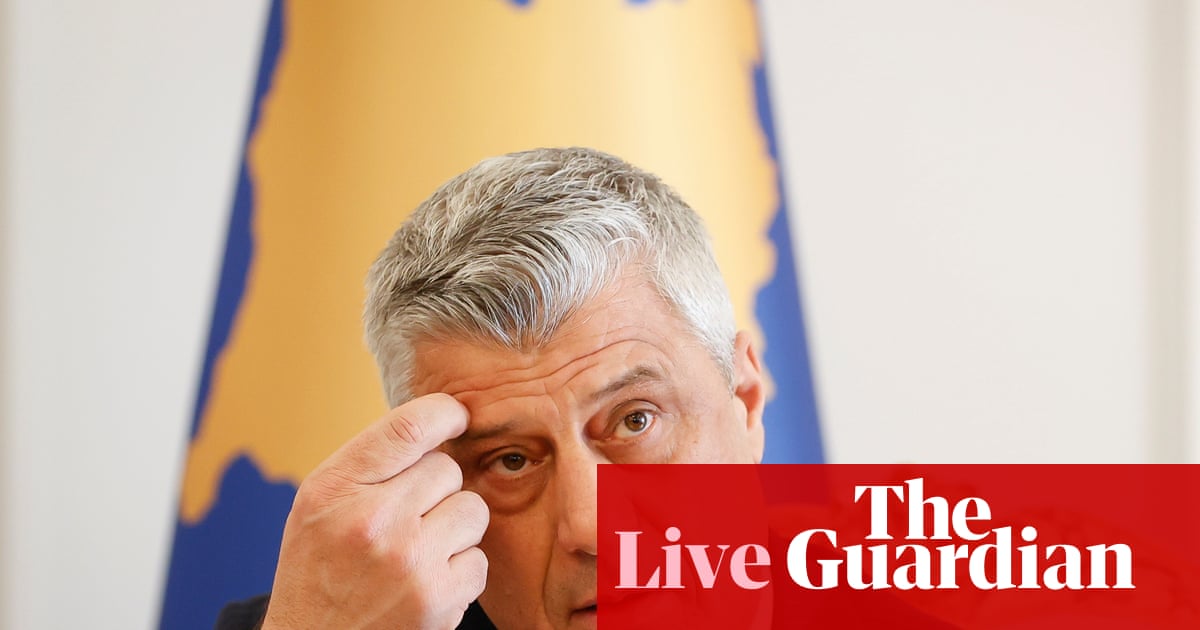
FormerKosovo Liberation Army commander and later Kosovo president Hashim Thaçi has been sentenced to 25 years in prison as he is held criminally responsible for war crimes during the violent break from Serbia in the 1990s by the international court in The Hague.
Thaçi had denied all charges.
I will bring you more on this shortly.
“As prosecutors presented their case against Thaci and fellow defendants Rexhep Selemi, Kadri Veseli and Jakup Krasniqi – all senior figures in the KLA’s leadership during the war against Serb forces from 1998 to 1999 – they described an alleged campaign of murder, torture and repression against opponents and members of ethnic minorities directed by the four men. …
The proceedings, deeply unpopular in Kosovo and neighbouring Albania, recall the period of brutal conflict between 1998 and 1999 where both Serbian and Kosovan armed organisations committed war crimes in the context of the KLA’s armed uprising and Belgrade’s military response.
His supporters gathered in Kosovo earlier today to listen to the verdict:
And, on that note, we will be closing the blog for today.
FormerKosovo Liberation Army commander and later Kosovo president Hashim Thaçi has been sentenced to 25 years in prison as he is held criminally responsible for war crimes during the violent break from Serbia in the 1990s by an international court in The Hague (11:33, 16:01).
It found that Thaçi “was a key member” in the Kosovo Liberation Army andeven “personally participated in crimes,” despite his denials (11:56).
The decision of the tribunal was deeply unpopular in Kosovo, where people booed the verdict and chanted in support of their former leader (12:40), while some of his supporters even briefly clashed with police in The Hague (13:11, 14:45).
European Commission president Ursula von der Leyen has warned the EU is “the strongest” but “most precarious” it has ever been as it faces “an openly hostile world”, as she floated the idea of Canada getting an “associate membership” of the bloc (10:42, 11:04).
There is no existing legal structure that would allow for that move, leaving lots of questions over what that would actually entail (16:40).
Carney is set to address the European parliament on Thursday (11:13), after visiting the UK this evening to watch his beloved Everton play in the third round of the Carabao Cup (13:28).
In a wide-ranging speech, von der Leyen also announced proposals to ban social media for children under 13 as she warned their omnipresence were “depriving children of their childhood.”
If you have any tips, comments or suggestions, email me at jakub.krupa@theguardian.com.
I am also on Bluesky at @jakubkrupa.bsky.social and on X at @jakubkrupa.
Left-leaning opposition retains lead as Sweden counts last remaining ballots
Final votes are being counted in Sweden, with authorities reporting some 300,000 early and overseas ballots.
The left-leaning opposition remains ahead with a projected 176 seats in parliament, compared with 173 for the governing right-leaning coalition and the far-right Sweden Democrats.
But the gap between the two blocs remains razor-thin – under 27,000 votes – with only 1.3% of districts yet to submit their results.
Swedish public broadcaster SVT projects that one seat could still shift, but no more than that, which would leave the opposition as the formal winners of the election.
Party leaders on both sides suggested that any formal talks about what’s next would only start once the final results are in – and both leaders, the incumbent prime minister Ulf Kristersson and opposition leader Magdalena Andersson, hinted that they would be keen to have a go at forming the next government.
What could 'associate EU membership' for Canada mean in practice? - analysis
Taking the European Commission president Ursula von der Leyen’s offer of an “associate membership” for Canada, our Brussels correspondent Jennifer Rankin looks at what it could possibly mean in practice.
“The 27-member EU has never had an associate membership category, although it has close ties with Norway, Iceland and Switzerland, allowing deep economic integration with these countries, who follow many EU rules. It remains to be seen what associate membership means, including for Canada’s relationship with the EU single market.
When the UK was negotiating its departure from the bloc and post-Brexit relationship, EU officials repeatedly said there was no status that enabled a foreign country to be half in and half out of the single market. The EU also staunchly defended unpicking the four freedoms of its internal market – freedom of goods, services, people and capital.
Sore points likely to be addressed include 10 EU member states, including France, Poland and Italy, having failed to ratify the EU-Canada trade deal, nearly 10 years after it was struck in 2016.
The offer of associate membership is certain to raise questions among other EU allies, including the UK, which has long sought a more flexible approach from Brussels.
Martin Leng at the Brussels Institute for Geopolitics thinktank said a world in flux was “pushing the EU towards far greater flexibility in its relations with third states”.
He said von der Leyen’s speech, with its focus on different sectoral areas of cooperation “points to the ambition and strategic breadth of the associate membership which the parties have in mind but also suggests that, in reality, Canada’s ‘membership’ may consist of ‘plugging in’ to existing programmes and frameworks, such as the European Defence Agency, rather than joining the union in any traditional sense”.
German state leaders rally behind Friedrich Merz amid doubts over his future
Powerful German state leaders from Friedrich Merz’s party have rallied behind him as speculation builds that his days in office may be numbered.
The chancellor’s hold on power has looked increasingly shaky since a bombshell regional election result earlier this month in which the far-right Alternative für Deutschland (AfD) party routed his Christian Democratic Union (CDU) party in Saxony-Anhalt.
With two more states heading to the polls on Sunday where the AfD is expected to perform well, Merz cancelled a plan to speak at the UN general assembly in New York next week because “his presence is required in Berlin”, a government official said on condition of anonymity.
The announcement triggered fresh rumours that the unpopular chancellor could be preparing his own exit or wanted to remain and fight off a potential coup. With Merz on the ropes after just 16 months in office, eight state premiers from the CDU issued a surprise joint statement backing him.
Citing the threat posed by nativist parties across Europe, they wrote: “Now more than ever, Germany’s political landscape needs stability”, pointing to elections in Poland, Italy, Spain, Greece and France next year in which the political establishment faces a far-right challenge. “The path to restoring public trust in Christian Democrats lies in listening and taking political action, not in debates over personnel.”
They added that Germany needed “reliability and decisive action” and, as state leaders, “we want to, and will, do our part to achieve this together with the chancellor”.
The signatories included leaders who have been mentioned as possible Merz successors, such as North Rhine-Westphalia’s Hendrik Wüst. Markus Söder, the Bavarian premier and an ambitious conservative populist, has also said he was backing Merz.
It remains to be seen how long the demonstration of solidarity with Merz will hold, with much depending on the outcome of the weekend elections. Polls indicate voters are very likely to punish the CDU again in the states of Berlin and Mecklenburg-Western Pomerania on the Baltic coast, amid widespread dissatisfaction with Merz’s federal coalition government formed with the Social Democrats.
Back to Thaçi’s sentencing in The Hague, here is our senior international correspondent Peter Baumont’s take on today’s events.
“Known by the nom de guerre of Commander Snake during the war, Thaçi stood out among the KLA leadership as an intelligent and articulate figure who would later charm diplomats – most notably the US secretary of state Madeleine Albright – at the negotiations in Rambouillet that ended the conflict.
But behind the self-assured image he projected as a senior political figure, he was long dogged by allegations of a darker and more ruthless side from his time as a wartime commander.
Thaçi’s defence partly rested on the notion that while serious abuses did occur, the KLA was a not a strictly centralised organisation, claiming that Thaçi’s senior position in the rebel group did not indicate culpability for crimes committed by local units.
“Throughout my life, I stood with the people of Kosovo defending freedom, life and dignity. I was always guided by the western ideals of democracy, equality and justice,” Thaçi told judges in February.
The trial was opposed by many in Kosovo. Outside the court, Kosovo foreign minister, Glauk Konjufca, told the media: “A terrible judgment for Kosovo, for our liberation war. It is a sad, unjust, undeserved decision.”
Burnham assures Rutte 'there has been a change of prime minister, but never any change in commitment to Nato' as they meet for talks on defence
Well, that wasn’t terribly exciting – and lasted under two minutes.
Burnham said he just wanted to make sure Rutte knew that “there has been a change of prime minister, but never any change in the UK’s unwavering commitment to Nato and our Nato obligations.”
Rutte said the UK remained “one of the leading forces in Nato,” and he thanked Burnham’s team for being “totally invested in the organisation and the need to stay as strong as possible.”
The pair will talk about defence spending, and associated “societal dividend” – that’s diplospeak for job and economic growth resulting from these investments, Rutte said.
Belarus frees 25 prisoners in exchange for US lifting some sanctions
In other news, Belarus has agreed to free 25 prisoners in return for a further easing of US sanctions, an envoy for president Donald Trump said.
Reuters reported that the deal was part of lengthy negotiations, under way since last year, in which Washington is urging Belarusian president Alexander Lukashenko to free hundreds of people including human rights campaigners, political activists, journalists and lawyers in return for sanctions relief.
“We agreed to an interim deal, and as a show of goodwill Belarus will release 25 people and in exchange the United States will lift sanctions on two companies,” Trump’s envoy, John Coale, told reporters in the Belarusian capital Minsk.
The figure of 25 releases was much lower than the 250 that Coale negotiated when he last visited Minsk in March, Reuters noted.
In April, the US broked a deal leading to the release of 123 people, including Polish-Belarusian journalist Andrzej Poczobut.
Coale said both sides would work to resolve outstanding issues to pave the way for more prisoners to go free and further sanctions to be removed.
“I hope hundreds (are released). I don’t know. That’s my hope,” Coale told Reuters of his next planned trip to Minsk.
Exiled Belarusian opposition leader Sviatlana Tsikhanouskaya said the 25 had been safely brought to neighbouring Lithuania.
She posted a video welcoming the 25, with a caption: “Thank you John Coale!”
The Thaçi verdict comes at a striking moment for the former Yugoslavia. Just days ago, thousands of people gathered in Belgrade to mourn and celebrate Ratko Mladić, the former Bosnian Serb military commander convicted of genocide, crimes against humanity and war crimes.
As Ana MilosavljevicandOliver Holmeswrite in this report, the convicted war criminal was given a “hero’s funeral” on 7 September, complete with military honours, while Serbia’s Orthodox patriarch spoke of the “deep sense of gratitude” felt towards him by many Serbs.
Both Thaçi and Mladić continue to be regarded as heroes by significant sections of their respective communities (Thaçi by many Kosovo Albanians, and Mladić by many Serb nationalists) illustrating the deeply divided ways in which the wars of the former Yugoslavia are remembered.
Back to HashimThaçi’s sentencing, the former Kosovan president who was handed a 25-year prison term after being found guilty of war crimes, we have a brief statement from Amnesty International. Its deputy director for Europe, Esther Major, said:
These convictions give hope to thousands of victims of the Kosovo war who have waited for more than two decades to get justice for the horrific crimes committed against them and to know the fate of their loved ones.
These convictions show that senior officials are not above the law.
These verdicts give hope that any attempt to obstruct justice, truth and reparation will not be tolerated, and that the victims and relatives of the missing will finally see justice.”
As commander of the Kosovo liberation army (KLA), Thaçi led its violent independence fight against Serbia in the 1990s. He was sentenced alongside three other top commanders of the now-disbanded KLA at a special tribunal in The Hague, known as the Kosovo specialist chambers, for war crimes including arbitrary detention, torture and murder.