 Firstpost ·
The long night of Bengal’s Hindus: Persecution in the East, amnesia in the West
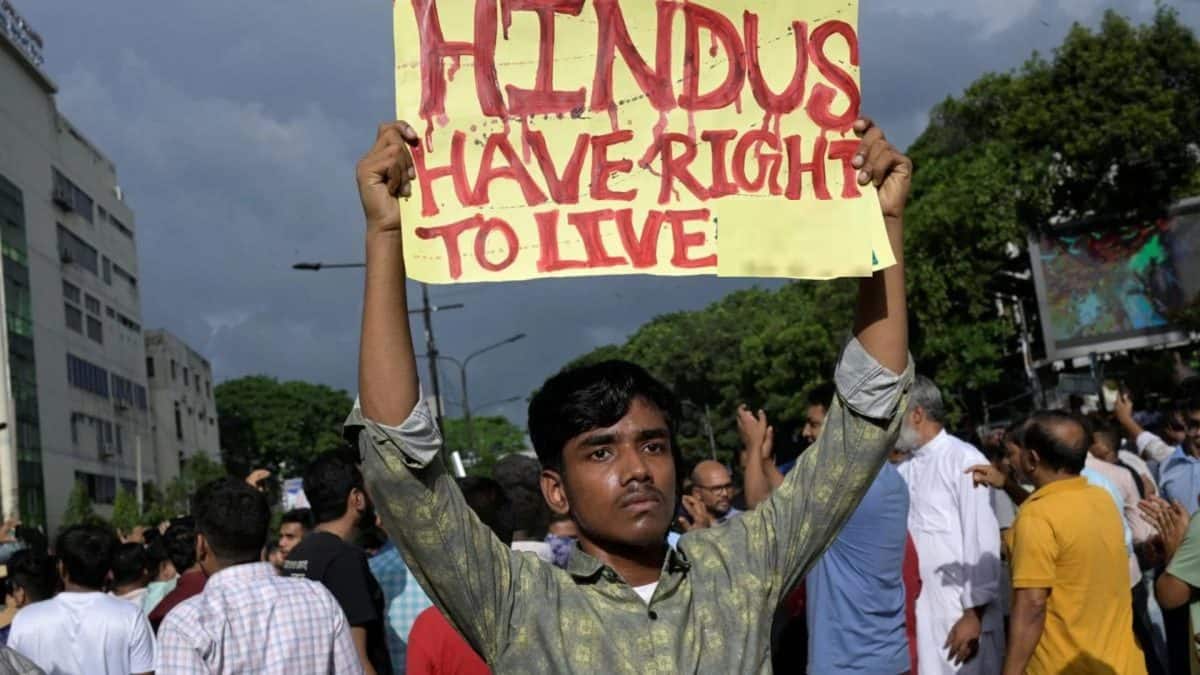
As Hindus in Bangladesh face persecution and displacement, West Bengal cannot afford historical amnesia
What time of night is it? There is no answer.
In truth, this is nothing new. It is the relentless persecution of a Hindu Bengali on the eastern side of undivided Bengal — a saga spanning 125 years.
In 1906, a letter from a Hindu revolutionary in old Chandpur revealed that League leaders Suleiman Sheikh and Jahir would hold his sister captive until he desisted from the movement to annul the Partition of Bengal. They threatened not merely captivity, but unspeakable acts — and they carried them out.
Police archives contain records of 178 such incidents documented in letters.
The year was 1946, in Srihatta (Sylhet). Belal Shah and Naved Khan — one a Bengali and the other a Bihari Muslim League leader — abducted the 19-year-old daughter of a middle-aged Hindu Mahasabha leader. The condition was simple: the girl, Nila, would be ravaged until the Mahasabha leader converted.
He did convert to Islam. Yet Nila did not survive. After 20 days of torture, when her father emerged post-conversion, the liberated girl said, “Father, I could have endured a little more, but you — a priest in the temple of Sri Prabhu — what have you done?” She then succumbed to death — the very life he had converted to save.
In truth, whether it is Nila from the day before yesterday, Hari from the day before that, Dipu Das from yesterday, or Chinmoy Krishna Das today — none of this is new. It is because the Hindu Bengali has lost both muscle and sword. The reasons are manifold. In East Bengal, which after Partition became East Pakistan, and post-1971 Bangladesh, daily existence means surviving as a soulless Hindu.
I, too, have become merely a spectator. My sleep might be disturbed for a night or two by the anguished cries of Sandhya Rani Dhar and her son, Chinmoy Das — that is all. Like tonight, or perhaps tomorrow night. Then I shall forget. I shall wear a mask and speak up for Hindus. Yet, when I look at myself in the mirror, I feel nauseous.
I shall forget these 125 years — the fierce struggle and sacrifice of the Hindus of East Bengal against British imperialism and Islamic fundamentalism. I shall forget the history — and the present reality — of the murders, rapes, looting, displacement, hostage-taking, etc., that defined their lives. For the past 70 years, the Hindu Bengalis of West Bengal have forsaken their brethren and ancestors, aligning themselves with causes in Gaza, Palestine and Iran. They have forgotten their lineage, their parents, their history, and the atrocities inflicted upon their own people — neglecting to stand by them. They choose to ignore the genocide of one of the world's largest communities and the mass exodus that has persisted for 80 long years. This is what passes for modernity, secularism, and the seductive, Soviet-style mantra of progressivism.
The Bengali Hindu has forgotten the path to liberation and the means of redress. The ‘Gen Z’ Bengali Hindu — descendants of those who once wielded daggers, swords, lathis, and guns at the local akhara or Kali temple — now live in amnesia. In coffee houses and university canteens, they spout rhetoric about Gaza, Nicaragua and Kashmir. But they fail to recognise that the relentless assault on Hindu culture and philosophy — orchestrated by ‘Leninist-jihadi’ scripts — is merely the latest act in a drama that has played out for 60 years. Consequently, they remain blind to the savage.
Bangladesh has become a slaughterhouse for Hindus, and we do nothing to challenge it.
How late is the hour? There, again, is no answer.
(Arindam Bhattacharyya has been a Professor at Calcutta University for the last 20 years. The views expressed in the above piece are personal and solely those of the author. They do not necessarily reflect Firstpost’s views.)