 Scroll.in ·
Why parents prefer private schools over government schools – despite similar learning outcomes
Conversations in Tamil Nadu provide a snapshot of the fears and hopes that are driving Indian parents to move their children away from government schools.
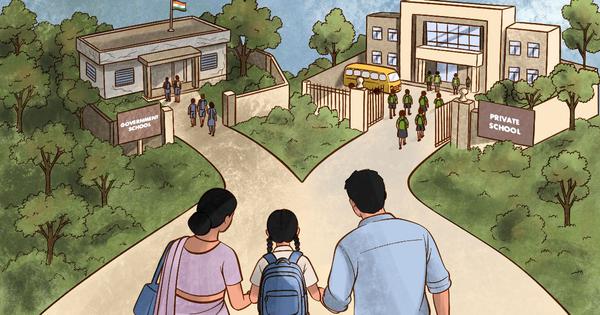
Balakrishnan V, a 44-year-old auto driver, has lived in the same locality all his life, an area predominantly occupied by low-income households, in Tamil Nadu’s Salem district.
Balakrishnan has four children: a son and three daughters.
The older two attend private schools. The son, who is in Class 11, is enrolled in a school that charges around Rs 50,000 a year. Balakrishnan’s eldest daughter, a Class 8 student, pays fees of around Rs 20,000 per year.
In contrast, the other two children study for free. His third child studies in a government-aided school and his fourth studies in a government school.
Balakrishnan would have liked to send his younger children to private schools also, but the fees for the first two are already a huge burden on the family. He explained that sometimes they have to even take loans to pay them.
But he has no doubt about the kind of schools he prefers. “Teachers are a lot better in private schools,” he said. “They pay more attention to individual students, and that will eventually help the child prepare well for their future as well.”
Such a preference among parents is reflected in attendance at the neighbourhood government school, where Balakrishnan studied as a child. He recounted that when he was there, the school had between 200 and 300 students. Today, it has only 30 students.
Balakrishnan’s neighbour Preetha also believes that children are better off in private schools. Her daughter used to study in a government school, but now studies in a private school. Preetha’s husband died years ago. She only has her earnings as a domestic worker to manage her expenses and her daughter’s fees of about Rs 50,000 a year.
This is a strain but she and her family say that only a private school education will guarantee her daughter a chance of landing a good job.
A key reason for this, Preetha said, is that teachers in government schools have assured salaries, so do not have any pressure to ensure that their students perform well. But as Preetha’s mother explained, “…If the child is not studying well, we can question private school teachers because we are paying fees.”
Balakrishnan, the auto driver, echoed this contention. Government school teachers “just come and teach but it’s up to the student whether or not they want to learn”, he said, “There is no pressure to push students to perform.”
Their perceptions are at odds with the findings of a recent study on low-fee private schools in Tamil Nadu. Researchers from the Centre for Public Policy and Research analysed the academic performance of students in Classes 3, 6 and 9 across several categories of schools and found that “once socio-economic factors, household characteristics and parental education levels are taken into account, the learning differences between government and private schools become minimal”.
In fact, when it came to primary education in the state, the study found that government school students showed better outcomes than private school students. Specifically, Class 3 students of state government schools and aided schools, as well as central government schools, performed better in both maths and languages than their counterparts in private schools.
The study noted that a key problem private schools struggled with was the quality of teachers. “There is a lack of teacher motivation; few are entering the profession owing to low salaries,” it noted. “Low-fee schools, especially, cannot afford to pay a lot to qualified teachers.”
In fact, other research also found that among teachers it looked at, government-school teachers were more qualified. A 2018 paper by Azim Premji University, on school choices in “low-information environments” studied 121 public and low-fee private schools and 1,210 families, in 10 districts across four states and found that 64% of public school teachers had a postgraduate degree, while only 44% of teachers from private schools had a postgraduate degree.
Preetha’s daughter, disagreeing with her mother, said she preferred her government school teachers, instead of the teachers she now has in the private school. “They taught us better,” she said. “These teachers don’t teach us properly. The one difference is that I speak English better now. But with regard to other subjects, I think the government school was better.”
And yet, data shows enrolment in private schools continues to grow even as government school enrolment declines. What is driving this shift to private school education in India? We looked for answers in Tamil Nadu, a state where around half of all school students now study in private schools.
Many parents Scroll spoke to cited surprising explanations for their preference for private schools. The conversations provided a snapshot of the fears and hopes that are driving Indian parents to move their children away from the government school system and into private schools.
This story is part of Common Ground, our in-depth and investigative reporting project. Sign up here to get the stories in your inbox soon after they are published.
The state of India’s government school system has been in the headlines ever since the Cockroach Janata Party recently launched its School Thik Karo – Fix the Schools – campaign. Fresh from their success at leading youth protests against the Modi government in Jantar Mantar, the activists of the new political outfit visited schools across the country including Rajasthan and Maharashtra in July and August. Videos from these visits showed a range of problems in these schools, including shortages of teachers, crumbling infrastructure and poor hygiene.
For many, these accounts from the ground are enough to explain why Indian parents’ preference has been shifting towards private schools.
In 2023-’24, government schools had 35.21 crore students enrolled in them, while private schools had 15.67 crore students. Within two years, the number of students enrolled in government schools fell to 32.48 crore, while private school enrolment shot up to 26.07 crore. (This period also coincided with a trend of students returning to private schools after families in economic distress during the Covid-19 pandemic shifted them to government schools.)
Currently, according to the Unified District Information System, which collects and maintains information on the public and private school system in India, 51.9% of students in India are enrolled in private, government-aided schools and “other schools”, while 48.1% are enrolled in government schools.
In contrast, in most Western countries, public schools form the bulk of the school systems. In the United States, for instance, only around 10% of students go to private schools, while in the United Kingdom around 7% do so.
While the term “private school” usually evokes an image of elite institutions that charge several lakhs in fees, these form only a small fraction of schools. A large proportion of the India’s private schools are of the kind that Balakrishnan and Preetha’s children study in, which charge much lower fees and cater to low-income or lower-middle income families.
These schools are referred to by educationists and researchers as low-cost or low-fee private schools, often defined as schools where monthly fees range between Rs 400 and Rs 3,500.
According to the Ministry of Statistics and Programme Implementation, 70% of students in private schools paid less than Rs 1,000 per month as fees.
In Tamil Nadu, too, a large number of private schools fall in this category. A 2026 paper on private schools in the state noted that “77.4% of schools in Tamil Nadu charge less than Rs 20,000 per year” and this includes “35.6% charging between Rs 5,000 and Rs 10,000, and 38.5% charging between Rs 10,000 and Rs 20,000”. At the higher end of the low fee private schools were those that charged between Rs 30,000 and Rs 50,000 per year, which made up 6.8% of the total.
On the face of it, data on the number of schools in the state, often lauded for its public schooling system, does not reflect a shift towards private school education. The total number of government schools in the state is 37,478, compared to 11,638 private unaided schools.
But student enrollment numbers tell a different story, more in keeping with trends across the country: according to Unified District Information System data, 46 lakh students are enrolled in government schools and 62 lakh are enrolled in private schools.
In some areas, the difference is stark. For example, in Tamil Nadu’s capital, Chennai, 1.64 lakh students are enrolled in government schools and 8.3 lakh students are enrolled in private schools. In Salem district, though only 20% of schools are private, around 2.75 lakh students study in them, while around 2.45 lakh study in government schools.
“It is understandable that parents don’t want to send their children to government schools, we cannot blame them for it,” said Prince Gajendra Babu, general secretary of the State Platform for Common School System Tamil Nadu. “The government has pushed parents to private schools, by refusing to invest more and run government schools better.”
Parents cited more complex reasons for their choice.
Balakrishnan, for instance, said better communication was one reason parents preferred private schools. “In private schools they call us frequently, if a child is sick, they will call and tell us, but government school teachers don’t do that,” he said.
Preetha’s family, meanwhile, explained that they felt reassured by the hours that private schools maintained, a sentiment that other families also echoed. “When she was in the government school, she would come back home early. Now she comes back very late,” Preetha’s mother said. “The teachers keep the children back after school and do extra coaching, so we know that the child is studying.”
Christuraj S, a child rights activist based in Salem said many parents told him they preferred private schools because they seemed safer. “A van comes and picks the kids,” he said. “If the child goes to a government school, they have to rely on the bus, which they deem unsafe.”
Babu, meanwhile, characterised the shift to private schools as part of a larger shift towards exam-oriented schooling, in response to which many of these schools began to advertise 100% pass rates. “Government schools never had 100% pass rates initially,” he said. “Kids would fail but pass in the supplementary exams, and then go on to do great things in their life.”
He added, “Exams weren’t everything, but learning was crucial, today that has changed.”
Among the surprising insights that many parents offered in conversations with Scroll was that they saw schools close to their homes as undesirable for their children.
This attitude presents a contrast with the direction of government policy on the matter – under the Right of Children to Free and Compulsory Education Act, 2009, it is mandatory for the government to ensure that children at the primary level have a school within a one-kilometre walking distance of their homes.
But 43-year-old Krishnamurthy A, an electrician who also works as a preacher and lives in the same locality as Balakrishnan, explained that he was wary of the social environment in the vicinity of his home, which has a government school within a kilometre. He said that he often finds boys and young men who use “bad words” loitering outside the school. “I cannot bear to hear the kinds of words they use,” he said.
He also said that there were problems of violence and drug abuse among youngsters in the area. “Since my wife is a nurse, a lot of children go there for treatment, and I hear very bad things about what the children are up to,” he said.
Thus, Krishnamurthy has chosen to send all his three children to different private schools, which are more than 5 km away, even though the family often has to borrow money to pay their fees. “Money will come and go but my children’s education is of utmost importance,” he said.
He hopes that this decision will be a step towards ensuring that his children can grow up and move out of the neighbourhood. “I wanted them to go to a school that is far away from this area,” he said. “And I hope they find a way to get out of here.”
Another fear loomed large over Krishnamurthy, one that was rooted in his own experience of studying in a government school: that his children would always be identified by their caste identity if they went to a nearby government school. “It’s because I know what that experience would be like,” he said. “I don’t want my children to face the same issues I faced.”
He recounted, “My teachers always identified me with my community. No matter what I did, I was the student who was from a lower caste.”
Indeed, Nandamma, a neighbour who is identified by a pseudonym for the story, said that her son, who went to the neighbourhood government school, faced discrimination in the classroom. “He would study well, but the teachers would say, ‘Oh even though you are from the cheri, you are studying well,” she said, referring to a derogatory term for a marginalised community settlement. “They always treated children who went from this area in an inferior manner.”
This problem extended even to activities outside school, the family explained.
Nandamma’s sister explained with pride that her daughter, who is now in the second year of her engineering degree, had learnt bharatanatyam, and had even had her inaugural performance – but for her training, the family had to find her a teacher far away from their residence. “We tried to find teachers nearby but because they knew where we were from, they knew what caste we were,” Nandamma said. “They did not allow her to attend classes.”
Parents also cited a range of other factors that guided their decision to send their children to private schools. Some, for instance, said they felt that the number of teachers in government schools had declined, as had their skill and enthusiasm.
Balakrishnan noted, for instance, that in the government elementary school in his locality, there were currently only two teachers for the 30 students. He recounted that earlier, government school teachers would go from house to house, urging families to enroll their children in the neighbourhood school. “But now nobody comes,” he said.
One government school teacher at an elementary school agreed that there had been an overall decline in the number of teachers in public schools – a key reason for this, she said, was that students had begun to opt for private schools in larger numbers. She recounted that when she joined 15 years ago, the school had a few hundred students. Today, they only have 30 students and two teachers. “According to the education policy, there must be two teachers for 30 students, so there are only two postings here,” she said. “The teachers we had got transferred to other schools.”
But this smaller number of students is also spread out across several grades – thus, teachers are forced to teach two or three grades simultaneously during a single period. “We also have both English and Tamil mediums at the school, so we have to speak once in one language and then in the other,” she said.
The teacher, who spoke to Scroll on the condition of anonymity, echoed Krishnamurthy’s reasoning for parents’ decision to opt for private schools. “They feel if a child goes to a school far away, they will get better education.”
Another key reason parents cited for preferring private schools is that most were English medium, whereas most government schools use the local language as the medium. “Parents feel English medium schools are better,” the teacher said.
Nandamma’s niece explained that though she and her schoolmates had found “decent jobs” after studying in government school, “because I don’t know English, I lose out on so many opportunities and I also struggle with simple tasks that I’m supposed to do in English”. She added, “Even during placements, government students lose out because we have not studied in English medium schools.”
These include opportunities outside the state. “If children only study in Tamil medium, then they will only be able to get jobs within Tamil Nadu, but if they want to go outside Tamil Nadu, or India, they need English,” Nandamma said. “Private schools also offer Hindi. It’s good for students to learn an extra language.”
Many also noted that children were exposed to more extracurricular activities at private schools. Balakrishnan recounted that in the past, government schools also offered these activities. “There would also be small programmes and festivals, fancy-dress competitions on Independence day,” he said. “But nothing of that kind happens these days either.”
Nandamma echoed this observation. “In government schools, there are hardly any activities for students, but private schools have such a wide range of activities,” she said. “Academics is just one part of school, it’s important to learn other things as well.”
Elsewhere in Salem district, some of the concerns about government schools were even more pronounced.
In the semi-urban area of Omalur, for instance, Ramya R, a parent of two children who study in government-aided private schools, said that the elementary government school in her neighbourhood was in such a dilapidated condition that she sometimes spotted snakes near it. “There’s no compound around the school either,” she said. “We’ve noticed all this when we have gone there to vote. It’s falling apart.”
In the same neighbourhood, the parents of a joint family of six, with three children, send all of them to a private school – their rationale echoed other parents’ desire that their children move out of the circumstances they were born into. “I feel so happy when I see her in a full neat uniform with proper shoes. I didn’t have that,” said the father, Surya Prakash, said about his eight-year-old daughter, Yashika. “I would be treated badly because I could not afford to wear shoes.”
The mother, Viveka, said, “When I was in school, I had to go home to use the toilet, and the food used to be terrible.”
At this, Yashika chimed in. “But I prefer the government school,” she said. “I don’t want my parents to struggle to pay my fees.”
Around 60 km away from Salem city, in the rural area of Attur taluk, locals told Scroll that many of the private schools in the area had come up only in the last few years – nevertheless, many preferred these schools, and cited similar rationale as their counterparts in the urban parts of the district.
Among the main reasons the parents preferred private schools here, too, were that they were English medium. “English is more important today than ever,” said one parent in the town of Yethapur, whose daughter is in upper kindergarten. “They need to be able to speak to get good jobs.”
In fact, the desire for an English-medium education was so pronounced that some parents said they only intended to enroll their child in a private school for as long as they needed to learn it. One mother, A Jayapradha, said that she planned to enroll her daughter in a private school until Class 5, because by then she would have mastered English. “Once they learn English well, then they can join Tamil medium school in high school,” she said.
Other parents had also planned to enroll their children in private schools up to Class 5, and cited better safety and attention from teachers as key factors for this decision. Another mother said, “The child is too young to manage on their own. Government school kids are usually left on their own in the schools.”
In these parts of the district, too, the cost of these schools was a major concern for parents.
Uma Maheshwari, who lives with her husband and two children in Yethapur, explained that their son studies at a private school that charges around Rs 30,000 a year. Maheshwari’s husband works as an accountant and the family is struggling to make ends meet.
As a result, their son’s education had seen a rocky path. During the years of the Covid-19 pandemic, the couple were forced to shift their son from a private school to a government school, because they could not afford his fees.
However, they were unhappy with their son’s performance in the government school, and shifted him back to a private school when they could afford it again. “He had learnt so much at the private school that he was in and then he forgot everything when he went to the government school,” she said. “I would check his notes too and felt like the teachers were not teaching well.”
Despite parents’ strong preference for private schools, conversations with them and teachers specifically about children’s academic performance revealed a more complex picture, which suggested that students were not necessarily assured a better education in the private schools.
This was reflected in the study by the Centre for Public Policy and Research on low-fee private schools in Tamil Nadu.
It found that while both categories of schools displayed “persistent gaps in student proficiency”, “private schools do not demonstrate a consistent or significant advantage over government schools, particularly in foundational literacy and numeracy”.
The principal of a government-aided school in Salem city said that she felt that these results corresponded with her experience. The management of her school also manages a private school. “So I know the kind of students who study there and study here,” she said.
The principal, who asked not to be named, said that she found that when students from the aided school decided to move to the private school, they had no difficulties catching up. “But students who come from there know very little. They struggle with basics,” she said. “It’s because the teacher quality is so poor.”
She argued that government-school teachers were often more qualified and skilled. “The teachers who come here are paid good salaries from the government and they are very experienced and are highly educated,” she said.
She added, “Private schools charge high fees, but don’t pay their teachers, and they don’t have any experience. And so the child learns nothing.”
Some parents’ accounts also reflected these observations on academic performance. Most who had children enrolled in private schools told Scroll that their children were average academic performers, and that they would attempt to discuss their worries with their teachers. “Sometimes they’ll tell us to send him to tuition, but we cannot afford it,” Maheswari said.
Balakrishnan said that his last daughter, who is enrolled in a government school, is happy to continue there and doesn’t want to change to a private school. In fact, he explained with pride that she “was studying very well in Tamil medium” and that her teachers had told them to shift her to an English medium government school. “She’s a very smart child,” he said.
The Azim Premji University study also suggested that the basis for parents’ preference for private schools was not always sound. “Data told us that there are mismatches between parental perceptions and school realities,” it stated. In large part, it observed, this was owing to private schools’ emphasis on marketing themselves heavily. “Most private schools organised systematic enrolment drives to generate admissions. These drives advertised safety elements like conveyance, CCTV cameras,” the study said.
Babu agreed with this assessment. “All private schools do is advertise,” he said. “It’s all marketing.”