 Firstpost ·
Beyond the Lines | Greatest battle: How a tennis court in Nagaland decided the end of World War II
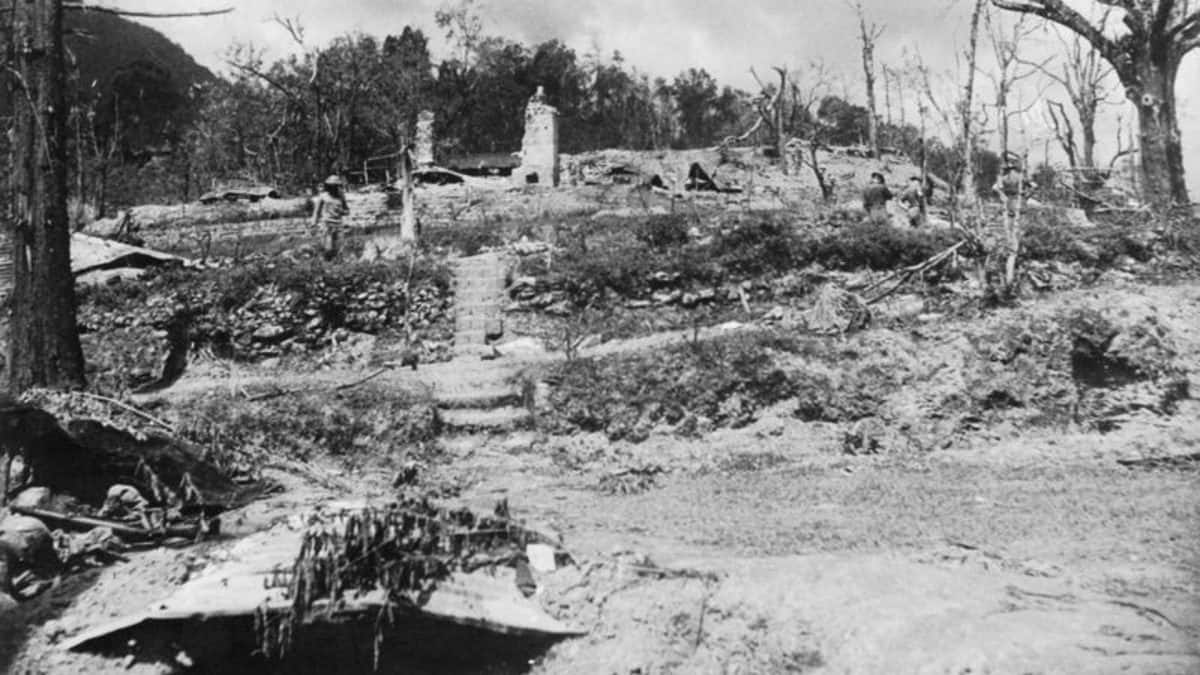
The Battle of the Tennis Court is sometimes called the Battle of the Cherry Tree, since the historic tree marks the last point of the Japanese advance.
There is a flowering cherry tree on a quiet slope atop a busy Kohima road. The tree holds an astonishing story. Close to it is the grave of Major MJ Johnson that captures the essence of the tale. Let us revisit this tree and the grave at the end of this piece.
When the history of World War II was written, most Western historians believed that the battles of Stalingrad and El Alamein turned the tide in favour of the Allies. Even the catastrophe at Dunkirk became a British badge of defiance. However, the outcome of the war, especially in Asia, was decided on a tennis court in India.
Upon a ridge in the hills of Kohima in Nagaland stood a routine tennis court that would turn into a milestone of history. Earlier, the events leading up to the exchanges on the court involved fierce battles in the jungles and rocky terrain of Imphal and Kohima along the India-Burma border. The Imperial Japanese Army planned to enter India and wrest control from the British. By pushing back the British and Indian troops in Burma, they had built the right momentum.
In March 1944, the Japanese Fifteenth Army juggernaut rolled into Imphal, aiming to capture supplies and strengthen logistics to go deep into India. They cut off the Imphal-Kohima road and overwhelmed the defences around Kohima as Indian and British soldiers struggled to hold on to their positions. By early April, they managed to isolate Kohima from the surrounding plains and, more importantly, put the Allied forces on the back foot. Thereafter, the Japanese set out to annex the isolated hill town of Kohima.
Here’s where it gets interesting.
Garrison Hill in Kohima was a high ridge which comprised the Deputy Commissioner’s bungalow and a tennis court on its slopes, above a road that connected Dimapur to Imphal. Having pushed back the British Indian Army, the Japanese needed to capture the key hill to annex Kohima. The indefatigable Japanese suffered losses as they advanced but kept climbing the hill. The British Army defended the lower slopes but ultimately wilted under relentless attacks.
When the advancing Japanese captured the Deputy Commissioner’s bungalow on the slope, the defending troops retreated to a higher point on the ridge: the tennis court. The two sides were now at handshaking distance, separated by the court, but kept firing at each other. The Japanese pressed hard throughout the night of April 9, as Gorkha, Indian and British troops occupied hurriedly dug trenches against ground attacks and artillery shelling. A fierce fight ensued.
While the 4th Royal West Kent battalion of the British Army bore the early onslaught of the Japanese on the tennis court, Indian battalions of the 161 Brigade fought tirelessly, stumbling to join the defences and retrieve the situation. Soldiers of 1st Punjab took on the Japanese at the perimeter of the ridge before launching counter-attacks on Garrison Hill.
The two rival sides were in trenches on either side of the tennis court. Indian soldiers fought alongside each other. The 1st Battalion of the Chamar Regiment was in direct combat, while Indian Sappers braved mortar fire to dig trenches and fortified bunkers to keep the enemy at bay. The 1st Battalion, Assam Regiment, with a medley of Mizo, Naga and Assamese troops, initially defended Garrison Hill on another slope, but as fighting grew intense on the tennis court, these men from India’s north-eastern hills waded into the Japanese Army.
Rattled, the Japanese hit back instantly. Artillery and mortar fire rained on the tennis court and the area around it, beefed up by infantry attacks. The two sides clashed in ferocious hand-to-hand combat, where Indian riflemen, engineers and British troops engaged in deadly, medieval-style combat against the Japanese, shooting at each other from close range, twisting their bayonets into enemy stomachs, lobbing grenades into trenches and, when all was gone, pouncing on each other. It was a frantic fight to the finish.
By the time the fight ended, the Japanese advance had been halted. They made a final attempt to capture the hill, but the British artillery was waiting for them. On April 18, the skies opened up and shells rained on Japanese positions, leading them to scamper and backpedal. Fighting stopped since the Japanese had run into an unexpected fortress. On the other hand, confidence was restored as the British 2nd Infantry Division broke through Japanese pickets on the Dimapur-Kohima road, clearing the route.
The Battle of the Tennis Court has been variously described as a grinding, savage, exhausting affair on the unusual and modest battleground of a tennis court. The battle also brought to the fore the heroism of Nagas, Assamese, Gorkhas, Rajputs, Punjabis and Sikhs, who showcased the syncretic nature of one of the world’s most inclusive armies. Several Indian units thus played their roles in ensuring the beginning of the end of the war.
The outcome at the tennis court changed the momentum in the Battle of Kohima. Kohima ensured the biggest defeat in history for the Japanese Army and damaged its military capability. The British Indian Army, on the other hand, reconquered Burma from the Japanese and regained its confidence.
The Aces Who Stayed Back at the Tennis Court
Today, the silent ridge overlooks the busy Kohima road, filled with lines of vehicles patiently making their way around town. A war cemetery near the tennis courts tells us a story long buried and forgotten. Rows of graves of Indian and British soldiers remind us that thousands died here, mostly young. Teenager Kharka Bahadur Gurung of 5 Gorkha Rifles has been away from his home in Nepal forever, buried here alongside his mates.
Some of them were not even adults. Sixteen-year-old Ghulam Mohammed of 2nd Punjab died fighting on the tennis court. Then there was 18-year-old Jemadar Abdul Hafiz, whose grave isn’t here because he died while carrying out an assault on Japanese positions and became the youngest Victoria Cross recipient. Then there were brave women, such as Ethel Carter, the nursing assistant who died while evacuating the injured.
Young Arthur Rist of the Dorsetshire Regiment perished in the final moments of the battle. Eighteen-year-old Jack Flynn of the Royal Scots is now part of the Kohima soil, buried thousands of miles from his home in Scotland. There are unnamed graves of soldiers unknown to families, countries and regiments they fought for. Japanese soldiers, too, lost their lives. To commemorate their soldiers, there is a peace memorial in Kohima that features a cenotaph bearing the Japanese word ‘Chinkon’, which means ‘may the souls rest in peace’. Kohima is a rare war that found its closure.
The poignant epitaph in the graveyard at Kohima never fails to remind us: “When you go home, tell them of us and say, for your tomorrow, we gave our today.” Lord Louis Mountbatten described it as ‘probably one of the greatest battles in history…’ A recent British Army Museum poll chose the twin battles of Kohima and Imphal over Waterloo as the greatest battles involving Britain in the last 400 years. In a significant way, Indian soldiers played a key role in bringing the world war to a close.
Overlooking the historic tennis court was a cherry tree that provided a vantage point for Japanese snipers. It was heavily targeted by the Allied forces and destroyed. At present, there is a shoot from the old stump. The Battle of the Tennis Court is sometimes called the Battle of the Cherry Tree, since the historic tree marks the last point of the Japanese advance. We would never know about the people whose names are inscribed on the stones here. Maj MJ Johnson is one such person, except that the epitaph on his grave brings alive the collective feat of all who now live here forever: ‘In a short time, he fulfilled a long time.’
(The writer is the author of ‘General Brasstacks: The Sundarji Story’, ‘Watershed 1967: India’s Forgotten Victory over China’ and ‘Camouflaged: Forgotten Stories From Battlefields’. His column for Firstpost — ‘Beyond the Lines’ — covers military history, strategic issues, international affairs and policy-business challenges. Views expressed in the above piece are personal and solely those of the author. They do not necessarily reflect Firstpost’s views. He tweets at @iProbal)