 Firstpost ·
Education
Indian-origin scientist Sethuraman Panchanathan named for National Academy of Engineering’s Arthur M. Bueche Award
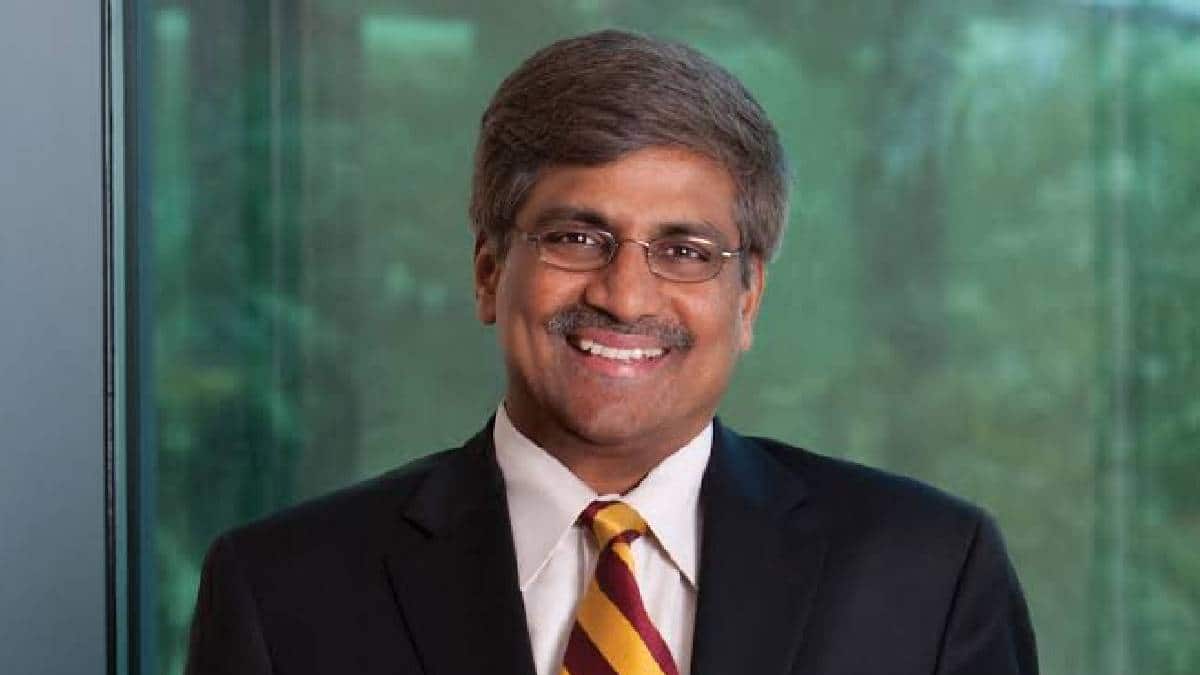
Sethuraman Panchanathan’s journey from seeing Apollo 11 Moon rocks in Chennai to leading the NSF has now earned him the 2026 Arthur M. Bueche Award for his contributions to science, technology and public policy.
Sethuraman Panchanathan got an early glimpse of his lifelong ambitions while looking at lunar rocks at the American Center in Chennai. He spent decades exploring. The sense of wonder he felt while peering through the glass at lunar rocks helped him achieve many accolades throughout his life, leading him from Chennai to a distinguished career in science, technology, research and public policy.
More than five decades later, Panchanathan is being recognised with the 2026 Arthur M. Bueche Award by the National Academy of Engineering (NAE). The former director of the US National Science Foundation, he is the first Indian American to receive the honour, as per Arizona State University.
The award recognises contributions to science and technology policy, technological development and collaboration among industry, government and universities. This pursuit to step beyond the norm and explore new fields started in 1969, when eight-year-old Panchanathan visited the American Center in Chennai with his father, where he saw Moon rocks brought back by the Apollo 11 mission.
This standalone experience became a core memory for him and sparked his interest in the science and engineering behind space exploration.
Born on June 24, 1961, he completed a BSc in Physics from the University of Madras in 1981, a BE in Electronics and Communication Engineering from the Indian Institute of Science in 1984, and an MTech in Electrical Engineering from IIT Madras in 1986. He later moved to Canada and earned a PhD in Electrical and Computer Engineering from the University of Ottawa in 1989, according to his official Padma award citation.
Over the years, Panchanathan’s professional career has spanned research laboratories, universities and government institutions. His research has explored areas including machine learning, human-centred multimedia computing, haptic interfaces and ubiquitous computing.
It was Panchanathan who founded Cognitive Ubiquitous Computing, which focused on assistive technologies and devices. The Government of India’s Padma Awards citation says he has published close to 500 research papers and mentored more than 150 graduate students, postdoctoral researchers, research engineers and research scientists.
During his tenure at the NSF, Panchanathan led the agency through a period that included the COVID-19 pandemic and the race to develop vaccines. It was during his tenure that the Directorate for Technology, Innovation and Partnerships was created, marking the NSF’s first new directorate in more than three decades.
During his tenure at the NSF, Panchanathan supported collaborations between Indian institutions and US researchers in areas including artificial intelligence, data science and advanced wireless technologies.
The Arthur M. Bueche Award recognises contributions to the broader relationship between science, technology, government, industry and academia, rather than a single invention or research discovery. The NAE recognised Panchanathan for his leadership in advancing fundamental science, technology and policy, promoting translational research and expanding opportunities across the US. He was elected to the National Academy of Engineering in 2024 and is the first person from Arizona to receive the Bueche Award, according to Arizona State University.
The award follows Panchanathan’s receipt of the Padma Shri in 2025 for his contributions to science and engineering, including research, education, innovation and technologies aimed at improving the quality of life for people with disabilities.
Since returning to Arizona State University, Panchanathan has continued working in areas such as artificial intelligence, quantum computing and higher education. In April 2026, Phoenix Mayor Kate Gallego appointed him to lead the city’s quantum strategy.
Panchanathan’s career spans decades, from his childhood in Chennai, where he encountered Apollo 11 Moon rocks, to leading one of the US' major science agencies. The 2026 Bueche Award adds another milestone to a career connecting research, technology, education and public policy across India and the US.