 Scroll.in ·
When Delhi floods, the villages around it bear the brunt
Raota on the Delhi-Gurugram border reflects an agricultural landscape shaped by the flows of water and labour between the city and the village.
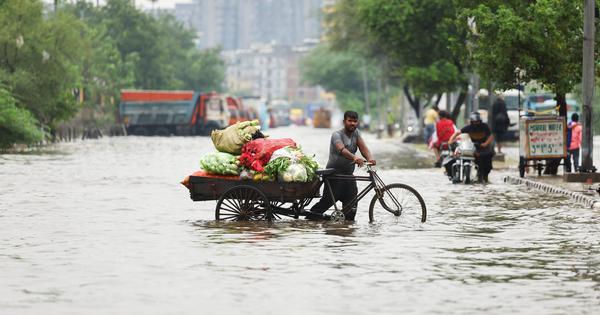
As the monsoon approached the National Capital Region, residents had to negotiate familiar challenges of waterlogged roads, overflowing drains and urban flooding.
Yet beyond Delhi and Gurugram lies another story that rarely makes headlines: the burden of protecting cities from floods is increasingly being shifted onto peri-urban villages that are at the margins of urban development.
Raota, a village located along the Najafgarh drain on the Delhi-Gurugram border, illustrates this reality. Like many villages on the expanding edges of Indian cities, Raota is neither fully rural nor fully urban.
As per official records, it is one of the remaining 49 rural villages of Delhi. Yet it has no elected village panchayat. In January 1990, the Lieutenant Governor of Delhi issued orders terminating the tenure of village pradhans across Delhi.
Even after the 73rd Constitutional Amendment strengthened Panchayati Raj institutions nationwide, Delhi’s villages were not provided with comparable mechanisms of decentralised local governance.
Such villages are now critical to the functioning of cities. They provide land, water and ecological services that sustain urban growth. At the same time, they absorb the environmental costs of that growth.
The Najafgarh Drain, once part of the Sahibi River system, now carries stormwater and wastewater from Delhi, Gurugram and Manesar. It is widely regarded as one of the most polluted stretches of water in the National Capital Region. Yet for decades, farmers in villages such as Raota, Daurala and Ghummanhera have depended on its water for irrigation.
What is remarkable is not merely the use of wastewater for agriculture, but the ingenuity with which farmers have organised themselves to access it. Faced with saline groundwater and unreliable rainfall, farmers collectively invested in underground pipelines, pumps and distribution systems that transport water from the drain to fields located up to 2 km away.
These systems are maintained through local norms of cooperation, cost-sharing and mutual accommodation. They demonstrate how communities adapt creatively to difficult ecological, political and institutional conditions.
The wastewater economy of the Najafgarh region also reveals the complex relationship between cities and their hinterlands. Urban wastewater, a nuisance in cities, becomes a valuable agricultural resource in nearby villages. Farmers use it primarily for paddy cultivation, while relying more heavily on groundwater for wheat grown for household consumption.
The result is a distinctive agricultural landscape shaped by the flows of water, labour and produce between villages and cities.
The same drain that provides irrigation also exposes surrounding communities to environmental risks. During periods of intense rainfall, the Najafgarh drain functions as a major stormwater outlet for the National Capital Region. As urban runoff pours into the channel, water levels rise rapidly, causing the drain to overflow into adjoining agricultural lands. Farmers located closest to the drain bear the greatest burden.
Tenant farmers and sharecroppers are especially vulnerable because they continue to owe rent or a share of produce even when crops fail.
In Raota, the consequences have become chronic rather than seasonal. According to farmers, more than 200 acres of agricultural land have been permanently inundated since the early 2000s. What was once productive farmland has gradually become unusable. For many households, this represents a loss of income and also the erosion of a way of life that has sustained generations.
“The state should buy our lands here and compensate us so that we can buy lands elsewhere,” many here say. “We cannot grow anything here now.”
This situation reflects a deeper governance challenge. While cities have expanded into surrounding rural landscapes, governance systems have failed to keep pace with these transformations. Delhi’s villages occupy an institutional grey zone where rural livelihoods continue but traditional mechanisms of local representation have weakened.
In Raota, the absence of an effective village-level governance structure has left residents with limited avenues through which to collectively negotiate, demand accountability or influence decisions affecting their land and water resources.
The experience of villages along the Najafgarh drain highlights a broader pattern observed across India’s urbanising regions. Urban expansion often depends on the acquisition of land, water and ecological resources from surrounding rural areas. While the benefits of growth are concentrated in cities, many of the environmental costs are externalised to villages. Floodwaters, wastewater, pollution and land-use pressures increasingly flow outward from cities to their margins.
The result is an unequal geography of development. Billions of rupees are invested in urban infrastructure, real estate and flood protection, while villages continue to struggle with inadequate drainage, drinking water, sanitation and public services.
As agricultural livelihoods become less viable, many farmers are pushed toward distress land sales, accelerating the conversion of rural landscapes into commercial, residential and other forms of real estate development.
The challenge, therefore, is a question of environmental justice.
Urban flood resilience cannot be achieved by transferring risk from cities to villages. Cities need a more integrated approach to water governance that recognises rural and urban villages as stakeholders rather than sacrifice zones.
This requires investment in decentralised stormwater management, restoration of natural drainage systems and wetlands, protection of floodplains, and institutional mechanisms through which villagers can participate meaningfully in decisions that affect their futures.
As climate change increases the frequency of extreme rainfall events, the costs of ignoring these questions will only grow. If Delhi and Gurugram are to become climate-resilient cities, they must stop treating villages such as Raota as flood buffers and begin recognising them as equal partners in the region’s future.
Vishal Narain is professor of public policy and governance at MDI Gurgaon. Paras Tyagi is co-founder of the Centre for Youth, Culture, Law and Environment (CYCLE) Delhi. Views expressed are personal.