 Scroll.in ·
Science and technology
A new irrigation project threatens to displace both cheetahs and humans in Kuno
Around 1,200 families living around Kuno National Park will be uprooted by the project.
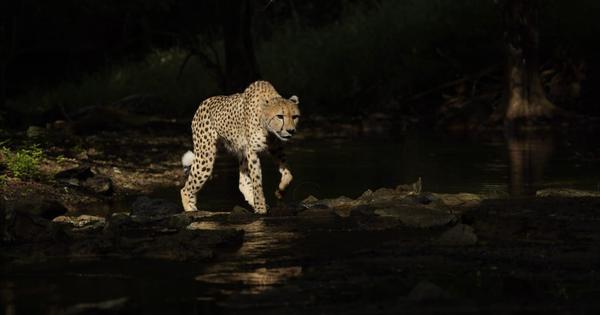
In April, an Indian-born cheetah, KP-2, walked several hundred kilometres from Kuno National Park in Madhya Pradesh to Rajasthan’s Ranthambore National Park.
KP-2’s mother, Asha, was one of eight cheetahs brought to Kuno from Namibia in September 2022, as a part of India’s cheetah reintroduction project. Today, there are a total of 48 cheetahs in the country, including 28 Indian-born cubs – most of them, however, remain in enclosures in Kuno. Three are roaming free in Gandhi Sagar Wildlife Sanctuary in Madhya Pradesh, which was developed as a second site for the cheetahs.
KP-2’s walk was not unusual – since their arrival, several instances have come to light of cheetahs who walked out of Kuno, and crossed the state border to Rajasthan in search of prey and mates. Experts argued that this pointed to a crucial problem with the project – that at 750 sq km, Kuno was far too small to host the planned population of 21 cheetahs, which are known to have large home ranges.
The same month that KP-2 was spotted in Ranthambore, another development came to light that could further reduce the habitat of Kuno’s cheetahs. In April, the ministry of environment, forest and climate change granted environmental clearance to the Chentikheda irrigation project, which would submerge eight villages around Kuno. Of the total 1,361 hectares of land it will need, 72 hectares are from Kuno’s forests.
“The project authorities themselves have admitted that Kuno alone cannot hold the cheetah population, and that is why they have been talking about a cheetah corridor across Rajasthan and Madhya Pradesh to allow for their movement,” said Ravi Chellam, a senior biologist who has worked in the landscape and is a coordinator of the Bengaluru-based Biodiversity Collaborative. “Any attempt to further destroy or fragment their habitat will have negative consequences. We are destroying Kuno, which was seen as the prime habitat, the first site of the cheetahs.”
But the project will not only affect cheetahs. Around 1,200 families living around the forest, of which around 900 are Adivasi, will lose lands and livelihoods.
In fact, of the eight villages being submerged and relocated, three will be seeing displacement a second time in 25 years. In the early 2000s, 24 villages were displaced from within the Kuno forest to make way for Asiatic lions from Gir. However, in 2004, the Gujarat government declined to part with the lions; by then, around 1,500 families had already been relocated outside the forest, away from its produce and fertile lands.
“First, they took us away from fertile lands, then when we finally established some footing here, they are asking us to move again,” said Shivlal Khushwa, a resident of village Pera-B, who is among what he refers to as the “double displacement families”.
Further, as the Chentikheda project moves forward with public hearings and resettlement surveys, locals say that many aspects of the Right to Fair Compensation and Transparency in Land Acquisition, Rehabilitation and Resettlement Act, 2013, or LARR, are not being complied with.
For instance, under the law, the revenue department is required to conduct public hearings in which it gives out crucial information, such as timelines for relocation, rehabilitation and resettlement plans, and calculations of the area of land it proposes to give displaced families as compensation. But those who attended these meetings told Scroll that the department provided only general, indicative information, and not specific details.
“They told us about the kind of facilities we will get in our relocated site, like hospitals and schools, but did not tell us exactly how much land will be given and when,” said Khushwa, who attended a meeting at the end of July this year. “They told us that they will take this up in the next meeting.”
The project’s environmental impact assessment report acknowledges the presence of several species on the site that enjoy the highest degree of protection under the Wild Life (Protection) Act, 1972. These include sloth bears, leopards and cheetahs. However, it notes that “no nesting or breeding sites were observed within the project footprint”, implying that that the project would have limited adverse impacts on these animals.
Experts disagree. “The proposed 70 hectares of submergence could be a part of the home range or territory of the cheetahs,” said Chellam. “This means that it’s possible that you may not find a den within this area, but the cheetahs could be using the space, and a restriction could still impact them.”
This is particularly worrying, experts say, because the wider cheetah corridor is also seeing other infrastructure work – specifically, an upcoming pumped hydro energy storage project in a forested area in Shahbad in Rajasthan’s Baran district, around 200 km away. Cheetahs from Kuno, including KP-2, have frequented that forest, they note. “Where is the cumulative assessment of all of these impacts on the cheetahs?” said Chellam.
The irrigation project also appears to have benefited from the fine print of regulations that bar several kinds of work in protected areas. Maps of the proposed project that Scroll has seen show that the project’s submergence area expands into Kuno’s eco-sensitive zone – this is a strip of land between two and 15 km from the forest, which was first demarcated in 2022, before the cheetahs arrived, and then finalised in February 2023, after they had been released.
Under the eco-sensitive zone notification for Kuno National Park, activities that are prohibited in the zone include “felling of trees” and “large hydropower projects” – categories that, experts confirmed to Scroll, the Chentikheda project does not strictly fall in, since it is a major irrigation project and does not produce electricity.
Kanchi Kohli, an independent legal policy researcher, argued that assessment of any project’s impact on wildlife and forest-dwelling population should not be restricted only to specific regulations “of what the ESZ allows or not”. Rather, she said, the feasibility should be seen “together with mandate and scope of other regulations and legislations” that govern forests and the environment. This includes prevailing tenurial and use rights and clearances pertaining to the environment, forest, and wildlife from the environment ministry.
These should be evaluated together “when making the decision on whether a project should be taken up”, Kohli said.
Among the forums at which such regulations are discussed is the National Board for Wildlife, which issues wildlife clearances to the project, and the forest advisory committee, which gives clearance for steps such as deforestation or submergence of forests for projects. The Chentikheda project was discussed at a wildlife board meeting this March. The board recommended a site visit by a committee that included members from the environment ministry, the Wildlife Institute of India and the National Tiger Conservation Agency “to assess the area impact of the project on the habitat of cheetah and tiger”.
The 2013 land acquisition act spells out who is to be counted as a project-affected family in any project. But developments so far with the Chentikheda project indicate that the number of affected people has been underestimated, and that several have not been counted, leaving them at the risk of being denied compensation or rehabilitation.
Section 19 of the act mandates that before the government acquires any land for a project, it has to declare a list of specific pieces of land that it intends to acquire, along with details of the land that will be allocated for resettlement, as well as information about a rehabilitation and resettlement scheme that will include all project-affected families. It specifies that such affected families are not just those who will lose land or property for an upcoming project, but also those who are landless, but whose livelihoods will be impacted by the acquisition, such as share-croppers or agricultural labourers, as well as those who depend on the forests being acquired.
The Section 19 notifications available on the district collector’s website pertaining to the Chentikheda project only declare lists of affected people for four of the eight villages, with a total of only 177 families. This is a list of only those individuals who own land in the area under submergence,” said Budhaditya Das, a professor of development at Azim Premji University’s Ranchi campus, who has worked in villages around Kuno. “This means that the administration has complied with only one part of Section 19 until now.”
The land acquisition act also mandates that a rehabilitation and resettlement scheme has to be put in the public domain, which will also cover families whose livelihoods will be affected by the project. “Landowners are just a fraction of the people impacted by the project,” Das said.
In a notification dated August 20, the collector’s office announced that it had postponed the publishing of a rehabilitation and resettlement scheme from August this year to February 2027. They attributed this delay to “practical challenges”, such as that land records were not organised and that impacted farmers were not living in the villages at the time of the survey.
“We hope the government follows the letter and spirit of the law when it fully implements Section 19,” Das said. “Especially since the LARR Act has widened the definition of project-affected families beyond only land-owning households and has incorporated the loss of forests, commons and informal livelihoods as significant impacts that must be counted and compensated.”
Kohli noted that communities affected by the project could be at a disadvantage because of “a siloed approach” to environmental decision making. Specifically, though the land acquisition act mandates that project authorities must carry out social impact assessments, irrigation projects are exempt from this requirement. “The assumption is that the environmental impact assessment would be enough to document these impacts as well,” Kohli said. But these “do not mention details of compensation packages or a detailed account of livelihoods lost”.
Locals also fear that the relocation could give rise to conflicts.
In Umri, several farmers have been cultivating land for which they have not been issued land titles. Now, the same land is being offered to those from villages such as Agara, around 10 km away who are being relocated for the Chentikheda project. “In the future, this will cause a lot of fights,” said Deependra Singh Bhadouriya, a resident of Agara who is losing around 80 bighas of land.
Another resident who attended the July public hearing meeting, but did not want to be named, said that locals from Umri had also been attending the public hearing meetings and voicing their concerns about other families being relocated on their cultivated land.
Those being resettled also noted with concern that Umri is upstream of the dam. The land acquisition act states specifically that in an irrigation project, land for resettlement has to be provided in the command area of the project – this refers to the area that is below the main canal system, fed by the irrigation channels. This would allow resettled families to also benefit from the irrigation project.
“Umri is upstream of the dam, so how will we be able to benefit from the irrigation facilities?” said Bhadouriya. “On the other hand, the land that we are losing is right next to the river and has irrigation facilities.”
Chellam argued that there was “a need to take a much more inclusive, comprehensive approach to the project in this landscape”. He pointed out that among the aims of the cheetah project was to protect the grassland and forest habitats they would inhabit – but now, he noted, these habitats faced threat from projects like Chentikheda. “It’s almost as if the right hand is not speaking with the left hand,” he said.
He added: “People and livelihoods have been moved around for this. It is not only a question of ecology, but also a question of equity.”