 Scroll.in ·
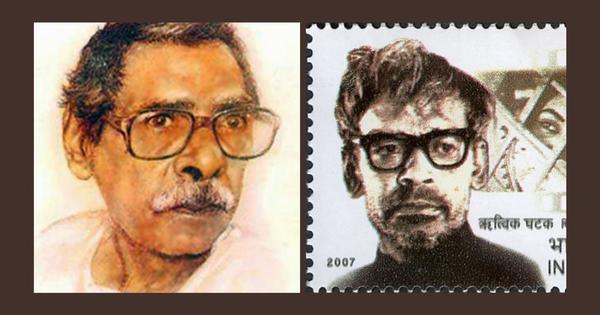
Fiction: When filmmaker Ritwik Ghatak and poet Binoy Majumdar were admitted to the same asylum
An excerpt from ‘Letters from the Asylum: A Novel of Art, Madness and Memory’, by Maitreyee Chowdhury. Majumdar was born on September 17, 1934.
As is the case with all good books, I was left in a vacuum of sorts, after reading Binoy so intimately. While Hashpatale Lekha Kobita Guchho was very different from his first book, it offered a lucid narration of life inside the asylum, of the smallness a person was reduced to inside it, and also the range of ups and downs that made up a poet’s mind. In fact, this somehow felt more personal than Fire Esho Chakka. I wondered, what was I to do with my time now that the book was no longer on my bedside?
A week later, on a whim, I decided to visit Thakurnagar, Binoy’s ancestral home. Thakurnagar is a town situated on the Bangladesh border, quite close to the Ichamati river, about four hours away from Kolkata. In spite of the fact that it is a small town, politically speaking, the area had gained prominence over the past few years, thanks to the Matua community who formed an important chunk of voters that every political party had their eyes on.
I had first heard about Thakurnagar through my office earlier this year when I was asked to go there on an assignment. After partition, the Matua sect, belonging to the Namoshudra community, had settled in the Nadia district of West Bengal, and the areas surrounding the North and South 24 Paraganas. In the past few years their political importance had grown tremendously.
Preliminary enquiries about Binoy’s house in Thakurnagar led to the discovery that it was open to public, and that a trust run by localities took care of the place. A call to Binoy’s publisher revealed more details. I was able to find the phone number of one of the trust members, Shambhu. Speaking on the phone, Shambhu said to me, “I knew him as a child since I grew up in the same neighbourhood. We used to call him Jethu. At that time, we did not really understand that he was an important literary figure. We used to hang out with him or listen to his stories when he came to the bookshop or the railway station for tea in the evenings.”
I called Mihir to tell him about my idea. ‘I’m thinking of visiting Binoy’s home in Thakurnagar, tui jabi?’
“Wow! You really want to see his place? Na re, Ina, I have too much on my plate right now. You go ahead, let me know if you need any help though.”
I wondered if I should club my trip to Thakurnagar with work. I could easily do it, especially if I were to shoot Binapani Devi, the grand dame of the community. But somehow, the idea didn’t feel too appealing. A strange sadness had enveloped me ever since I had read about Binoy. In my head it somehow felt like he hadn’t really got his due as a poet. By the time I had stumbled onto his poetry, his genius and his strange life story, he was already dead. Visiting his house would be a way of touching something tangible about him, without which my reading of him somehow felt incomplete.
I applied for leave from office, and took off by 11.30 with Proshanto who drove Baba’s car. While chatting with him on the way, I discovered that Proshanto’s village lay just beyond Thakurnagar. As we travelled through the highway, punctuated by several other small towns and villages, Proshanto enlightened me with titbits about the small places and the speciality food that was to be found in each of these places. When we finally arrived on the outskirts of Thakurnagar, it was just past three. I stepped out of the car on the outskirts of the town to take in the greenery around me. It never ceased to surprise me how just a few hours beyond the city could transform the entire landscape. The green here seemingly never ending.
The car now moved from the main Jessore road, though a small diversion that weaved through abundant fields of mustard, golden in colour as they swayed in the light wind from the Ichamati close by. Banana plantains and tall beetle-nut trees flanked the narrow roads as the car passed by, and small children and middle-aged men in bicycles stopped to wave at us.
I could not help being struck by the sheer coincidence of being on Jessore Road in September. Memories of a favourite poet, Allen Ginsberg, and his poem “September on Jessore Road” flitted in. Jessore Road was an emotion. Allen’s lines sprang involuntarily on my lips:
No place to shit but sand channel ruts..
Proshanto waved his hands towards the horizon, trying to show me the general direction in which the waters of Ichamati flowed. During his interview to Khabar, Malay Roy Choudhury had recounted stories of how Binoy had tried to walk through the waters of the Ichamoti desperate to visit his ancestral land. I remember his words now: “Imagine trying to cross an entire river; can you understand how he would have felt? I don’t think it’s possible to understand what that loss means. No other state in India, other than Punjab, will understand this emotion, and in some ways, it still wraps us and our next generation.”
Bewildered at someone trying to cross a river, I had asked, “But why try to cross the river, why couldn’t he have gone through the proper channel. Done his visa and taken a bus, train or a flight?”
Malay-da had replied, “When you’re that emotional, Ina, you feel you have a right over the place; both land and water become yours. Often common-sense deserts us under such circumstances. Do you not remember Ritwik Ghatak crying from the plane, when he was flying over the Padma.”
“I didn’t know that about Ghatak, Malay-da.”
“We used to go for the IPTA shows while in college. We would see them often in the theatre halls.” The journalist in me still didn’t understand why Binoy might have tried to cross the river, not once but apparently thrice. But I did understand loss, and its burden. While trying to cover the Matua story earlier this year, I had interviewed many people who had crossed over the border many years ago and made home here. They had cried during these interviews; the memory of that loss still so deeply embedded in them. When the issue had been published, and my photographs along with the interviews splashed over the main page, our office received an outpouring of random people calling in to share similar stories. There had been other calls too, those that had discreetly asked the whereabouts of such people so that they could be sent away. In any case, the attention that the story had garnered remained with me.
I asked Proshanto to take a slight deviation from Binoy’s house. We now headed to the area that was part of the no-man’s land between the India–Bangladesh border. I stepped out of the car, and watched the small road scattered with a few shops, army men patrolling, blaring mikes and rickshaw vans peddling their wares. I looked out yonder across the fence, where my ancestors too once had a home. I didn’t know what I had expected – a signboard, a line of armed personnel maybe, but there seemed to be nothing at all here. No indicators of two different countries. All I could see were rolling expanses of green fields. I had travelled across both sides of Bengal for work, and in most cases, the borders with Bangladesh seemed fluid, sometimes even without barricades. I hadn’t experienced partition myself, but I could very well understand what Binoy would have gone through, staying as he did, so close to the border. Across the street from where I stood, I could see the Border Security Force guards standing on patrol. I realised that military jammers were on here. A BSG jawan slowly cycled past me, and on his bike a small radio was hung, from which Mohammed Rafi’s voice gently strolled down the road – “sabhi kuchh lutaa kar huye hum tumhaare/ke hai jeet uski jo dil aaj hare…”
Excerpted with permission from Letters from the Asylum: A Novel of Art, Madness and Memory, Maitreyee Chowdhury, Om Books International.