 ThePrint ·
Politics
Rahul’s position on Manusmriti isn’t a political invention. Debate goes back to Constituent Assembly
Long before today’s debates over the Manusmriti, the Constitution makers fought over its place in India’s new legal order with even Dr BR Ambedkar strategically employing it to argue for women's rights.
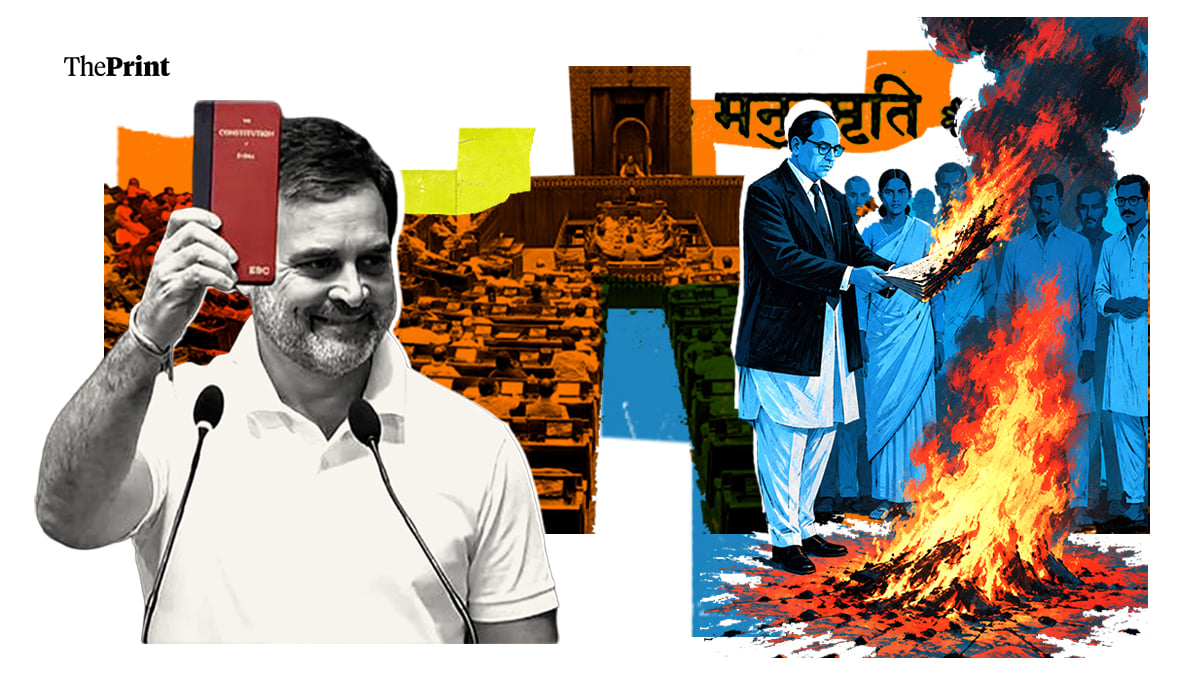
New Delhi: Two days before the Constitution was adopted by the Constituent Assembly on 26 November 1949, social reformer and Congress leader Keshavrao Jedhe congratulated Dr B.R. Ambedkar and his colleagues for framing the country’s new Constitution. But he had a concern.
“Some members (of the Assembly) while congratulating Dr Ambedkar have called him the present Manu. I am certain that he would not like this appellation. I know he hates Manu who has created four castes, the lowest of which is the untouchable class,” Jedhe said.
Recalling Ambedkar’s public burning of the Manusmriti during the Mahad Satyagraha in 1927, Jedhe asserted that Ambedkar had instead framed the ‘Bhim Smriti’—the Constitution of India.
Nearly eight decades later, the debate over Manusmriti continues to have political resonance. In August this year, Congress leader Rahul Gandhi’s remarks on Manusmriti and women’s rights at a ‘Chhatron ki Goonj’ event in Pune drew sharp reactions from several BJP leaders.
The Leader of Opposition in the Lok Sabha spoke against the “Manusmriti mindset”, exhorting students to “smash patriarchy”, and said women belonged to themselves, not their fathers, husbands or sons. “The Manusmriti says clearly that in childhood, a female must be subject to her father…in youth, she belongs to her husband, when her lord is dead, she belongs to her sons. A woman must never be independent…These words are a shame,” Gandhi said.
In response, BJP leaders quoted other verses from Manusmriti that they claimed emphasised respect for women, and accused Gandhi of targeting Hinduism under the garb of women’s empowerment.
The political exchange echoes a debate that had already found its way into the debates by members of the Constituent Assembly. Manusmriti and other Smritis came up repeatedly during discussions on the Hindu Code Bill, the Uniform Civil Code, the upliftment of Scheduled Castes (SCs), and even polygamy and polyandry.
However, the way the text was invoked by members varied widely. Some cited it strategically to push for reform or demonstrate their willingness to accept principles contrary to the Manusmriti. Others invoked the Smritis to defend traditional Hindu law and oppose the Hindu Code Bill.
“In the debates, several members said that we need to go beyond the ancient laws, which caused a lot of problems. So that way, the Constituent Assembly was very progressive in its outlook,” S.N. Sahu, former press secretary to former President the late K.R. Narayanan, told ThePrint.
As an illustration, Sahu referred to the statement made by K.M. Munshi, one of the most active members of the Assembly, in November 1948, during discussions on the draft Constitution. Referring to the Hindu Law draft pending before the Legislative Assembly, Munshi had asserted that most of its provisions would run counter to the injunctions of Manu and Yagnyavalkya. “But after all, we are an advancing society. We are in a stage where we must unify and consolidate the nation by every means without interfering with religious practices,” Munshi had said.