 The Indian Express ·
Politics
UPSC Key: Houthis, Devolution in United Kingdom and Himalayan Hazards
Why Exclusive Economic Zone is relevant to the UPSC exam? What is the significance of topics such as Indian Electric Mobility Index, Pakistan–China Boundary Joint Commission, and Employees' Deposit Linked Insurance Scheme on both the preliminary and main exams? You can learn more by reading the Indian Express UPSC Key for September 17, 2026.
Important topics and their relevance in UPSC CSE exam for September 17, 2026. If you missed the September 16, 2026 UPSC CSE exam key from the Indian Express, read it here
Preliminary Examination: Current events of national and international importance.
Mains Examination: General Studies II: Effect of policies and politics of developed and developing countries on India’s interests
What’s the ongoing story: A drone was intercepted and destroyed south of Mecca by Saudi Arabia’s air defences before it entered prohibited airspace in Mecca premises, said a Saudi-led military coalition, news agency Reuters reported. Following the attack, Saudi Arabia issued security alerts in Mecca and other parts of the country.
• Houthi military spokesman Yahya Saree, in a post on X, said Saudi warplanes carried out 52 airstrikes over 24 hours and over 450 attacks in the past week, using F-15 and Typhoon aircraft from Khamis Mushait and Taif airbases. He alleged that schools, bridges and roads in Taiz were among the targets, along with sites in Al-Jawf, Al-Bayda, Saada and Amran.
• The developments come as the wider West Asia conflict expands into Yemen, increasing tensions around the Bab el-Mandeb Strait. The Houthis have also targeted commercial vessels in the maritime corridor, while Saudi-led coalition warnings over Mecca have further escalated rhetoric between Riyadh and the Houthi movement.
• Saudi Military Coalition spokesperson Turki al-Malki said the incident was the second Houthi attempt to target Mecca, following a reported ballistic missile launch in July 2017. He warned that the coalition would take necessary deterrent measures against the Iran-aligned group.
• Houthi military spokesperson Yahya Saree said a F-15 jet was downed over Marib using a locally made air-to-air missile. The Yemeni Armed Forces claimed Saudi warplanes carried out more than 450 airstrikes across seven provinces this week, causing civilian casualties.
It said the strikes involved F-15 and Typhoon aircraft operating from Khamis Mushait and Taif airbases.
• In response, Yemen claimed it shot down a Saudi F-15 over Marib while it was conducting operations in support of Saudi military deployments. In a post shared on X, Yahya Saree denied Saudi claims that Yemen had targeted Mecca in a drone attack, saying its operations were aimed at oil facilities and military bases away from the holy sites. Reuters quoted a Houthi military source denying any threat to Mecca or any other Islamic holy sites.
• Yemen’s civil war, which commenced in 2014 in the aftermath of the Arab Spring, has flared up with renewed intensity. The latest offensives by Ansar Allah, widely known as the Houthis, have resulted in their control of the Red Sea coast of Yemen, including the strategic port of Mocha, from which, incidentally, café mocha originates. The Houthis now also control the vital islands across the Hanish–Zuqar archipelago between Yemen and the Horn of Africa. In short, the Bab el-Mandeb Strait is now under effective Houthi firepower.
• The Bab el-Mandeb , situated at the mouth of the Red Sea, is the sole gateway to the Suez Canal from the Arabian Sea, carrying roughly 12 per cent of global trade. At its narrowest point between Yemen and Djibouti, the strait spans about 29 kilometres,While the Houthis have threatened the waterway with long-range weapons in recent years, occupying Perim Island provides them an unobstructed line of sight over commercial traffic, placing them within direct range of artillery and short-range missiles from the coast.
• The roots of the Saudi-Houthi confrontation trace back to the aftermath of the seven-year war with the Saudi-led coalition that began in 2015. The Houthis remained deeply frustrated with the terms of the UN-brokered truce in 2022. While the truce eased previous conditions, it still imposed restrictions, requiring flight clearances to be granted by the internationally recognised Yemen government based in Aden, as well as strict inspections on all maritime cargo destined for Houthi-controlled areas.
• More importantly, the Houthis were aggrieved that they were unable to get any share of Yemen’s oil revenues, and so, for years, they have not been able to pay their civil servants. Though the truce officially ended after six months of its implementation, the Houthis did not have any choice but to endure the restrictions and grew increasingly frustrated with the “no war, no peace” stalemate and the lack of progress toward a political settlement.
• That dynamic shifted dramatically when cracks within the anti-Houthi alliance widened. The rift between Saudi Arabia and the UAE, which culminated in Abu Dhabi completely withdrawing its presence from Yemen early this year, sharply exacerbated tensions between rival local factions. This friction between the UAE-backed forces controlling Mocha and key strategic islands and their Saudi-backed counterparts ultimately provided a critical opening for the Houthis.
• The last straw came in mid-July when Saudi fighter jets attacked and damaged the Sana’a airport runway to prevent an Iranian plane from landing without the requisite clearance. This led to the Houthis declaring a naval blockade on Saudi Arabia, followed by regular attacks on Saudi tankers in the Red Sea as well as its oil-related facilities.
Other Important Articles Covering the same topic:
Previous year UPSC Prelims Question Covering similar theme:
1) Consider the following pairs: (UPSC, CSE, 2019)
Which of the pairs given above are correctly matched?
Previous year UPSC main Question Covering similar theme:
📍“Energy security constitutes the dominant kingpin of India’s foreign policy, and is linked with India’s overarching influence in Middle Eastern countries.” How would you integrate energy security with India’s foreign policy trajectories in the coming years? (UPSC, GS2, 2025)
Mains Examination: General Studies II: India and its neighborhood- relations.
What’s the ongoing story: India summoned Pakistan’s Charge d’Affaires (top diplomat in absence of High Commissioner) in New Delhi over “unacceptable and unprofessional conduct”, after a Pakistani ship collided with an Indian Navy vessel on Tuesday (September 15).
• India said the Pakistani vessel’s conduct was in “direct contravention” of Article 10 of the 1991 Agreement between India and Pakistan on Advance Notice on Military Exercises, Manoeuvres and Troops Movements. Later, Pakistan also summoned the Charge d’Affaires of the Indian High Commission.
• According to the Ministry of External Affairs, Pakistan Naval Ship (PNS) Hunain approached an Indian naval warship at high speed in international waters and manoeuvred in an unsafe manner, resulting in a minor collision. The incident took place about 120 nautical miles (I nautical mile equals 1.852 km) from the Gulf of Oman. Under the UN Convention on the Law of the Sea, a country’s territorial sea extends up to 12 nautical miles from its coast. India’s Exclusive Economic Zone (EEZ), however, extends up to 200 nautical miles, and in this area, India has the right to explore and manage seabed resources.
• The Indian warship was on a routine surveillance mission in the North Arabian Sea. PNS Hunain was damaged in the collision, while no damage was reported to the Indian vessel, which continued its mission.
• The Pakistan government’s statement said that while its Navy was undertaking its “biennial exercise SEASPARK-26, the Indian vessel carried out aggressive maneuvers in dangerously close proximity of Pakistani naval ship, resulting in contact between the two vessels.” It also mentioned the 1991 agreement.
• The incident reminded many of the last such incident between Indian and Pakistani naval ships at sea – on June 16, 2011, the Pakistani naval warship PNS Babur brushed past the Indian Navy frigate INS Godavari in the Gulf of Aden, causing minor damage to the Indian warship’s helicopter safety net.
• According to the text of the agreement, it was signed to establish a mechanism for India and Pakistan to inform each other about military exercise or troop movements “in order to prevent any crisis situation arising due to misreading of the other side’s intentions.”
• It lays down rules for the land, naval and air forces of both countries, saying that while major military exercises close to each other’s territories should be avoided, if they are to take place, they should follow certain regulations and the other party should be informed. For naval forces, a major exercise is defined as “involving six or more ships of destroyer/frigate size and above, exercising in company and crossing into the other’s Exclusive Economic Zone (EEZ).”
• Article 10, which the government specifically referred to, says, “The Naval ships and submarines belonging to the other country are not to close less than three Nautical Miles (NMs) from each other so as to avoid any accident while operating in international waters.” It is this provision that India says was violated in the September 15 incident.
• The rules for aircraft include, “Combat aircraft including fighter, bomber reconnaissance, jet military trainer and armed helicopter aircraft will not fly within ten kms of each other’s airspace, including the Air Defence Identification Zones (ADIZ), except when such aircraft are operating form Jammu, Pathankot, Amritsar and Suratgarh air bases on the Indian side, as well as Pasrur, Lahore, Vehari and Rahimyar Khan air bases on the Pakistan side, in which case they will maintain a distance of five kms from each other’s airspace.”
• After the bloody war of the previous decade in which India comprehensively defeated Pakistan, the 1980s saw some confidence-building measures. The contributing factors, to put it very briefly, included the heightened activity to build a nuclear weapon in both countries, which dramatically escalated the cost of war, and the Soviet invasion of Afghanistan in December 1979, which made both Pakistan and the US keen to avoid any disturbance on Pakistan’s eastern border, with India. Thus, on March 10, 1983, came the Agreement for the establishment of a joint commission between India and Pakistan. On December 31, 1988, two agreements were finalised, Cultural cooperation Agreement between India and Pakistan and Agreement on the prohibition of attack against nuclear installations and facilities between India and Pakistan.
January 1987, in Punjab and Rajasthan along the India-Pakistan border.
• The 1991 agreement therefore created mechanisms for reducing that uncertainty. Depending on the size and nature of an exercise, India and Pakistan were required to give advance notice — from 15 days for certain air and naval exercises to 60 days for corps-level exercises and 90 days for army-level exercises. The agreement also allowed either side to seek clarification about the assembly of forces, the direction and extent of an exercise and its duration. On the same day, April 6, 1991, another related treaty, Agreement between India and Pakistan on prevention of air space violations and for permitting over flights and landings by military aircraft, was signed.
2) With reference to the United Nations Convention on the Law of Sea, consider the following statements: (UPSC, CSE, 2022)
1. A coastal state has the right to establish the breadth of its territorial sea up to a limit not exceeding 12 nautical miles, measured from baseline determined in accordance with the convention.
2. Ships of all states, whether coastal or land-locked, enjoy the right of innocent passage through the territorial sea.
3. The Exclusive Economic Zone shall not extend beyond 200 nautical miles from the baseline from which the breadth of the territorial sea is measured.
Which of the statements given above are correct?
📍‘Sea is an important Component of the Cosmos’ Discuss in the light of the above statement the role of the IMO (International Maritime Organisation) in protecting environment and enhancing maritime safety and security. (UPSC, GS2, 2023)
📍Terrorist activities and mutual distrust have clouded India – Pakistan relations. To what extent the use of soft power like sports and cultural exchanges could help generate goodwill between the two countries? Discuss with suitable examples. (UPSC, GS2, 2015)
What’s the ongoing story: The First Ministers of Scotland, Wales, and Northern Ireland signed a joint memorandum of understanding on Monday (September 14) to signal their intent of putting their respective nations on the path to referendums towards independence from the United Kingdom. The three nations, along with England, make up the UK.
• At a summit in the Welsh capital of Cardiff, the three leaders — Wales’ Rhun ap Iorwerth, Scotland’s John Swinney, and Northern Ireland’s Michelle O’Neill — as well as the Republic of Ireland’s leader of the opposition Mary Lou McDonald affirmed in the “Cardiff Agreement” that “the political landscape across these islands is changing”.
• “For the first time ever, there are First Ministers in Scotland, in Wales and in the North of Ireland who are all committed to independence from the United Kingdom… there could be no clearer sign that Westminster’s time is coming to an end,” the memorandum read. “Our nations have the right to self-determination: No Westminster government has the right to block democracy or undermine the principle that our people will decide their own future.”
• The Cardiff Agreement came on the back of two recent developments: UK Prime Minister Andy Burnham expressing that referendums for Scotland and Northern Ireland were not on the cards, and US President Donald Trump saying on Saturday (September 12) that he would “love” to see the reunification of Ireland.
• The United Kingdom of Great Britain and Northern Ireland, commonly known as the United Kingdom (UK) or Britain, is a country in northwestern Europe, off the coast of the continental mainland. It comprises England, Scotland, Wales and Northern Ireland.
• The British Isles, a group of over 6,000 islands located in northwestern Europe, comprises the two major islands of Great Britain and Ireland besides several smaller islands. Great Britain consists of three nations — England, Scotland, and Wales — whereas Ireland is made up of the Republic of Ireland and Northern Ireland.
• The name “Great Britain” assumed significance only in the 18th century, when the kingdoms of England and Scotland were united in 1707 by an Act of Union, becoming the United Kingdom of Great Britain.
• Wales, which is also located on the island of Great Britain, was conquered by the English in the late 1200s, but was legally annexed and made a part of the Kingdom of England only in 1536 through an Act of Union.
Meanwhile, the island of Ireland had been under British control since the late 12th century but entered the UK as a political entity only in 1801, following a failed Irish rebellion (1798) and the Acts of Union (1800). Thereafter, the UK came to be officially known as the United Kingdom of Great Britain and Ireland.
• The name, however, lasted for over a century until 1922, when the majority of Ireland — barring six counties that make up Northern Ireland — gained independence from the British after the Anglo-Irish War (1919-21). With Northern Ireland choosing to remain part of the UK, the latter became the United Kingdom of Great Britain and Northern Ireland.
• On September 18, 2014, the Scottish independence referendum was conducted with the single-point question “Should Scotland be an independent country?”, with voters having to choose yes or no. The result: 55.3% voted No and 44.7% voted Yes, and Scotland remained with the UK.
• In 2022, the UK Supreme Court ruled that the Scottish Parliament doesn’t have the power to unilaterally call a second referendum on Scottish independence, with the subject “reserved” for the UK Parliament in Westminster, London. Although SNP’s Swinney said Monday that he wants to hold a second Scottish independence referendum by 2031, the 2022 ruling could pose a major obstacle since major British parliamentary parties such as Labour, Conservatives, and Liberal Democrats remain opposed to it.
3) We adopted parliamentary democracy based on the British model, but how does our model differ from that model? (UPSC, CSE, 2021)
1. As regards legislation, the British Parliament is supreme or sovereign but in India, the power of the Parliament to legislate is limited.
2. In India, matters related to the constitutionality of Amendment of an Act of the Parliament are referred to the Constitution Bench by the Supreme Court.
Select the correct answer using the code given below.
📍Compare and contrast the British and Indian approaches to Parliamentary sovereignty. (UPSC, GS2, 2023)
Preliminary Examination: Economic and Social Development
Mains Examination: General Studies II: Government policies and interventions for development in various sectors and issues arising out of their design and implementation.
What’s the ongoing story: The Union Cabinet Wednesday approved a hike in the wage ceiling for subscribers of the Employees’ Provident Fund Organisation (EPFO) from Rs 15,000 to Rs 25,000 per month, a revision after a gap of 12 years.
• Union Minister of Labour and Employment Mansukh Mandaviya said the hike is expected to incentivise social security and formal employment, adding that the revised wage ceiling will be effective Thursday, which is also Vishwakarma Day.
• The revision means over 8 crore workers will be mandated to contribute to the retirement fund for social security up to the wage limit of Rs 25,000, beyond which contributions will be voluntary. The monthly pension contribution, under the Employees’ Pension Scheme (EPS), will be capped at Rs 2,080, up from Rs 1,250 at present.
• Both employees and employers contribute 12% of the employee’s basic salary, dearness allowance and retaining allowance, if any, to the EPF. The employee’s entire contribution goes to EPF, while the 12% contribution by the employer is split as 3.67% to EPF and 8.33% to EPS.
• The government contributes 1.16% for an employee’s pension up to the wage ceiling. Employees do not contribute to the pension scheme. The hike in the wage ceiling is expected to bring in an additional 51 lakh employees under the ambit of EPFO, and the government will have to bear the additional cost of Rs 1,089 crore – the annual government outgo on account of additional pension contributions will increase to about Rs 11,339 crore as against the existing annual budgetary support of about Rs 10,250 crore.
• The Employees’ Provident Fund (EPF) is a mandatory savings and retirement scheme for salaried individuals in India, administered by the Employees’ Provident Fund Organisation (EPFO)
• The Employees’ Pension Scheme (EPS) is a government-backed social security initiative managed by the Employees’ Provident Fund Organisation (EPFO), designed to provide a guaranteed monthly pension to organized sector employees after retirement.
• Employee Provident Fund (EPF) is one of the most popular forms of long-term retirement savings, wherein the employee and the employer contribute an equal amount towards savings. A government-administered retirement savings programme that was designed and launched in 1952, the Provident Fund (PF) in India is a scheme that ensures the financial well-being of workers. It was established by the Employees’ Provident Funds and Miscellaneous Provisions Act (EPF & MP Act) under the Ministry of Labour and Employment and is managed by the Employees’ Provident Fund Organisation (EPFO). Under this programme, employees contribute a portion of their salary to the PF account, and the accumulated amount is payable to the employee at the time of retirement or resignation or to their family in the event of the employee’s death.
4) With reference to casual workers employed in India, consider the following statements: (UPSC, CSE, 2021)
1. All casual workers are entitled for Employees Provident Fund coverage.
2. All casual workers are entitled for regular working hours and overtime payment.
3. The government can by a notification specify that an establishment or industry shall pay wages only through its bank account.
Which of the above statements are correct?
Preliminary Examination: Indian and World Geography-Physical, Social, Economic Geography of India and the World.
• General Studies I: Important Geophysical phenomena such as earthquakes, Tsunami, Volcanic activity, cyclone etc., geographical features and their location-changes in critical geographical features (including water-bodies and ice-caps) and in flora and fauna and the effects of such changes.
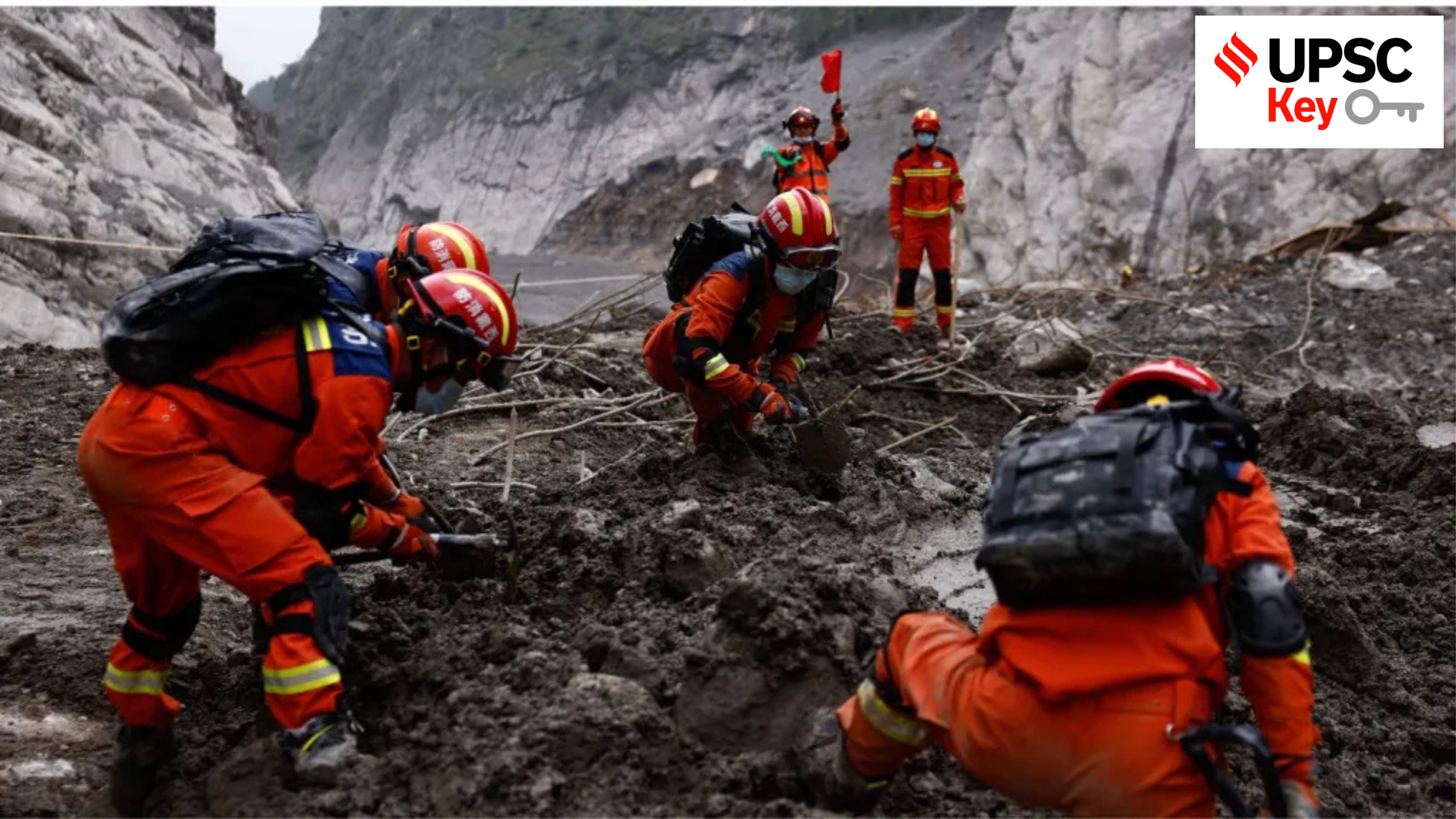
What’s the ongoing story: Tracking the cause of last month’s Nepal flash floods, a new study by a team of international scientists has said that an estimated 110 million cubic metres of rock and ice crashed down the Langtang Lirung peak, tearing off a huge part of the mountain’s northern face measuring 2.2 sq km in area, with a depth of 50 metres.
• It has said that rather than a single extreme weather event, this was likely caused by a “compound crisis” involving climatic and geological factors, worsened by the impacts of climate change.
• To put the numbers in perspective, the area is roughly equivalent to 300 football fields, filled with rock and ice up to a depth of 50 metres. The World Weather Attribution (WWA) study has said that the rock and ice avalanche fell 1,400 metres from a height of 5,150 metres, before slamming into the valley floor, leading to an impact that got measured as a seismic shock of 5.2 magnitude.
• The WWA is an international scientific collaboration, comprising a group of scientists who analyse and communicate the possible influence of climate change on extreme weather events.
• The factors that likely contributed included glacier thinning, thawing of permafrost (frozen rock and earth), impact of the 2015 earthquake, high temperatures and increased meltwater, and warming due to climate change, it said.
• The team analysed climate models, actual temperatures including localised trends, glacier thinning data and precipitation trends. While the 7.8 magnitude earthquake in 2015 may have weakened the rock mass, its specific contribution to the disaster was not confirmed. The study said the 2015 earthquake may have “pre-conditioned” the slope for failure.
• Rock avalanches of this size are rare, estimated to occur once in 1,000-10,000 years, the study said. The avalanche eroded and gathered more material, including buried glacier ice from the valley bottom, thereby increasing debris volume as it barrelled down. It took just seven to eight minutes for the debris flood to reach Gyirong Port in Tibet from the valley bottom, with an average velocity of 170 kilometres per hour, the study said.
• Warming and permafrost degradation likely weakened the source rock wall by increasing bedrock temperatures, and thawing ice within fractures, it said. “Climate change is thus best understood as a destabilising factor acting on a pre-existing geological predisposition, rather than a fundamental cause of the failure,” the study stated.
• On the thinning of glaciers, the study said they have been losing mass for decades at about half-a-metre per year. Since 2010, the rate of recession of the Langtang Lirung glacier extent has accelerated, increasing from 0.5% per annum over the previous two centuries to 1-2.3 % per annum in the past 16 years, it said.
• The assessment called for strengthening of high Himalaya earth observation, hazard monitoring, and trans-boundary data knowledge sharing. It said that minimising future risks requires a rapid transition away from fossil fuel use and delivering on climate finance commitments for adaptation.
Previous year UPSC Mains Question Covering similar theme:
📍What is the phenomenon of ‘Cloudbursts’? Explain. (UPSC, GS1, 2024)
What’s the ongoing story: India on Wednesday rejected the “so-called” boundary joint commission set up by Pakistan and China, saying that the body has no legal basis to decide on arrangements related to Indian territory under illegal occupation. New Delhi’s reaction came following the first meeting of the Pakistan-China Boundary Joint Commission in Islamabad.
• India has been consistently maintaining that Pakistan’s handing over of certain territories such as Shaksgam Valley to China in 1963 was illegal and unacceptable. New Delhi has also opposed the China-Pakistan Economic Corridor as part of it passes through Pakistan-occupied Kashmir (PoK). “Our position on this matter is clear and consistent. There is no boundary between Pakistan and China. We reject the so-called Joint Commission, which is without any legal basis,” Ministry of External Affairs spokesperson Randhir Jaiswal said on the Pakistan-China Boundary Joint Commission.
• The entire UTs of Jammu & Kashmir and Ladakh “have been, are and will always remain integral and inalienable parts of India,” he said. “We have never recognised the so-called ‘China-Pakistan Boundary Agreement’ of 1963 and have consistently maintained that it is illegal and invalid.”
• “We resolutely oppose and reject attempts to alter the status of these occupied territories or legitimise illegal occupation, impinging on India’s sovereignty and territorial integrity… any so-called boundary cooperation between China and Pakistan concerning Indian territories would be completely unacceptable and would have no bearing whatsoever on India’s sovereignty over these territories.”
• Official Spokesperson Randhir Jaiswal said the commission lacked legal basis and that no boundary exists between Pakistan and China, reiterating that Jammu & Kashmir and Ladakh are integral and inalienable parts of India.
• On Wednesday, the Pakistani Foreign Ministry said in a post on X, “In a significant milestone for Pakistan- China relations, the two sides today operationalized the Pakistan-China Boundary Joint Commission, setting the stage for enhanced cooperation in border management, joint border surveys, trade flows and people to people connectivity.” Its inaugural meeting was held in Islamabad.
• According to the Pakistani newspaper Dawn, “The commission has its origins in the 2013 Agre¬ement on the Boundary Mana¬gement System signed during the visit of then Chinese Premier Li Keqiang to Islamabad. Article 45 of the agreement provides for establishment of the joint commission to oversee implementation of the border management arrangements.” The report said the body will provide a coordination mechanism for a border “that is important for movement between Pakistan and China, including thr¬ough the Khunjerab crossing, and for trade and connectivity linked to the China-Pakistan Economic Corridor (CPEC).”
• CPEC connects Kashgar in China with Pakistan’s Gwadar port on the Arabian Sea. It is part of China’s ambitious infrastructure investment plan, the Belt and Road Initiative (BRI), and India has long objected to CPEC for passing through Pakistan-occupied Kashmir (PoK).
• The MEA spokesperson said on Wednesday that “Pakistan has no locus standi to enter into arrangements concerning Indian territory under its illegal and forcible occupation. We have never recognised the so-called ‘China-Pakistan Boundary Agreement’ of 1963 and have consistently maintained that it is illegal and invalid…”
• Historically, the princely state of Jammu and Kashmir was formed after the signing of the Treaty of Amritsar of 1846 between the British East India Company and the Dogra ruler Maharaja Gulab Singh. It included Gilgit-Baltistan, PoK, Jammu, Ladakh, Kashmir and the Trans-Karakoram Tract.
• The 1963 agreement came at a time when the China-Pakistan relationship, often described as “ironclad” by the countries today, was deepening. Despite its Cold War alliance with the United States, Pakistan sought to leverage ties with China, which had fought a war with India in 1962.
• Around that time, Pakistan ceded Shaksgam Valley, or the Trans Karakoram Tract, to China. It is part of the Hunza-Gilgit region occupied by Pakistan and lies to the north of the Siachen glacier. Spread over more than 5,000 sq km, its terrain and climatic conditions make it difficult for human habitation. While it is claimed by India, Pakistan used to control it.
• On its part, China had attempted to assert itself in the region even earlier. Although India has always considered Aksai Chin to be part of J&K, in the 1950s, the Chinese built a highway connecting Tibet with Xinjiang through the region, which was more easily accessible to the Chinese than the Indians. China has since claimed Aksai Chin as part of Hotan county of its Xinjiang province.
📍China’s Belt and Road Initiative (BRI) has transformed South Asia from a regional space into a theatre of great power competition.” Analyse the strategic implications of the BRI for India’s security and regional influence in South Asia (UPSC, GS2, 2026).
What’s the ongoing story: Delhi has topped NITI Aayog’s India Electric Mobility Index (IEMI) 2025 for the development of the e-mobility ecosystem and the adoption of electric vehicles (EVs) on Indian roads.
• It is followed by Maharashtra and Karnataka, the only two of the 17 large states to feature among the top performers in EV implementation, according to the report released.
• IEMI is a composite Index, which assesses the policy framework and implementation outcomes for e-mobility at the state-level. NITI Aayog developed the index in collaboration with WRI India. The report covers three themes: transport electrification progress, charging infrastructure readiness, and EV research and innovation status.
• According to the index, the composite scores on performance across all 36 States and Union Territories (UTs) ranges from 10 to 84, and a median score of 40. Delhi bagged the highest score of 84, followed by Maharashtra (78), Karnataka (73), Chandigarh (71), and Goa (65). When compared to the 2024 index, Delhi and Maharashtra maintained the top two positions, while Karnataka moved to the third place after overtaking Chandigarh, while Goa climbed ten spots to secure fifth position.
• The index further shows that eight large states — Tamil Nadu, Madhya Pradesh, Odisha, Andhra Pradesh, Telangana, Haryana, Rajasthan, and Uttar Pradesh — have qualified as frontrunners, meaning they scored 50-64 out of 100. The other seven large states such as Chhattisgarh, West Bengal, Bihar, Kerala, Jharkhand, Punjab, and Gujarat were emerging performers with a score of 35-49.
• The report also shows that Delhi, Chandigarh, and Maharashtra were the only UTs and states to qualify as top performers in transport electrification progress, which is assigned the highest weightage of 50% in index calculation. It evaluates market absorption, consumer acceptance, and demand-side momentum by measuring how effectively EVs are being adopted and supported across the states.
• In India, the EV transition has gained momentum over the years. According to the report, by 2025-26, EV penetration, or share of EVs in total vehicles registered reached 8.25%, up from 0.5% in 2018. In 2025-26, over 8.7 million EVs were running on roads. Close to 2.5 million EVs were registered during 2025-26 alone, with a rise of about 25% over the previous financial year.
• The two-wheelers accounted for most at 1.3 million units, followed by passenger three-wheelers, while passenger cars held a modest and rising share. Commercial goods vehicles saw the sharpest growth across the electric light, medium and heavy-duty segments, where their share climbed from 0.6% in 2024 to 1.4% in 2025. E-bus adoption in India has also gained momentum since 2021.
For any queries and feedback, contact priya.shukla@indianexpress.com