 The Indian Express ·
Crime, law and justice
Person can’t have two dates of birth in official records, says Delhi High Court
The Delhi High Court directed NIOS to correct a man’s date of birth in its records, holding that a genuine clerical error cannot create conflicting official records.
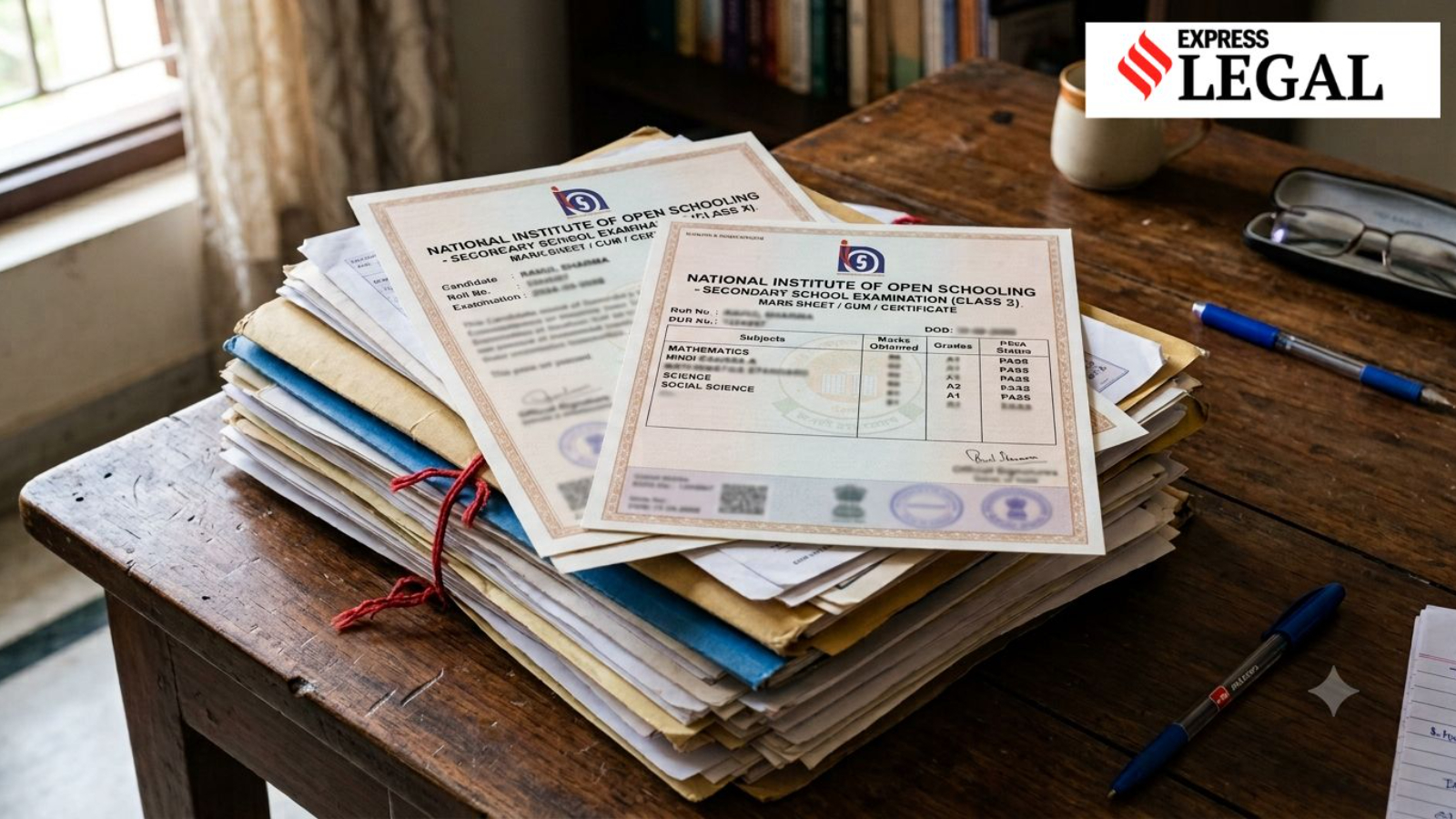
A person cannot be made to carry two different dates of birth in official records, the Delhi High Court recently said, and ordered the National Institute of Open Schooling (NIOS) to correct a man’s birth date on his records and reissue his certificates. The court observed that failing to fix the typographical error would leave the petitioner with two different legal dates of birth, which would be “impractical and legally impermissible”.
Justice Jasmeet Singh was hearing a plea filed by a man who had filed a plea to get his date of birth corrected in the NIOS’s official records and get updated certificates. The school had rejected his request as it was made after the legal time limit.
“A person cannot be made to carry two different dates of birth in official records, and an educational authority cannot perpetuate an apparent factual error merely because the error remained uncorrected for a considerable period. The concern of administrative convenience is undoubtedly legitimate, but it cannot override the obligation of a statutory educational authority to maintain accurate public records, particularly where the correction sought is of a genuine clerical or factual error,” the September 16 order read.
The high court further stated that “if the typographical error is not corrected, the petitioner (the man) would effectively have two different dates of birth, one reflected in the official records and another in his class X certificate. Such a situation is not only impractical but also impermissible in law”.
The man completed his Class X in 2005 from the NIOS, but the mark sheet and certificate recorded his date of birth as February 10, 1989, which was incorrect. The man claimed that the wrong date of birth was a typographical error and his actual date of birth was February 10, 1990, which was consistently reflected in his birth certificate, school records, transfer certificate, among other public documents.
According to the man, on August 13, 2018, he approached the NIOS for correction of the date of birth, but his request was rejected on the ground of time limitation given in law. He then filed a plea against the rejection before the Allahabad High Court was dismissed on March 8, 2019.
On July 6, 2022, the NIOS amended its laws, providing for correction of genuine typographical or factual errors, after which the man submitted a fresh request for correction on October 14, 2025, along with supporting documents. However, the man had to approach the Delhi High Court with his request, as the NIOS had failed to take a decision on his request.
While granting the request of the man, the high court observed that the NIOS had themselves admitted that the man was now governed by the notification of May 14, 2026, which provided for correction of date of birth without prescribing a time limit and “The respondent (NIOS) is required to consider the petitioner’s representation in accordance with the regulatory framework presently governing such requests”.
Advocates Suriti Chowdhary and Tanya Sharma, appearing for the man, argued that the discrepancy was a “mere clerical error”. The counsel contended that according to the current legal position, “genuine corrections in educational records cannot be rejected on hyper-technical grounds where the correct particulars are supported by authentic public documents”.
Advocates S Rajappa and Gowrishankar, representing the NIOS, submitted that the man was admitted to NIOS in 2005 and, as per applicable laws, correction of the date of birth was allowed either before the first examination or within three years from the date of registration. The counsel contended that since the man’s request was made after the allowed period, the request was barred by limitation and could not be dealt with.